


China, Russia, Iran and North Korea are strengthening collaboration to become a cross-regional axis of authoritarianism, exerting pressure on global democracy and security, Deputy Minister of Foreign Affairs Francois Wu (吳志中) said yesterday during a keynote speech at the Berlin Security Conference.
Taiwan and Europe need to strengthen ties and joint resilience to protect regional security in both the Indo-Pacific and Europe, he added.
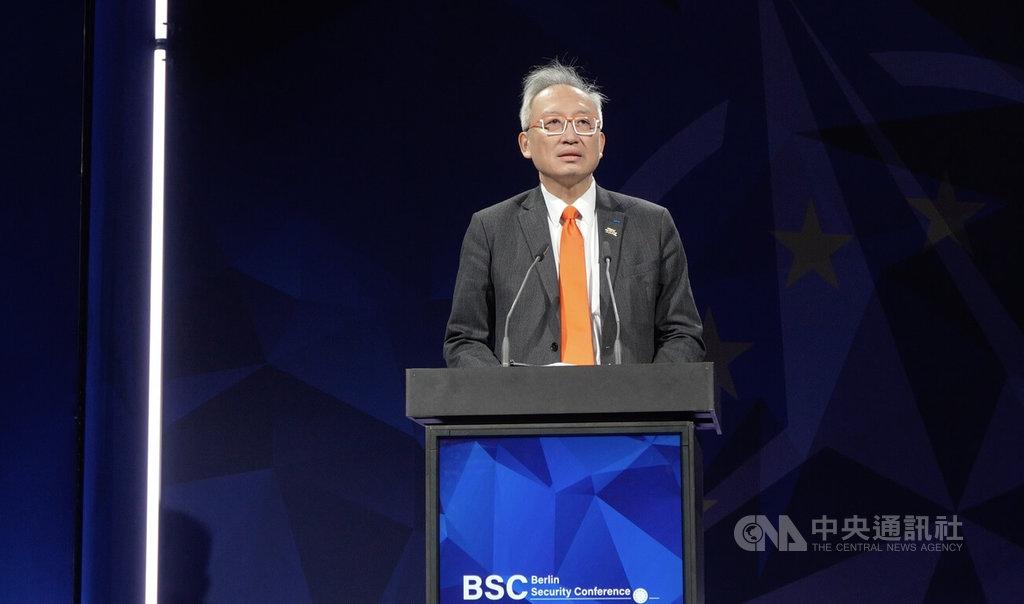
Photo: CNA
The two-day conference, organized by the Behörden Spiegel and held on Tuesday and yesterday, is one of the largest European security and defense policy events, hosting keynote speeches, debates, forums and exhibitions.
This year’s theme is “Reliable Resilience — Credible Deterrence,” focusing on Russia’s invasion of Ukraine, hybrid threats and Indo-Pacific security, bringing together various international heads of national defense, European officials and military experts.
Taiwan is on the frontline of the Indo-Pacific security issues, and a global tech hub, producing around 70 percent of the world’s semiconductors and more than 95 percent of the most sophisticated microchips, Wu said.
In the event of a Taiwan contingency, it would trigger the most severe disruption to a technology supply chain since World War II, he added.
Taiwan is to increase national defense spending to US$30 billion next year, to reach the goal of five percent of GDP in 2030, in line with NATO standards, he said.
Last year, Europe sent a number of naval vessels through the Taiwan Strait, with France, the UK and Italy deploying aircraft carrier strike groups to Indo-Pacific exercises, he said.
Europe’s concept of “total defense” is implemented in Taiwan as “whole-of-society defense,” Wu said, which emphasizes collaboration between the government, the military, businesses and civilians.
Taiwan and Europe have strong potential for cooperation in combating disinformation, enhancing cybersecurity, ensuring energy stability and protecting critical infrastructure, he added.
They are also highly complementary in artificial intelligence, semiconductors and supply chains, he said, referencing the Taiwan Semiconductor Manufacturing Co’s (TSMC) first European fab in Dresden, Germany, to begin operations in 2027.
“Today is not a day to challenge the free world,” he said in his concluding remarks, adding that Taiwan and Europe, as partners in the free and democratic camp, are to jointly cope with the expansion of the axis of authoritarianism to safeguard regional stability.
Meanwhile, Wu said during an interview with German news outlet Deutsche Welle, aired today, that, despite the US and Japan remaining Taiwan’s closest partners, Taiwan shares “more and more common interests” with European countries and investment in the region is increasing.
Wu said his visit to Germany, Belgium and France is intended to boost dialogue and exchanges, while urging Europe to “pay more attention” to China’s military buildup.
What worries Taiwan the most is not China’s increasing nuclear arsenal, but its vast fleets including more than 400 ships which outnumber the US, and aircraft carriers that can reach Taiwan’s east coast, he said.
He does not believe that China would utilize nuclear weapons to deter the US from involvement in a possible Taiwan conflict, he said, but is investing heavily to prove its capabilities on the global stage.
If war occurs, no one would “be the winner,” he said, adding “I hope that Germany can understand the situation” and “raise its voice” to defend the “status quo,” democracy and freedom of navigation in the region.
“You cannot be naive, you need to know that the policy of China is domination,” he said.

FUKUOKA SITUATION: Japanese media reported that the pathogen is expected to be identified by the summer, while the CDC downplayed the idea that it was hMPV A “mysterious cold-like illness” reported in Japan’s Fukuoka Prefecture does not seem to be a new disease, but Japanese authorities have been asked about the situation, the Centers for Disease Control (CDC) said yesterday. The Fukuoka Prefectural Medical Association on Wednesday told a news conference that a “mystery cold” that has become a hot topic on social media is “highly likely to be caused by some kind of viral infection,” Japan’s KBC News reported. “Many people are experiencing symptoms starting with a sore throat, followed by a runny nose, phlegm and a severe cough,” KBC News reported, citing association officials. Health authorities are

Nvidia Corp CEO Jensen Huang (黃仁勳) arrived in Taiwan yesterday ahead of upcoming AI and technology events, saying he plans to meet with clients and Taiwan Semiconductor Manufacturing Co Chairman C.C. Wei (魏哲家) during his visit. After landing at Taipei Songshan Airport, Huang posed for photos with fans and handed out Yakult drinks to reporters and supporters waiting at the scene, saying he has “a lot to do” during the trip. Asked about reports that Nvidia’s planned headquarters site in Taipei’s Beitou Shilin Technology Park could break ground on May 27, Huang said that if the company holds an event, he would

The Ministry of Finance this afternoon announced the winning numbers for the March-April uniform invoice lottery. The winning number for the NT$10 million (US$318,060) special prize is 19531471, and the winning number for the NT$2 million grand prize is 85941329. Three numbers were drawn for the NT$200,000 first prize: 07225810, 20231230 and 83518781. Those with receipts matching the last seven digits of any of the first-prize numbers will win the NT$40,000 second prize, while those matching the last six digits will win the NT$10,000 third prize. Those whose receipts match the last five digits of the first-prize numbers can claim the NT$4,000 fourth prize,
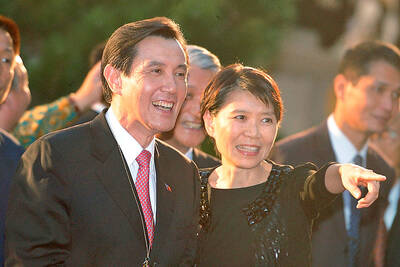
Former president Ma Ying-jeou (馬英九) yesterday expressed “shock and regret” over a statement issued by his wife without his consent, and rejected her assertion that his eldest sister, Ma Yi-nan (馬以南), would manage his medical care or act as his spokesperson amid an ongoing embezzlement probe into his foundation. Ma Ying-jeou in a statement said he was shocked by a statement by his wife, Chou Mei-ching (周美青), regarding his affairs. Ma Yi-nan “must not” be in charge of his healthcare and other personal affairs, nor can she be allowed to represent the Ma family, the former president said. He said he was also


 RSS
RSS