


An exhibition curated by the National Palace Museum (NPM) exploring the cultural and historical significance of dragons across Asia opened at the Musee du Quai Branly Jacques Chirac in Paris on Tuesday.
NPM director Hsiao Tsung-huang (蕭宗煌) and deputy director Yu Pei-chin (余佩瑾) joined Emmanuel Kasarherou, president of the Musee du Quai Branly, at an opening ceremony for "Dragons."
Visitors entering the gallery are first greeted by the "Jade Plate with Dragon Pattern" (玉龍紋盤), a national treasure believed to date to the Liao or Northern Song dynasty, the NPM said.
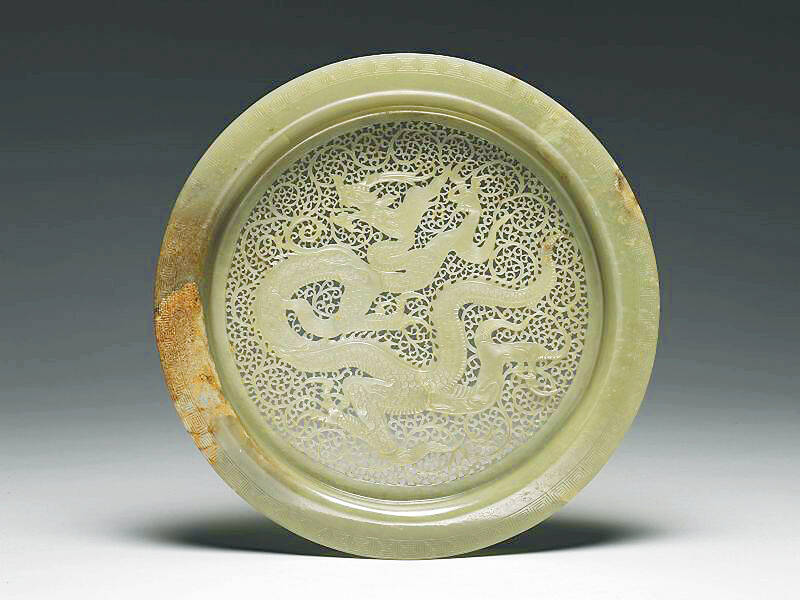
Photo courtesy of National Palace Museum
Nearby stands another highlight, the "Celestial Globe Vase with Lotus and Dragon Decoration in Underglaze Blue" (青花穿蓮龍紋天球瓶), from the Yongle period of the Ming Dynasty.
Yu, who also served as cocurator, said that the NPM loaned 83 objects to the exhibition.
Among them, the jade plate is considered the centerpiece for its exceptionally detailed depiction of a dragon.
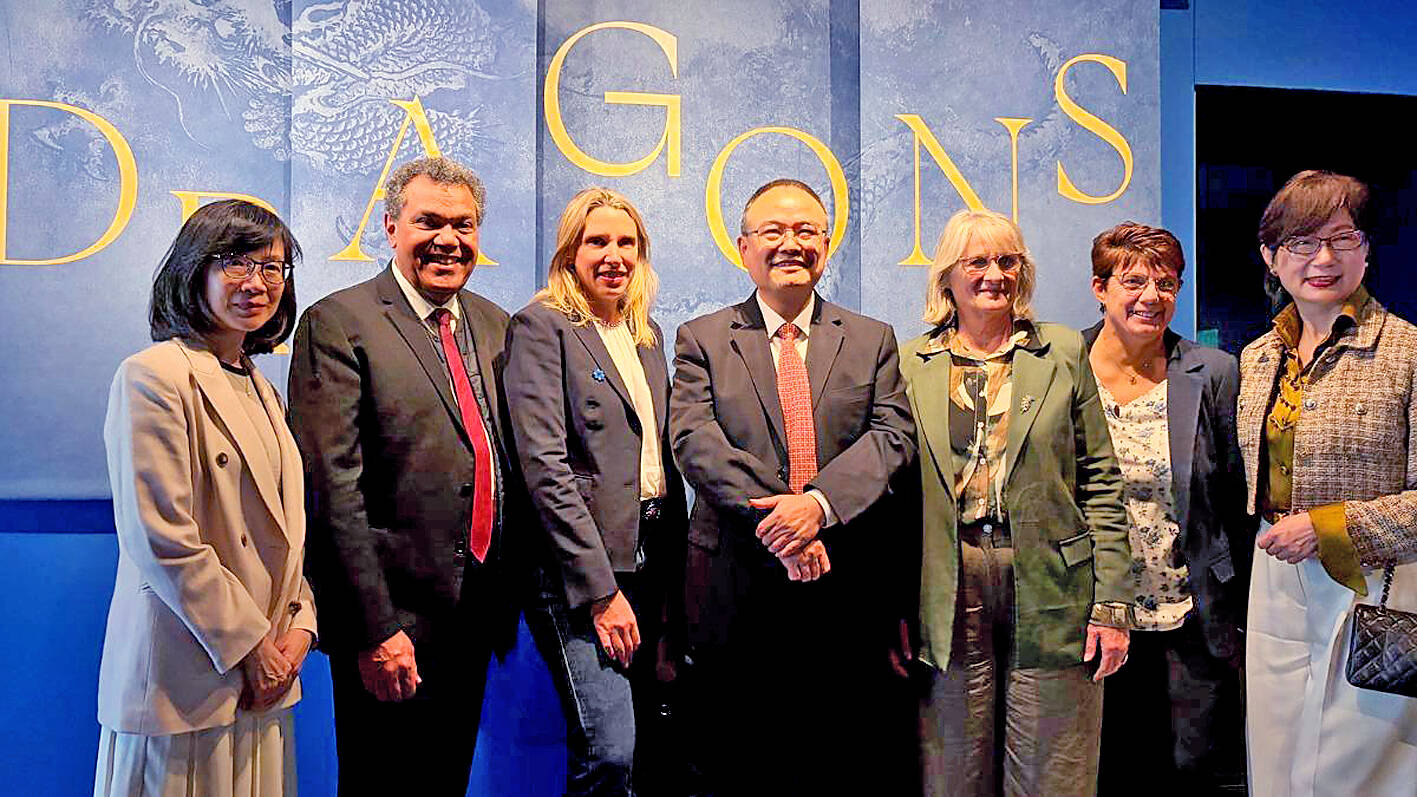
Photo courtesy of National Palace Museum
She said the exhibition is divided into four sections: dragon imagery across historical eras, dragons in folklore and religion, imperial dragon culture and contemporary interpretations of dragons.
Other NPM national treasures on display include a "Pan Water Vessel with Coiling Dragon Pattern" (蟠龍紋盤) from the late Shang Dynasty and two jade imperial seals of the Qianlong Emperor — the "Treasure of His Majesty at 70" (古稀天子之寶) and the "Treasure of His Majesty at 80" (八徵耄念之寶) — created to mark the emperor’s 70th and 80th birthdays.
The Taipei museum’s artifacts feature mainly in the first three sections, while the Quai Branly also invited the Musee des Arts Asiatiques de Nice, the Musee Guimet and the Musee Cernuschi to participate.
Security was also a major focus during the exhibition following a high-profile theft of historically significant jewels from the Louvre last month, prompting widespread scrutiny of museum safeguards across France.
The NPM said it carried out internal reviews and simulations and worked closely with the Musee du Quai Branly to ensure rigorous protection of the loaned artifacts.
Hsiao said that while the Louvre relies on added security systems installed within a historic structure, the modern architecture of the Quai Branly incorporates advanced security mechanisms from the outset, resulting in stronger overall protection.
More than 700 guests attended Monday evening’s opening reception, including Representative to France Hao Pei-chih (郝培芝) and Marie-Noelle Battistel, chair of the French National Assembly’s Taiwan friendship group.
"Dragons" runs through March 1 next year.

FUKUOKA SITUATION: Japanese media reported that the pathogen is expected to be identified by the summer, while the CDC downplayed the idea that it was hMPV A “mysterious cold-like illness” reported in Japan’s Fukuoka Prefecture does not seem to be a new disease, but Japanese authorities have been asked about the situation, the Centers for Disease Control (CDC) said yesterday. The Fukuoka Prefectural Medical Association on Wednesday told a news conference that a “mystery cold” that has become a hot topic on social media is “highly likely to be caused by some kind of viral infection,” Japan’s KBC News reported. “Many people are experiencing symptoms starting with a sore throat, followed by a runny nose, phlegm and a severe cough,” KBC News reported, citing association officials. Health authorities are

Nvidia Corp CEO Jensen Huang (黃仁勳) arrived in Taiwan yesterday ahead of upcoming AI and technology events, saying he plans to meet with clients and Taiwan Semiconductor Manufacturing Co Chairman C.C. Wei (魏哲家) during his visit. After landing at Taipei Songshan Airport, Huang posed for photos with fans and handed out Yakult drinks to reporters and supporters waiting at the scene, saying he has “a lot to do” during the trip. Asked about reports that Nvidia’s planned headquarters site in Taipei’s Beitou Shilin Technology Park could break ground on May 27, Huang said that if the company holds an event, he would

The Ministry of Finance this afternoon announced the winning numbers for the March-April uniform invoice lottery. The winning number for the NT$10 million (US$318,060) special prize is 19531471, and the winning number for the NT$2 million grand prize is 85941329. Three numbers were drawn for the NT$200,000 first prize: 07225810, 20231230 and 83518781. Those with receipts matching the last seven digits of any of the first-prize numbers will win the NT$40,000 second prize, while those matching the last six digits will win the NT$10,000 third prize. Those whose receipts match the last five digits of the first-prize numbers can claim the NT$4,000 fourth prize,
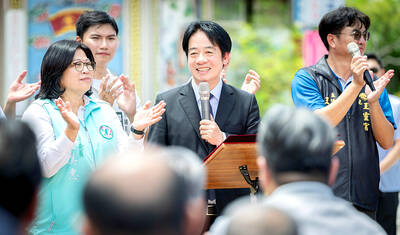
SIX SUBSIDIES: The monthly allowance for older farmers is to increase to NT$10,000, and NT$5,000 is to be given to homemakers under the national pension system, Lai said The government is to implement major welfare policies for disadvantaged groups, including raising the monthly allowance for older farmers to NT$10,000 and providing homemakers with NT$5,000 per month, President William Lai (賴清德) said yesterday. Lai made the remarks during a visit to Wangling Temple in Chiayi County, saying that the planned increases were being introduced amid economic growth and an increase in tax revenue. Touting a policy, in which the government plans to provide a monthly allowance of NT$5,000 for every child under the age of 18 in a bid to address Taiwan’s low birthrate, Lai said that if received for the


 RSS
RSS