


“Taiwan has never been a problem, but rather it provides solutions,” and is working with international partners to maintain peace and stability in the Indo-Pacific region and the Taiwan Strait, the Ministry of Foreign Affairs said yesterday.
Ministry spokesman Hsiao Kuang-wei (蕭光偉) made the remarks in response to a reporter’s comment on changes in relations between Japan and China over the “Taiwan issue or the so-called Taiwan problem.”
“I must explain first that Taiwan has never been a ‘problem,’ but rather a solution,” Hsiao said at a weekly news conference in Taipei.
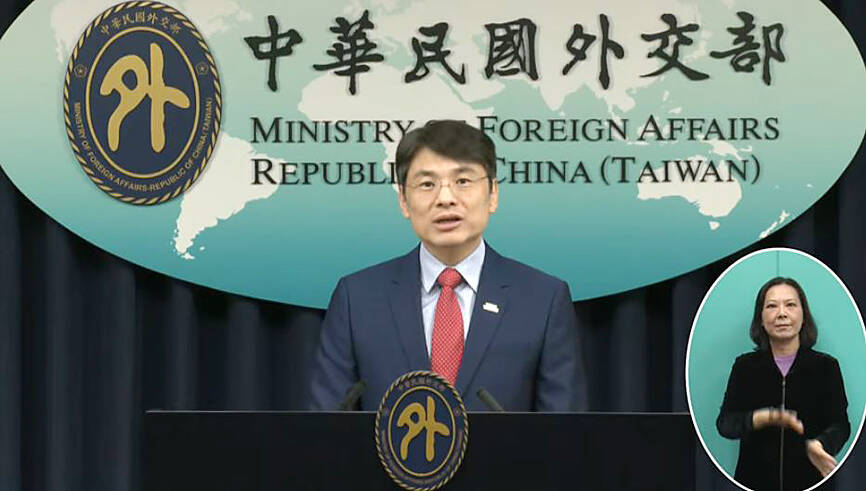
Photo: screen grab from a Ministry of Foreign Affairs livestream
Taiwan is working with international partners to maintain peace and stability in the Indo-Pacific region and the Taiwan Strait, and the ministry and the Japan-Taiwan Exchange Association maintain close contact and exchange ideas on a variety of issues regularly, he said.
Meanwhile, China has held frequent large-scale military exercises and conducted “gray zone” harassment in the East China Sea, the South China Sea and the Taiwan Strait, actions that are a hybrid threat to nations in the region, Hsiao said, adding that they undermine regional security and stability, while escalating tension in the region.
“We urge China to fulfill its responsibility as a great power and stop any of its provocative actions that harm regional stability and security,” he said.
The ministry would continue to pay close attention to China’s challenges to the international order and Taiwan would continue to work closely with like-minded countries to ensure peace, prosperity, freedom and openness in the Indo-Pacific region, he added.
Separately, the ministry said that it strongly condemns and refutes claims in a joint statement by the foreign ministers of China and Syria that denigrated Taiwan’s sovereignty.
Chinese Minister of Foreign Affairs Wang Yi (王毅) and Syrian Minister of Foreign Affairs and Expatriates Asaad al-Shaibani attended a summit in Beijing on Monday and issued a joint statement that said “Taiwan is an inalienable part of Chinese territory.”
The claim is a serious deviation from reality, the ministry said in a separate statement, adding that it strongly condemns the Chinese Ministry of Foreign Affairs for continuously luring other countries and spreading preposterous claims that belittle Taiwan’s sovereignty.
It expressed regret that the Syrian transitional government had succumbed to and complied with China’s authoritarian actions.
“The Republic of China, Taiwan, is a country with independent sovereignty, and it and the People’s Republic of China are not subordinate to each other,” it said. “Any claims that arbitrarily and intentionally distort Taiwan’s sovereign status are bullying behavior that harm international peace and stability, and they cannot change the objective fact and status quo of the two sides not being subordinate to each other.”
The ministry urged the global community to recognize China’s authoritarian nature, and its intention to mislead states into believing that the Taiwan issue is an internal affair of China and block support for Taiwan.
Taiwan calls for the international community to continue countering China’s aggression via tangible actions, including clearly expressing their objection to China’s malicious intention to change the “status quo” in the Taiwan Strait, it said.
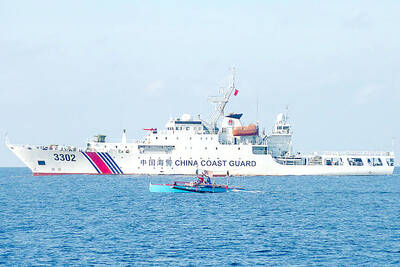
EXPANSIONIST: China deploys an average of 40 to 50 warships and coast guard vessels daily in the South China Sea, despite pledges not to militarize the region, an official said China is attempting to expand its influence across the First Island Chain and increase pressure on Japan by sending coast guard vessels into waters off of Taiwan under the pretext of maritime negotiations with Japan and the Philippines, a national security official said yesterday. China’s recent actions in the waters east of Taiwan and Japan and the Philippines’ exclusive economic zones (EEZ) are attempts to establish dominance in First Island Chain waters, said the official who declined to be named, adding that this is “expansion disguised as law enforcement.” Framing China’s actions solely as a cross-strait issue is a serious misjudgment that
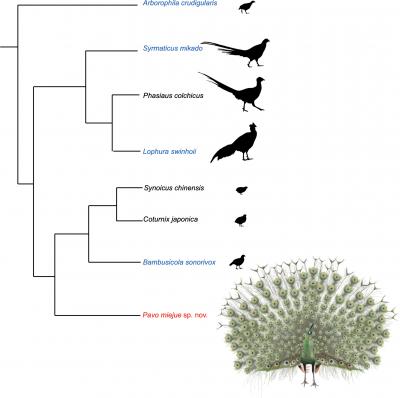
Through analyzing fossil evidence, a research team at National Taiwan University (NTU) discovered the largest endemic bird to have lived in Taiwan, naming it Pavo miejue, or extinct peafowl (滅絕孔雀). The Mikado pheasant, which is printed on the back of the NT$1,000 bank note, was previously believed to be the biggest endemic bird to Taiwan. The research team’s findings suggest that Pavo miejue lived during the Pleistocene epoch tens of thousands of years ago. It is the first endemic extinct bird species discovered and formally named in Taiwan. The study was coauthored by NTU Institute of Ecology and Evolutionary Biology professor Tsai Cheng-hsiu (蔡政修),
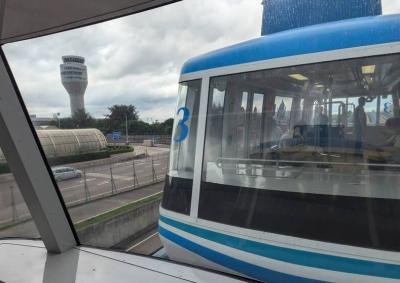
Taiwan Taoyuan International Airport is to suspend its automated Skytrain service connecting Terminal 1 and Terminal 2 starting on July 1 to facilitate connection works for the upcoming Terminal 3, the airport operator said today. Passengers and staff who need to travel between the two terminals after the suspension can instead use the Taoyuan MRT or the airport's 24-hour shuttle bus service, Taoyuan International Airport Corp said. The Taoyuan MRT Airport Line directly links the two terminals, while the shuttle buses are to operate around the clock, the company added. The Skytrain provides free transportation between the airport’s two terminals for travelers and
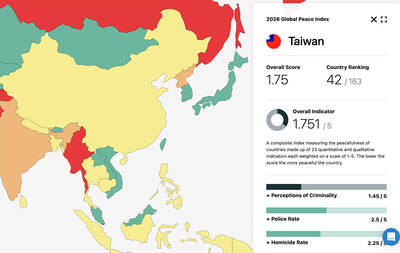
Taiwan ranked 42nd in terms of peacefulness among 163 countries, down five places from last year, according to this year’s Global Peace Index. With an overall score of 1.751, Taiwan dropped from 37th last year, the report published by the global Institute for Economics and Peace showed. The overall score measures a country’s level of peacefulness using 23 quantitative and qualitative indicators across three domains — ongoing domestic and international conflict, societal safety and security, and militarization. While Taiwan ranked 42nd worldwide, it was listed in ninth place among the 19 Asian-Pacific countries in the report, after New Zealand, Singapore, Japan, Malaysia,


 RSS
RSS