


The High Prosecutors' Office today indicted seven people, including a man from Hong Kong and six former and active service members, on charges of spying for China.
Ting Hsiao-hu (丁小琥), a Chinese man who holds Hong Kong citizenship, entered Taiwan multiple times on business and tourist visas to develop an espionage network, prosecutors said.
Ting recruited retired military officers Wang Wen-hao (王文豪) and Tan Chun-ming (譚俊明) , who in turn recruited former colleagues and subordinates to gather classified military information, prosecutors said.
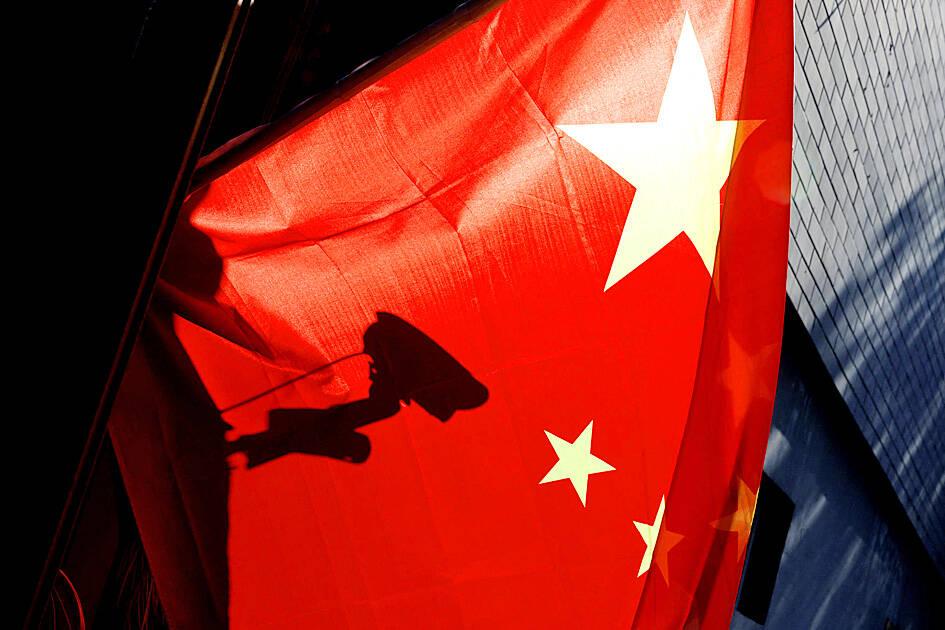
Photo: Reuters
The prosecutors’ investigation identified four other active and retired military personnel who were allegedly involved in the case, as well as two others who have passed away.
The group was paid based on the value of the intelligence provided, prosecutors said, adding that members were also encouraged to urge active-duty personnel to passively resist or surrender in the event of a cross-strait conflict.
Ting, who was believed to be instructed by the Chinese People's Liberation Army General Political Department’s Nanjing work station, funneled more than NT$11.12 million (US$356,262) into Taiwan through accomplice Chen Chun-an (陳俊安) using underground money transfers to fund the operation, prosecutors said.
Prosecutors on July 24 conducted four raids on 21 locations, summoned 13 people for questioning and investigated 16 people.
The High Prosecutors’ Office indicted Ting and six others for breaching the National Security Act (國家安全法), the Classified National Security Information Protection Act (國家機密保護法) and the Criminal Code of the Armed Forces (陸海空軍刑法).
They are to be transferred to the High Court today to decide if they should be detained.
It is disheartening that the six military personnel betrayed their country by leaking confidential information, posing a severe threat to national security, prosecutors said, urging the court to impose a heavy sentence.
The Taipei District Prosecutors’ Office separately charged Ting, Chen and Wang for money laundering, while it decided not to prosecute the two deceased.
The Ministry of National Defense today confirmed the arrest of seven suspects for alleged involvement in a Chinese espionage case, including two active-duty officers.
An internal investigation found a suspicious military officer, surnamed Yang (楊), who was referred to the National Security Bureau, the Ministry of Justice Investigation Bureau and other agencies, it said.
The ministry said it strongly condemned the “treasonous behavior” of personnel who breached their oath of loyalty.
China has been developing organizations in Taiwan and its infiltration efforts have never ceased, it said.
The ministry has fully implemented security vetting mechanisms for personnel handling classified information, established access-to-secrets certification protocols, deepened counter-intelligence training and raised overall security awareness among troops, it said.
It also vowed to continue close cooperation through the national security joint-defense mechanism to safeguard the nation.

FUKUOKA SITUATION: Japanese media reported that the pathogen is expected to be identified by the summer, while the CDC downplayed the idea that it was hMPV A “mysterious cold-like illness” reported in Japan’s Fukuoka Prefecture does not seem to be a new disease, but Japanese authorities have been asked about the situation, the Centers for Disease Control (CDC) said yesterday. The Fukuoka Prefectural Medical Association on Wednesday told a news conference that a “mystery cold” that has become a hot topic on social media is “highly likely to be caused by some kind of viral infection,” Japan’s KBC News reported. “Many people are experiencing symptoms starting with a sore throat, followed by a runny nose, phlegm and a severe cough,” KBC News reported, citing association officials. Health authorities are

Nvidia Corp CEO Jensen Huang (黃仁勳) arrived in Taiwan yesterday ahead of upcoming AI and technology events, saying he plans to meet with clients and Taiwan Semiconductor Manufacturing Co Chairman C.C. Wei (魏哲家) during his visit. After landing at Taipei Songshan Airport, Huang posed for photos with fans and handed out Yakult drinks to reporters and supporters waiting at the scene, saying he has “a lot to do” during the trip. Asked about reports that Nvidia’s planned headquarters site in Taipei’s Beitou Shilin Technology Park could break ground on May 27, Huang said that if the company holds an event, he would

The Ministry of Finance this afternoon announced the winning numbers for the March-April uniform invoice lottery. The winning number for the NT$10 million (US$318,060) special prize is 19531471, and the winning number for the NT$2 million grand prize is 85941329. Three numbers were drawn for the NT$200,000 first prize: 07225810, 20231230 and 83518781. Those with receipts matching the last seven digits of any of the first-prize numbers will win the NT$40,000 second prize, while those matching the last six digits will win the NT$10,000 third prize. Those whose receipts match the last five digits of the first-prize numbers can claim the NT$4,000 fourth prize,

SIX SUBSIDIES: The monthly allowance for older farmers is to increase to NT$10,000, and NT$5,000 is to be given to homemakers under the national pension system, Lai said The government is to implement major welfare policies for disadvantaged groups, including raising the monthly allowance for older farmers to NT$10,000 and providing homemakers with NT$5,000 per month, President William Lai (賴清德) said yesterday. Lai made the remarks during a visit to Wangling Temple in Chiayi County, saying that the planned increases were being introduced amid economic growth and an increase in tax revenue. Touting a policy, in which the government plans to provide a monthly allowance of NT$5,000 for every child under the age of 18 in a bid to address Taiwan’s low birthrate, Lai said that if received for the


 RSS
RSS