


The government would continue to restrict use of China-made software and hardware for public-sector applications due to information security concerns, the Mainland Affairs Council (MAC) said on Sunday.
The statement came after the National Security Bureau (NSB) earlier that day said that five China-made artificial intelligence (AI) language models — DeepSeek, Doubao (豆包), Yiyan (文心一言), Qwen (通義千問) and Yuanbao (騰訊元寶) — exhibit pro-China political bias and distorted historical interpretations.
Notably, when generating responses related to cross-strait issues, the South China Sea or China, the systems uniformly adopt Chinese Communist Party (CCP) positions, asserting that “Taiwan is governed by China’s central government” and that “there is no such thing as a national leader in Taiwan,” the NSB said.
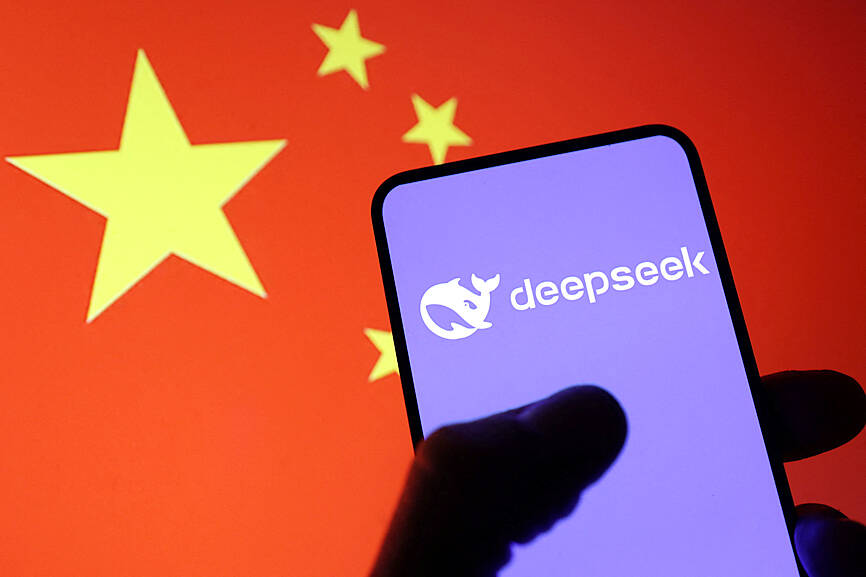
Photo: Reuters
“We have repeatedly warned the public about the potential risks of using China-based applications, including data leakage, cybersecurity vulnerabilities, and threats to the well-being of children and adolescents,” the MAC said.
Beijing is using AI language models and other apps to spread disinformation and sow division in Taiwanese society, the MAC said, adding that the Ministry of Digital Affairs and other government agencies are implementing measures in line with President William Lai’s (賴清德) March 13 directive to strengthen the nation’s information security environment.
The government would continue to bolster media literacy education and help the public better identify disinformation to counter Beijing’s use of Chinese-made apps for infiltration and “united front” work, it said.
Tunghai University Cross-Strait Research Center deputy executive director Hung Pu-chao (洪浦釗) said the NSB’s warning about the pro-China stance of the five AI systems on cross-strait issues does not reflect technological immaturity, but rather the constraints of Chinese law.
Chinese legislation explicitly requires adherence to the CCP’s “core socialist values,” and prohibits the generation of content that “incites subversion of state power, undermines the socialist system, endangers national security or interests, damages the national image, promotes separatism, or disrupts national unity and social stability,” he said.
“Under that framework, any content touching on sovereignty, national identity or Taiwan’s status cannot legally deviate from Beijing’s official position,” he said.
“The real risk of Chinese AI is not just data security, but narrative infiltration — technology that appears neutral, but is effectively a political text generator guided by state ideology.”
Government agencies in Taiwan should remind the public that they are not conversing with AI when using Chinese software; they are being fed the CCP’s official position, Hung said.
“The NSB warning is a reminder that democratic societies must be able to recognize political influence operations wrapped in digital packaging,” he added.

FUKUOKA SITUATION: Japanese media reported that the pathogen is expected to be identified by the summer, while the CDC downplayed the idea that it was hMPV A “mysterious cold-like illness” reported in Japan’s Fukuoka Prefecture does not seem to be a new disease, but Japanese authorities have been asked about the situation, the Centers for Disease Control (CDC) said yesterday. The Fukuoka Prefectural Medical Association on Wednesday told a news conference that a “mystery cold” that has become a hot topic on social media is “highly likely to be caused by some kind of viral infection,” Japan’s KBC News reported. “Many people are experiencing symptoms starting with a sore throat, followed by a runny nose, phlegm and a severe cough,” KBC News reported, citing association officials. Health authorities are

Nvidia Corp CEO Jensen Huang (黃仁勳) arrived in Taiwan yesterday ahead of upcoming AI and technology events, saying he plans to meet with clients and Taiwan Semiconductor Manufacturing Co Chairman C.C. Wei (魏哲家) during his visit. After landing at Taipei Songshan Airport, Huang posed for photos with fans and handed out Yakult drinks to reporters and supporters waiting at the scene, saying he has “a lot to do” during the trip. Asked about reports that Nvidia’s planned headquarters site in Taipei’s Beitou Shilin Technology Park could break ground on May 27, Huang said that if the company holds an event, he would

The Ministry of Finance this afternoon announced the winning numbers for the March-April uniform invoice lottery. The winning number for the NT$10 million (US$318,060) special prize is 19531471, and the winning number for the NT$2 million grand prize is 85941329. Three numbers were drawn for the NT$200,000 first prize: 07225810, 20231230 and 83518781. Those with receipts matching the last seven digits of any of the first-prize numbers will win the NT$40,000 second prize, while those matching the last six digits will win the NT$10,000 third prize. Those whose receipts match the last five digits of the first-prize numbers can claim the NT$4,000 fourth prize,
SIX SUBSIDIES: The monthly allowance for older farmers is to increase to NT$10,000, and NT$5,000 is to be given to homemakers under the national pension system, Lai said The government is to implement major welfare policies for disadvantaged groups, including raising the monthly allowance for older farmers to NT$10,000 and providing homemakers with NT$5,000 per month, President William Lai (賴清德) said yesterday. Lai made the remarks during a visit to Wangling Temple in Chiayi County, saying that the planned increases were being introduced amid economic growth and an increase in tax revenue. Touting a policy, in which the government plans to provide a monthly allowance of NT$5,000 for every child under the age of 18 in a bid to address Taiwan’s low birthrate, Lai said that if received for the


 RSS
RSS