


The National Center for Research on Earthquake Engineering (NCREE) yesterday said it is encouraging private homeowners to undergo an earthquake resistance evaluation, particularly if their house was built before the 921 Earthquake.
Nearly 60 percent of homes that have existed for more than 30 years were built before the magnitude 7.3 earthquake struck on Sept. 21, 1999, when the nation had a relatively underdeveloped construction code, Ministry of the Interior data showed.
The 921 Earthquake, which damaged more than 100,000 houses, was a turning point in earthquake-resistant construction in Taiwan, NCREE Director Ou Yu-chen (歐昱辰) said.
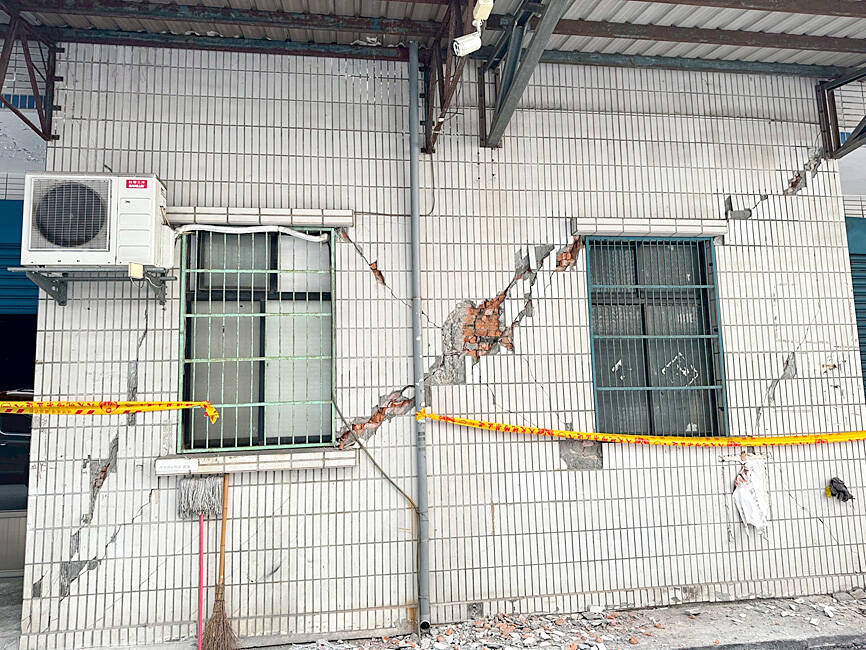
Photo courtesy of the New Taipei City Public Works Department
After the quake, the government implemented stricter construction codes and set up an earthquake-resistant certification system for buildings, Ou said.
He cited the buildings damaged during the Hualien County earthquake on April 3 last year — most of which were built before 1999 — as proof of the progress in building earthquake-resistant facilities.
The government also reinforced the seismic resistance of bridges, schools and public buildings after the 921 Earthquake, Ou added.
However, the collapse of a residential building in Tainan following an earthquake in 2016, which killed 115 people, showed that the earthquake resistance of private housing needed to be addressed, he said.
The NCREE in 2020 set up a special team to bolster the earthquake resistance of privately owned buildings, identifying and prioritizing high-risk apartment buildings, he said.
The goal is to reinforce the seismic resistance of 30 buildings per year, he said, adding that the team has improved 171 buildings.
Boosting the earthquake resistance of private buildings is a challenge, given the complicated ownership situation and the sharing of expenses among residents, Ou said.
The center is to launch the “Townhouse Earthquake-Resistance Portal” next year, which would allow people to enter the address of a building and view its earthquake-resistance evaluation, he said.
NCREE Deputy Director Chai Juin-fu (柴駿甫) said the center has developed a “5D SmartES” platform, where users can create a virtual model that accurately reflects a physical object, system, city or process in real time.
Kaohsiung and the National Taiwan Museum have joined the platform, Chai said.
Through the platform, Kaohsiung residents can see the age and floor plans of buildings in the city, while museum staff can examine whether a building was damaged after an earthquake, by looking at the 5D model and real-time images captured by detectors, he added.

Kenting National Park service technician Yang Jien-fon (楊政峰) won a silver award in World Grand Prix Photography Awards Spring Season for his photograph of two male rat snakes intertwined in combat. Yang’s colleagues at Kenting National Park said he is a master of nature photography who has been held back by his job in civil service. The awards accept entries in all four seasons across six categories: architectural and urban photography, black-and-white and fine art photography, commercial and fashion photography, documentary and people photography, nature and experimental photography, and mobile photography. Awards are ranked according to scores and divided into platinum, gold and

SPACE VETERAN: Kjell N. Lindgren, who helps lead NASA’s human spaceflight missions, has been on two expeditions on the ISS and has spent 311 days in space Taiwan-born US astronaut Kjell N. Lindgren is to visit Taiwan to promote technological partnerships through one of the programs organized by the US for its 250th national anniversary. Lindgren would be in Taiwan from Tuesday to Saturday next week as part of the US Bureau of Educational and Cultural Affairs’ US Speaker Program, organized to celebrate the 250th anniversary of the signing of the Declaration of Independence, the American Institute in Taiwan (AIT) said in a statement yesterday. Lindgren plans to engage with key leaders across the nation “to advance cutting-edge technological partnerships and inspire the next generation of scientists and engineers,”

The Chinese Nationalist Party (KMT) caucus yesterday said it opposes the introduction of migrant workers from India until a mechanism is in place to prevent workers from absconding. Minister of Labor Hung Sun-han (洪申翰) on Thursday told the Legislative Yuan that the first group of migrant workers from India could be introduced as early as this year, as part of a government program. The caucus’ opposition to the policy is based on the assessment that “the risk is too high,” KMT caucus secretary-general Lin Pei-hsiang (林沛祥) said. Taiwan has a serious and long-standing problem of migrant workers absconding from their contracts, indicating that

TRADE-OFF: Beijing seeks to trade a bowl of tempura for a Chinese delicacy, an official said, while another said its promises were attempts to interfere in the polls The government must carefully consider the national security implications of building a bridge connecting Kinmen County and Xiamen, China, the Public Construction Commission (PCC) said yesterday. PCC Commissioner Derek Chen (陳金德), who is also a minister without portfolio, made the remarks in a meeting of the legislature’s Transportation Committee, after Democratic Progressive Party Legislator Hsu Fu-kuei (徐富癸) asked about China’s proposal of new infrastructure projects to further connect Kinmen and Lienchiang (Matsu) counties with Xiamen. China unveiled the bridge plan, along with nine other policies for Taiwan, on Sunday, the last day of Chinese Nationalist Party (KMT) Chairwoman Cheng Li-wun’s (鄭麗文) visit


 RSS
RSS