


Taiwan should bolster the military’s command and control capabilities to enhance its integration with US and Japanese forces, former defense officials from the US and Japan said.
They made the remarks to the Central News Agency after a series of tabletop wargames in Taipei hosted by the Prospect Foundation, the Sasakawa Peace Foundation and the Institute for Indo-Pacific Security.
Taiwan must improve its command and control capabilities to defend itself alongside US and Japanese forces against Chinese aggression, said Institute for Indo-Pacific Security chairman Randall Shriver, a former US deputy assistant secretary of state for East Asia and Pacific affairs.
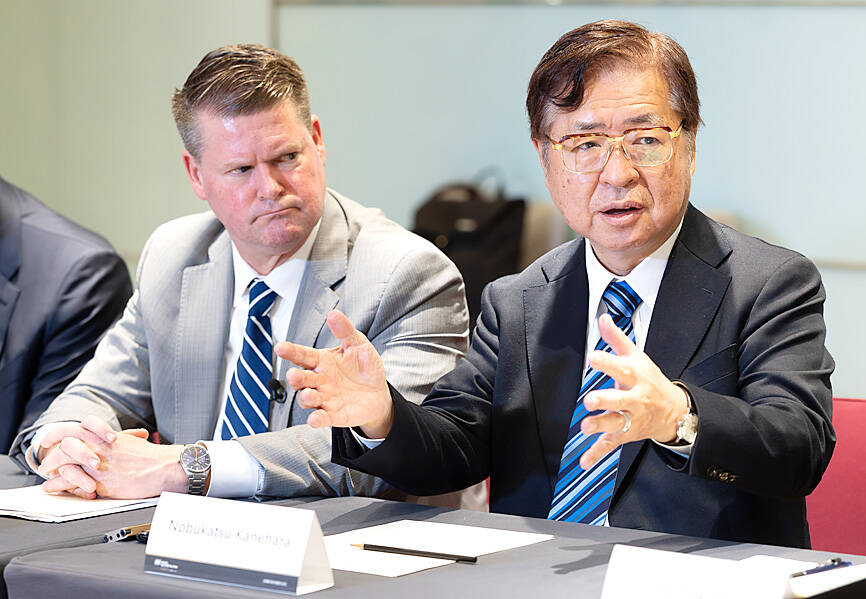
Photo: CNA
The three nations’ joint command and control efforts have failed to achieve the level of information sharing needed in complicated operations such as establishing air corridors, Shriver said.
The armed forces need better battlefield awareness, optimized operational monitoring, and coherent links with US and Japanese forces, he said.
Such capabilities are a prerequisite for the military’s ability to wage joint warfare, make operational decisions quickly and autonomously, and fight efficiently as part of a coalition, he said.
Although Taiwan and Japan have made progress in integrating their command and control systems, the wargame exposed flaws in communication that could cause the defenders to suffer heavy losses, Shriver said.
Taiwan is a close US partner, but not an official ally, which results in insufficient integration in the two nations’ communications and war planning, he added.
Shriver also said that Taiwan’s resilience and military preparedness would have a major impact on the US leadership’s willingness to assist with its defense.
In case of a conflict, Taiwan must be able to resist long enough so that US forces could intervene, he said.
Strengthening the nation’s energy grid and telecommunications infrastructure would benefit it more than procurement of arms, he said.
President William Lai’s (賴清德) decision to head the Whole-of-Society Defense Resilience Committee sent the world a powerful message, he said.
Self-sufficiency is key in Taiwan’s chances of survival against blockades and other forms of aggression that fall short of a full-scale invasion, he added.
The US Congress’ bid to include Taiwan in the Rim of the Pacific Exercise (RIMPAC) is of limited usefulness, as the joint drills have been “dumbed down” to accommodate international participants, he said.
RIMPAC’s focus on international conflicts lies outside of Taiwan’s security needs, he said, adding that the integration of Taiwanese armed forces in joint operations requires their participation in more sophisticated and rigorous exercises.
Sasakawa Peace Foundation senior fellow Tomohisa Takei, a former Japan Maritime Self-Defense Force chief of staff, said that improved communications in joint operations are key to avoiding friendly fire incidents.
Integrating Taiwan into the US-Japan bilateral security framework poses a significant challenge, Takei said.
Tokyo is not prepared to deal with a military threat from China, whose economy is four times the size of Japan’s, Sasakawa Peace Foundation executive director Nobukatsu Kanehara said.
Tokyo must enhance trilateral security cooperation arrangements with Taiwan and the US to achieve effective deterrence, he said.
The lack of formal diplomatic relations between Taiwan and Japan has hampered government-to-government collaborations, he added.
Taiwan’s inadequate oil reserves — sufficient for sustaining the nation for only two weeks — is a serious concern, Kanehara said.
There is not much Taipei could do to bolster energy self-sufficiency other than making use of nuclear energy, he said.

FUKUOKA SITUATION: Japanese media reported that the pathogen is expected to be identified by the summer, while the CDC downplayed the idea that it was hMPV A “mysterious cold-like illness” reported in Japan’s Fukuoka Prefecture does not seem to be a new disease, but Japanese authorities have been asked about the situation, the Centers for Disease Control (CDC) said yesterday. The Fukuoka Prefectural Medical Association on Wednesday told a news conference that a “mystery cold” that has become a hot topic on social media is “highly likely to be caused by some kind of viral infection,” Japan’s KBC News reported. “Many people are experiencing symptoms starting with a sore throat, followed by a runny nose, phlegm and a severe cough,” KBC News reported, citing association officials. Health authorities are

Nvidia Corp CEO Jensen Huang (黃仁勳) arrived in Taiwan yesterday ahead of upcoming AI and technology events, saying he plans to meet with clients and Taiwan Semiconductor Manufacturing Co Chairman C.C. Wei (魏哲家) during his visit. After landing at Taipei Songshan Airport, Huang posed for photos with fans and handed out Yakult drinks to reporters and supporters waiting at the scene, saying he has “a lot to do” during the trip. Asked about reports that Nvidia’s planned headquarters site in Taipei’s Beitou Shilin Technology Park could break ground on May 27, Huang said that if the company holds an event, he would

The Ministry of Finance this afternoon announced the winning numbers for the March-April uniform invoice lottery. The winning number for the NT$10 million (US$318,060) special prize is 19531471, and the winning number for the NT$2 million grand prize is 85941329. Three numbers were drawn for the NT$200,000 first prize: 07225810, 20231230 and 83518781. Those with receipts matching the last seven digits of any of the first-prize numbers will win the NT$40,000 second prize, while those matching the last six digits will win the NT$10,000 third prize. Those whose receipts match the last five digits of the first-prize numbers can claim the NT$4,000 fourth prize,
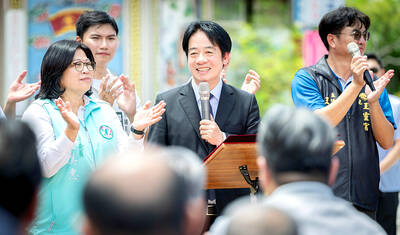
SIX SUBSIDIES: The monthly allowance for older farmers is to increase to NT$10,000, and NT$5,000 is to be given to homemakers under the national pension system, Lai said The government is to implement major welfare policies for disadvantaged groups, including raising the monthly allowance for older farmers to NT$10,000 and providing homemakers with NT$5,000 per month, President William Lai (賴清德) said yesterday. Lai made the remarks during a visit to Wangling Temple in Chiayi County, saying that the planned increases were being introduced amid economic growth and an increase in tax revenue. Touting a policy, in which the government plans to provide a monthly allowance of NT$5,000 for every child under the age of 18 in a bid to address Taiwan’s low birthrate, Lai said that if received for the


 RSS
RSS