


The Democratic Progressive Party (DPP) yesterday urged the Chinese Nationalist Party (KMT) to back an increase in the national defense budget, after the KMT presented a poll showing that more than half of the public supports it.
According to the TVBS poll, 57 percent of respondents supported increasing the national defense budget, while 35 percent opposed it.
About 71 percent in the 20-to-29 age bracket supported the policy, topping all other age brackets, with 54 percent of respondents who identified themselves as politically neutral supporting the policy.

Photo: Chen Chih-chu, Taipei Times
Fifty-six percent of respondents said they were not worried that China would invade Taiwan, while 38 percent said they were.
Respondents who were KMT supporters comprised 41 percent of those who were worried, while 57 percent of KMT supporters were not concerned.
The poll saw 48 percent of respondents agree that China’s disinformation campaign against Taiwan was severe, compared with 32 percent who felt otherwise.
Sixty percent of respondents in the 20-to-29 age bracket believed that the Chinese disinformation campaign against Taiwan was severe.
DPP Legislator Rosalia Wu (吳思瑤) yesterday said that the KMT commissioned TVBS to conduct the poll, which might put the results at risk of being skewed by the “house effect.”
Nonetheless, the poll showed the majority supported strengthening national defense, she said.
As the KMT commissioned the poll, it should heed the public’s opinion and refrain from boycotting the national defense budget, she said.
Citing the same poll, the KMT said that 47 percent were dissatisfied with DPP Legislator Puma Shen’s (沈伯洋) performance, 29 percent were satisfied and 24 percent had no opinion.
KMT spokesperson Niu Hsu-ting (牛煦庭) told a news conference that the results show that Shen’s support has not expanded beyond DPP supporters.
The poll also asked the public about their opinions on the Kuma Academy — which was founded by Shen — and the government’s general defense mobilization policies, with 33 percent supporting the academy and the policy, 32 percent opposing and 35 percent without an opinion, Niu said.
Asked separately about the poll, Shen said that it was meaningless.
He said he had no intention to run in an election, and that the general public was not familiar with him, further questioning the rationale for a poll about him.
The poll should have been about himself and Chinese President Xi Jinping (習近平) to contrast the victim and the aggressor, Shen said.
Shen denied that he had considered contesting the DPP primary for its Taipei mayoral candidate against Enoch Wu (吳怡農), who on Nov. 1 expressed his intent to seek the nomination.
TVBS conducted the poll on behalf of the KMT, with telephone interviews commencing on Oct. 31 and completed on Monday. The poll garnered 1,074 valid responses, and has a margin of error of 3 percentage points and a confidence level of 95 percent.
Additional reporting by Lee Wen-hsin
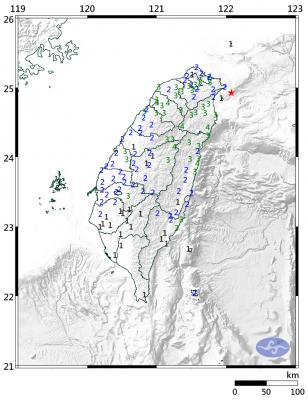
A magnitude 6.1 earthquake struck off the coast of Yilan County at 8:39pm tonight, the Central Weather Administration (CWA) said, with no immediate reports of damage or injuries. The epicenter was 38.7km east-northeast of Yilan County Hall at a focal depth of 98.3km, the CWA’s Seismological Center said. The quake’s maximum intensity, which gauges the actual physical effect of a seismic event, was a level 4 on Taiwan’s 7-tier intensity scale, the center said. That intensity level was recorded in Yilan County’s Nanao Township (南澳), Hsinchu County’s Guansi Township (關西), Nantou County’s Hehuanshan (合歡山) and Hualien County’s Yanliao (鹽寮). An intensity of 3 was
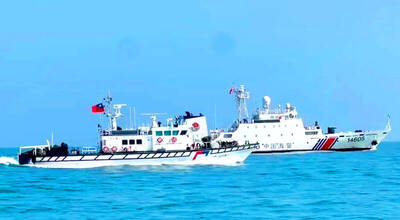
Instead of focusing solely on the threat of a full-scale military invasion, the US and its allies must prepare for a potential Chinese “quarantine” of Taiwan enforced through customs inspections, Stanford University Hoover fellow Eyck Freymann said in a Foreign Affairs article published on Wednesday. China could use various “gray zone” tactics in “reconfiguring the regional and ultimately the global economic order without a war,” said Freymann, who is also a nonresident research fellow at the US Naval War College. China might seize control of Taiwan’s links to the outside world by requiring all flights and ships entering or leaving Taiwan
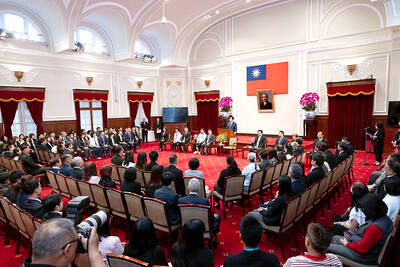
The next minimum wage hike is expected to exceed NT$30,000, President William Lai (賴清德) said yesterday during an award ceremony honoring “model workers,” including migrant workers, at the Presidential Office ahead of Workers’ Day today. Lai said he wished to thank the awardees on behalf of the nation and extend his most sincere respect for their hard work, on which Taiwan’s prosperity has been built. Lai specifically thanked 10 migrant workers selected for the award, saying that although they left their home countries to further their own goals, their efforts have benefited Taiwan as well. The nation’s industrial sector and small businesses lay
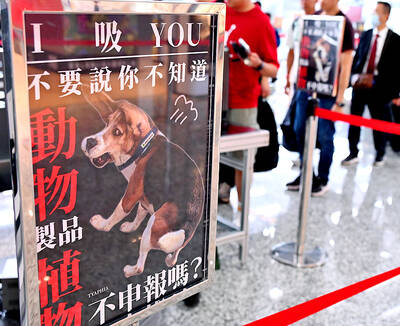
Quarantine awareness posters at Taiwan Taoyuan International Airport have gone viral for their use of wordplay. Issued by the airport branch of the Animal and Plant Health Inspection Agency, the posters feature sniffer dogs making a range of facial expressions, paired with advisory messages built around homophones. “We update the messages for holidays and campaign needs, periodically refreshing materials to attract people’s attention,” quarantine officials said. “The aim is to use the dogs’ appeal to draw focus to quarantine regulations.” A Japanese traveler visiting Taiwan has posted a photo on X of a poster showing a quarantine dog with a


 RSS
RSS