


Regulators should punish airlines that contravene labor standards by penalties up to the loss of flying rights, flight attendant unions said in a protest at the Civil Aeronautics Bureau in Taipei yesterday.
More than 100 union members participated in the event organized by the Taoyuan Flight Attendants’ Union and the EVA Air Union, following the death of an EVA Airways flight attendant last month who was made to continue working despite falling gravely ill.
Union officials urged the bureau to amend regulations governing flight operations and flying rights, saying that airlines would not respect workers’ health and safety unless they face more stringent penalties for violating labor standards.
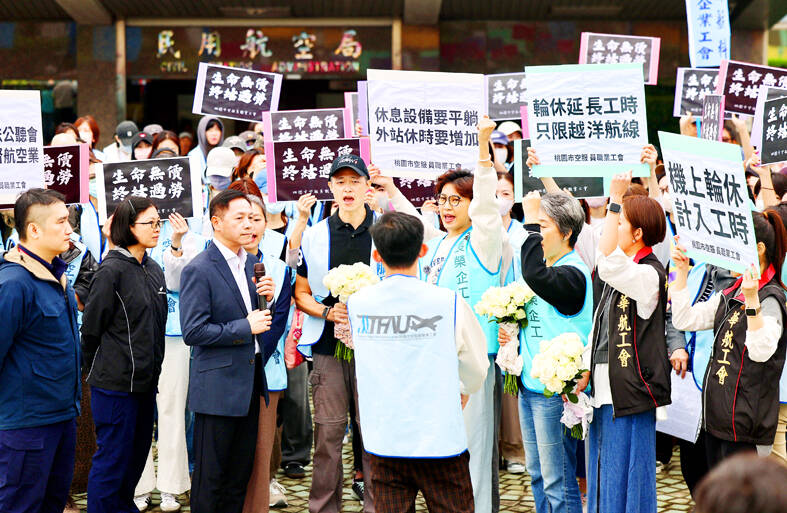
Photo: CNA
Airlines have repeatedly stymied efforts to update the rules governing flight operations to reflect changes made more than 10 years ago to the Labor Standards Act (勞動基準法), resulting in meager protections for workers, they said.
Citing an example, union officials said most Taiwanese employers are required to give employees 11 hours of rest between shifts, compared with nine hours for large swathes of flight attendants.
Regulations governing flying rights should also be revised to punish airlines that repeatedly fail to abide by labor laws, as paltry fines have proven ineffective in curbing employer labor violations, they said.
EVA Airways has been cited for multiple labor standard violations, for which it paid just NT$2 million (US$64,205), union officials said.
The Civil Aeronautics Administration has repeatedly turned a blind eye to labor rights abuses by companies, despite being fully authorized and empowered to regulate these companies, they said.
The lack of provisions to penalize airlines that ignore labor standards has fostered a vicious cycle in which companies cut employee medical leave to retain their competitive edge, union officials said.
In response, bureau representatives said that the government held eight public hearings on the matter, but decided to table the issue after union and business representatives failed to come to an understanding.
Currently, labor standards governing the working conditions of flight attendants are determined by negotiated agreements between business and labor representatives in each company, they said.
The bureau is considering alternatives to improve conditions in the industry, they added.
On Oct. 8, a flight attendant, surnamed Sun (孫), died of undisclosed causes shortly after returning from a work assignment in Milan, Italy.
The death triggered a backlash from the nation’s labor groups, including the EVA Air Union, leading to threats of a boycott against the corporation’s marathon, which was eventually held on Oct. 26.
The airline’s handling of Sun’s death sparked public furor following revelations that the company had asked Sun to turn in a leave request.
Sun’s family slammed the airline’s handling of her death, particularly over a human resources manager’s demand for her to turn in paperwork for being absent at work, according to communications later leaked to the press.
Working conditions at the airline have been at the center of several high-profile labor disputes over the years, including a flight attendants’ strike in 2019 and a pilots’ strike last year.

The Ministry of Finance this afternoon announced the winning numbers for the March-April uniform invoice lottery. The winning number for the NT$10 million (US$318,060) special prize is 19531471, and the winning number for the NT$2 million grand prize is 85941329. Three numbers were drawn for the NT$200,000 first prize: 07225810, 20231230 and 83518781. Those with receipts matching the last seven digits of any of the first-prize numbers will win the NT$40,000 second prize, while those matching the last six digits will win the NT$10,000 third prize. Those whose receipts match the last five digits of the first-prize numbers can claim the NT$4,000 fourth prize,

SIX SUBSIDIES: The monthly allowance for older farmers is to increase to NT$10,000, and NT$5,000 is to be given to homemakers under the national pension system, Lai said The government is to implement major welfare policies for disadvantaged groups, including raising the monthly allowance for older farmers to NT$10,000 and providing homemakers with NT$5,000 per month, President William Lai (賴清德) said yesterday. Lai made the remarks during a visit to Wangling Temple in Chiayi County, saying that the planned increases were being introduced amid economic growth and an increase in tax revenue. Touting a policy, in which the government plans to provide a monthly allowance of NT$5,000 for every child under the age of 18 in a bid to address Taiwan’s low birthrate, Lai said that if received for the
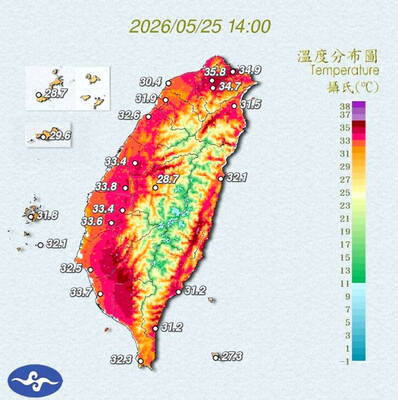
STAY COOL: The HPA recommended that people stay hydrated, use air-conditioning or fans while indoors, wear loose-fitting clothes and walk in the shade while outdoors Employers must implement measures such as installing cooling equipment, and providing drinking water and rest breaks for outdoor workers starting from Monday next week, the Taipei Department of Labor said on Sunday. Employers who fail to comply could face fines of NT$30,000 to NT$300,000 under the Occupational Safety and Health Act (職業安全衛生法), the department said. Businesses in Taipei employing fewer than 100 workers, as well as registered self-employed workers with labor insurance coverage, could receive on-site assessments and guidance from occupational safety consultants to help them apply for central government subsidies to implement or improve heat-protection measures, it said. Under the Ministry of

NATIONAL SECURITY: Authorities are working to confirm the identities of the military personnel involved and investigating possible illegal conduct and regulatory violations Authorities are probing possible national security implications after Kinmen police and immigration officers on Sunday found a Chinese woman allegedly posing as a tourist while engaging in prostitution involving more than 10 military personnel. The woman, surnamed Chen (陳), has since been deported, authorities said, adding that investigators are still working to confirm the identities of those implicated, as the records only listed code names and aliases. The case stemmed from a report received by the Kinmen District Prosecutors’ Office on Friday last week from the Jinhu Precinct of the Kinmen County Police Bureau. On Sunday, police, along with the National Immigration


 RSS
RSS