


While Taiwan attempts to maintain the cross-strait status quo, the Chinese Communist Party (CCP) acts as a “troublemaker” seeking to alter that status quo, Mainland Affairs Council Deputy Minister Shen Yu-chung (沈有忠) said today at a conference in Taichung.
Peace and stability in the Taiwan Strait is in the shared interest of the global community, he said, despite recent threatening messages from the CCP and Beijing’s distortion of international narratives.
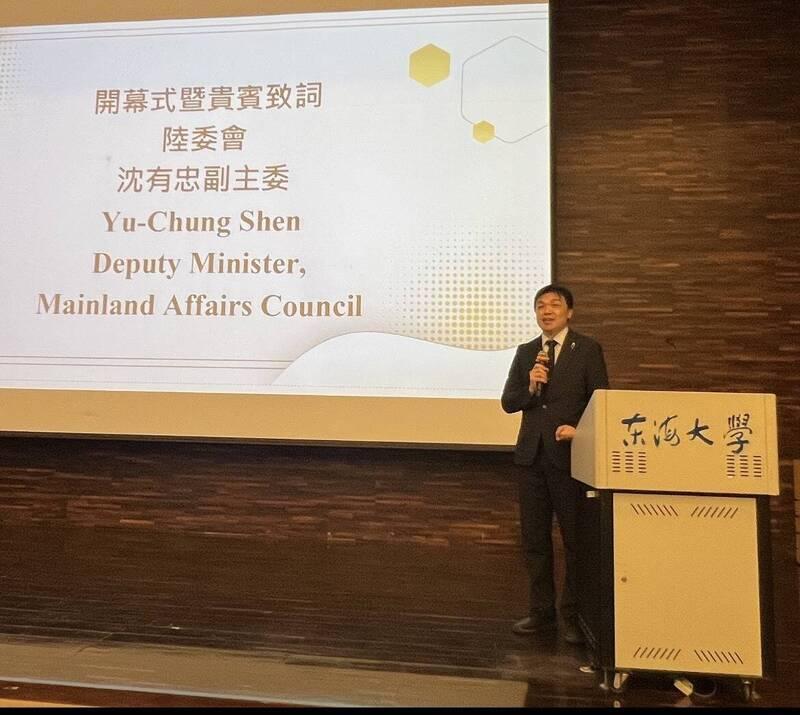
Photo courtesy of the Mainland Affairs Council
Shen today attended the 2025 International Seminar on Mercantilism Returns to International Politics: Tariffs, War, AI, and Great Power Competition, which opened this morning at Tunghai University in Taichung.
Global attention on cross-strait affairs has been mounting in recent years, with many democratic countries speaking out on behalf of Taiwan and the importance of maintaining regional peace and stability, he said.
China uses various tactics to promote the “one China principle,” including the “three 80th anniversaries” — as this year marks the 80th anniversary of the victory of the Chinese people’s War of Resistance Against Japanese Aggression (as China refers to the Second Sino-Japanese War), the UN’s 80th anniversary and the 80th anniversary of the retrocession of Taiwan — he said.
It also willfully misinterprets UN Resolution 2758, passed in 1971, which states that the People’s Republic of China (PRC) is the only legitimate government of China, which enabled it to replace the Republic of China (ROC), Taiwan’s official name, as a permanent member of the UN Security Council, he added.
However, Resolution 2758 has no bearing on Taiwan’s sovereign status or international position, he added.
He thanked democratic nations for using diplomatic relations or parliamentary meetings to refute the CCP's distortion of the resolution to silence Taiwan and block its meaningful participation in international organizations.
Calls from the international community, however, remain unacknowledged by China as it continues to use threatening rhetoric towards countries that are friendly to Taipei, he said.
Japanese Prime Minister Sanae Takaichi sparked a diplomatic row with Beijing with remarks in parliament last week that a Chinese attack on Taiwan could amount to a "survival-threatening situation" and trigger a military response from Tokyo.
China's top diplomat in Osaka shared a news article about Takaichi's remarks about Taiwan on X and commented "the dirty neck that sticks itself in must be cut off", prompting a protest from Japan's government.
China's Taiwan Affairs Office spokesman Chen Binhua (陳斌華) said that Japan should “deeply reflect on history, draw lessons from history, strictly adhere to the one-China principle... and exercise extreme caution when handling Taiwan-related matters,” China’s state-run Xinhua news agency reported on Wednesday.
Moreover, Vice President Hsiao Bi-khim's (蕭美琴) spoke at the European Parliament in Brussels on Friday while the annual Inter-Parliamentary Alliance on China (IPAC) summit was being held.
Chen then smeared IPAC as “merely a clique of anti-China elements,” Chinese state media China Daily reported.
The CCP has no intention of engaging in dialogue with Taiwan’s democratically elected government, Shen added.
Beijing further promotes its claim to the international community that issues surrounding Taiwan are an “internal matter,” he said.
Shen called on all parts of society to assess cross-strait dynamics objectively and uphold national sovereignty, security and democratic values.
Additional reporting by Reuters
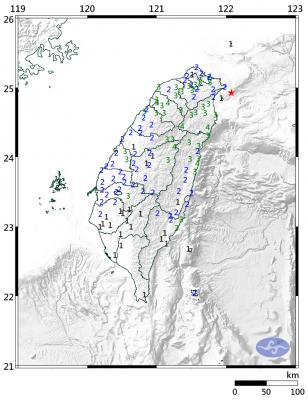
A magnitude 6.1 earthquake struck off the coast of Yilan County at 8:39pm tonight, the Central Weather Administration (CWA) said, with no immediate reports of damage or injuries. The epicenter was 38.7km east-northeast of Yilan County Hall at a focal depth of 98.3km, the CWA’s Seismological Center said. The quake’s maximum intensity, which gauges the actual physical effect of a seismic event, was a level 4 on Taiwan’s 7-tier intensity scale, the center said. That intensity level was recorded in Yilan County’s Nanao Township (南澳), Hsinchu County’s Guansi Township (關西), Nantou County’s Hehuanshan (合歡山) and Hualien County’s Yanliao (鹽寮). An intensity of 3 was
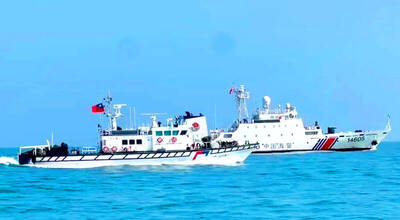
Instead of focusing solely on the threat of a full-scale military invasion, the US and its allies must prepare for a potential Chinese “quarantine” of Taiwan enforced through customs inspections, Stanford University Hoover fellow Eyck Freymann said in a Foreign Affairs article published on Wednesday. China could use various “gray zone” tactics in “reconfiguring the regional and ultimately the global economic order without a war,” said Freymann, who is also a nonresident research fellow at the US Naval War College. China might seize control of Taiwan’s links to the outside world by requiring all flights and ships entering or leaving Taiwan
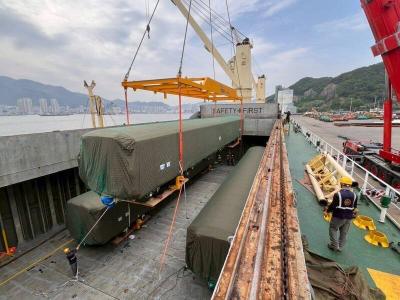
The first of 10 new high-capacity trains purchased from South Korea’s Hyundai Rotem arrived at the Port of Taipei yesterday to meet the demands of an expanding metro network, Taipei Rapid Transit Corp (TRTC) said yesterday. The train completed a three-day, 1,200km voyage from the Port of Masan in South Korea, the company said. Costing NT$590 million (US$18.79 million) each, the new six-carriage trains feature a redesigned interior based on "human-centric" transportation concepts, TRTC said. The design utilizes continuous longitudinal seating to widen the aisles and optimize passenger flow, while also upgrading passenger information displays and driving control systems for a more comfortable
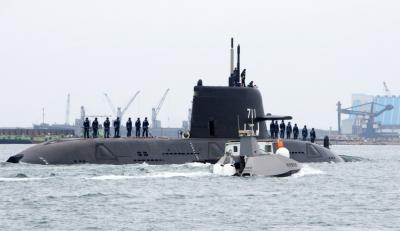
Taiwan's first indigenous defense submarine, the SS-711 Hai Kun (海鯤, or Narwhal), departed for its 13th sea trial at 7am today, marking its seventh submerged test, with delivery to the navy scheduled for July. The outing also marked its first sea deployment since President William Lai (賴清德) boarded the submarine for an inspection on March 19, drawing a crowd of military enthusiasts who gathered to show support. The submarine this morning departed port accompanied by CSBC Corp’s Endeavor Manta (奮進魔鬼魚號) uncrewed surface vessel and a navy M109 assault boat. Amid public interest in key milestones such as torpedo-launching operations and overnight submerged trials,


 RSS
RSS