


Overseas Community Affairs Council (OCAC) representatives may be unable to attend a board meeting of the 33rd Asia Taiwanese Chambers of Commerce in Singapore next month due to visa issues suspected to be caused by pressure from Beijing, council Minister Hsu Chia-ching (徐佳青) said today.
The OCAC has been in contact with the Taipei Representative Office in the Republic of Singapore, but the response is not looking optimistic, she told lawmakers during a legislative committee meeting.
Hsu said it looks unlikely she and other officials would be granted a visa to attend the chambers’ second board meeting from Dec. 9 to 11.
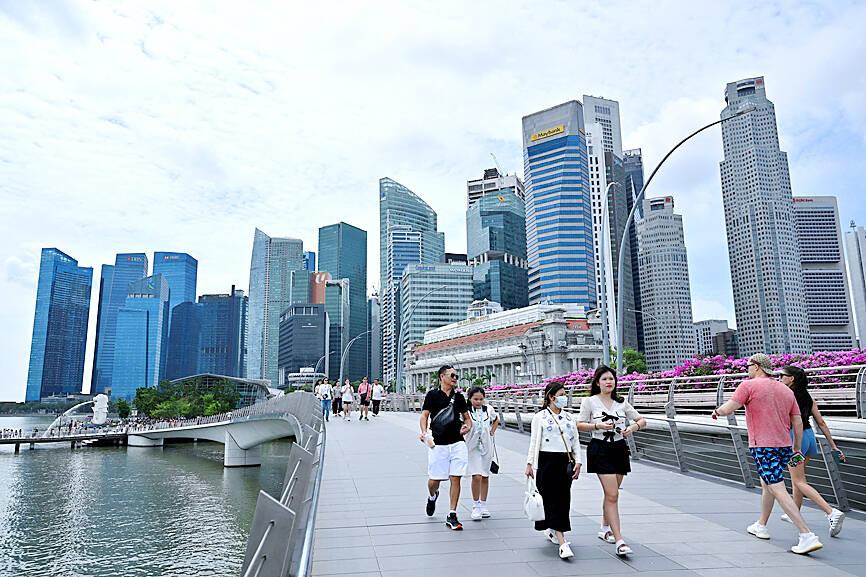
Photo: Reuters
Singapore is concerned that the council’s visit would affect its overseas Taiwanese community and therefore may refuse to grant visas to any OCAC officials, Hsu said.
Although Singapore has visa-free entry for Taiwanese, government officials require authorization to travel.
Last year when the meeting was held in Vietnam, Hanoi refused to issue visas to Taiwanese lawmakers and officials, leaving Hsu and Deputy Legislative Speaker Johnny Chiang (江啟臣) unable to attend, she said.
Meanwhile, Democratic Progressive Party (DPP) Legislator Michelle Lin (林楚茵) said that Singaporean Prime Minister Lawrence Wong (黃循財) reaffirmed his opposition to “Taiwanese independence” when he met with Chinese Premier Li Qiang (李強) on Oct. 25.
She suggested that the council monitor China’s “long-arm jurisdiction,” saying that Singapore has an extradition agreement with Hong Kong.
Hsu said that the OCAC continues to monitor international developments and has advised Taiwanese to exercise caution when transiting through or traveling to certain countries.
Singapore is not currently included on the travel alert list, but may be added in the future for those sanctioned by China, such as DPP Legislator Puma Shen (沈伯洋), who may face risks when traveling to Singapore, she added.
Upon further questioning, Hsu clarified that the possibility of Singapore being added to an alert list is her personal opinion and does not represent the position of the national security team.

A magnitude 6.1 earthquake struck off the coast of Yilan County at 8:39pm tonight, the Central Weather Administration (CWA) said, with no immediate reports of damage or injuries. The epicenter was 38.7km east-northeast of Yilan County Hall at a focal depth of 98.3km, the CWA’s Seismological Center said. The quake’s maximum intensity, which gauges the actual physical effect of a seismic event, was a level 4 on Taiwan’s 7-tier intensity scale, the center said. That intensity level was recorded in Yilan County’s Nanao Township (南澳), Hsinchu County’s Guansi Township (關西), Nantou County’s Hehuanshan (合歡山) and Hualien County’s Yanliao (鹽寮). An intensity of 3 was

Instead of focusing solely on the threat of a full-scale military invasion, the US and its allies must prepare for a potential Chinese “quarantine” of Taiwan enforced through customs inspections, Stanford University Hoover fellow Eyck Freymann said in a Foreign Affairs article published on Wednesday. China could use various “gray zone” tactics in “reconfiguring the regional and ultimately the global economic order without a war,” said Freymann, who is also a nonresident research fellow at the US Naval War College. China might seize control of Taiwan’s links to the outside world by requiring all flights and ships entering or leaving Taiwan
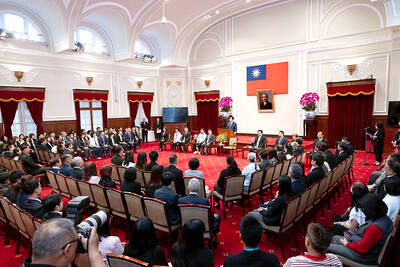
The next minimum wage hike is expected to exceed NT$30,000, President William Lai (賴清德) said yesterday during an award ceremony honoring “model workers,” including migrant workers, at the Presidential Office ahead of Workers’ Day today. Lai said he wished to thank the awardees on behalf of the nation and extend his most sincere respect for their hard work, on which Taiwan’s prosperity has been built. Lai specifically thanked 10 migrant workers selected for the award, saying that although they left their home countries to further their own goals, their efforts have benefited Taiwan as well. The nation’s industrial sector and small businesses lay
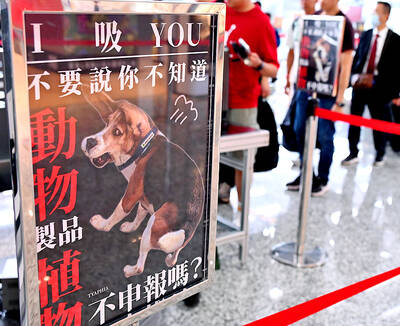
Quarantine awareness posters at Taiwan Taoyuan International Airport have gone viral for their use of wordplay. Issued by the airport branch of the Animal and Plant Health Inspection Agency, the posters feature sniffer dogs making a range of facial expressions, paired with advisory messages built around homophones. “We update the messages for holidays and campaign needs, periodically refreshing materials to attract people’s attention,” quarantine officials said. “The aim is to use the dogs’ appeal to draw focus to quarantine regulations.” A Japanese traveler visiting Taiwan has posted a photo on X of a poster showing a quarantine dog with a


 RSS
RSS