


The Taichung City Government has dismissed three senior officials for mishandling the city’s response to an African swine fever (ASF) outbreak, Taichung Mayor Lu Shiow-yen (盧秀燕) said yesterday.
Agriculture Bureau Director Chang Ching-chang (張敬昌), Environmental Protection Bureau Director Chen Hung-yi (陳宏益), and Taichung City Animal Protection and Health Inspection Office Director Lin Ju-liang (林儒良) were removed from their posts, effective immediately, for failing to follow central government epidemic prevention guidelines and creating significant risks, the city government said.
Lu said that following the gradual lifting of restrictions on pig transport and slaughter, “citizens and industries can begin to return to normal life.”
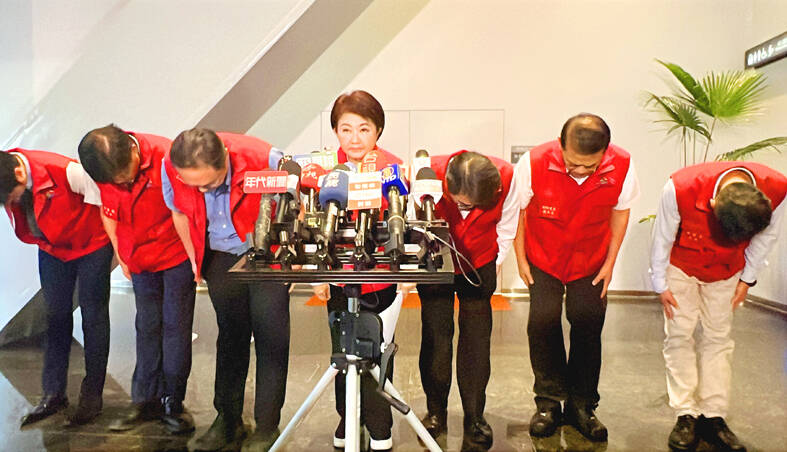
Photo: Liao Yao-tung, Taipei Times
“The most important task in this prevention effort was to contain the outbreak and prevent the virus from spreading,” she said, referring to the pig farm in the city’s Wuci District (梧棲) where several dead pigs tested positive for ASF on Oct. 21, prompting authorities to ban the transport and slaughter of pigs nationwide.
“Taichung and the central government worked completely united to accomplish this mission,” Lu said. “I am deeply grateful for the central government’s guidance and assistance, and at the same time, I thank the many county and city leaders, people’s representatives, industry figures, and citizens for their concern and encouragement.”
Lu said she was sorry that the city “did not perform well enough” in its ASF prevention work and that as mayor she “must take full responsibility and apologize.”
Personnel changes had been made, and the outbreak investigation was being accelerated, she said, adding that the results would be made public, he said.
Lu also said she would take the incident as a “lesson.”
Democratic Progressive Party (DPP) Taichung City Councilor Wang Li-jen (王立任) accused Lu of delaying prevention efforts by attending an event for the Taichung Shopping Festival, while DPP City Councilor Chiang Chao-kuo (江肇國) alleged that the city government “kept concealing and evading” the issue until the central government intervened.
DPP City Councilor Lin Te-yu (林德宇) said the timing of the two bureau directors’ dismissals coincided with “Lu’s political damage control” and was “very inappropriate.”
Meanwhile, Chinese Nationalist Party (KMT) Taichung City Councilor Lee Chung (李中) said his party respected the mayor’s authority and urged the city to learn from the incident.
The outbreak showed that departments’ initial response was “disorganized,” Lee said, adding that dismissing the officials for administrative negligence was an appropriate measure.
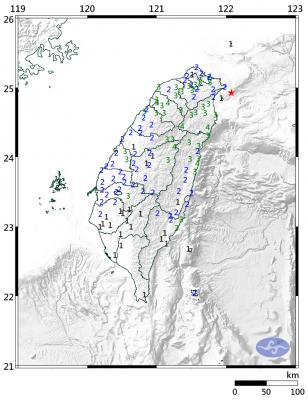
A magnitude 6.1 earthquake struck off the coast of Yilan County at 8:39pm tonight, the Central Weather Administration (CWA) said, with no immediate reports of damage or injuries. The epicenter was 38.7km east-northeast of Yilan County Hall at a focal depth of 98.3km, the CWA’s Seismological Center said. The quake’s maximum intensity, which gauges the actual physical effect of a seismic event, was a level 4 on Taiwan’s 7-tier intensity scale, the center said. That intensity level was recorded in Yilan County’s Nanao Township (南澳), Hsinchu County’s Guansi Township (關西), Nantou County’s Hehuanshan (合歡山) and Hualien County’s Yanliao (鹽寮). An intensity of 3 was

Instead of focusing solely on the threat of a full-scale military invasion, the US and its allies must prepare for a potential Chinese “quarantine” of Taiwan enforced through customs inspections, Stanford University Hoover fellow Eyck Freymann said in a Foreign Affairs article published on Wednesday. China could use various “gray zone” tactics in “reconfiguring the regional and ultimately the global economic order without a war,” said Freymann, who is also a nonresident research fellow at the US Naval War College. China might seize control of Taiwan’s links to the outside world by requiring all flights and ships entering or leaving Taiwan
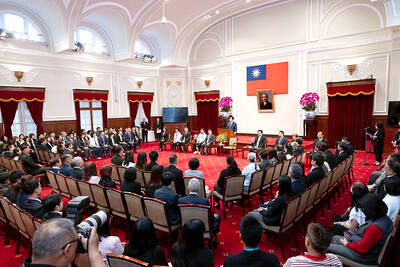
The next minimum wage hike is expected to exceed NT$30,000, President William Lai (賴清德) said yesterday during an award ceremony honoring “model workers,” including migrant workers, at the Presidential Office ahead of Workers’ Day today. Lai said he wished to thank the awardees on behalf of the nation and extend his most sincere respect for their hard work, on which Taiwan’s prosperity has been built. Lai specifically thanked 10 migrant workers selected for the award, saying that although they left their home countries to further their own goals, their efforts have benefited Taiwan as well. The nation’s industrial sector and small businesses lay
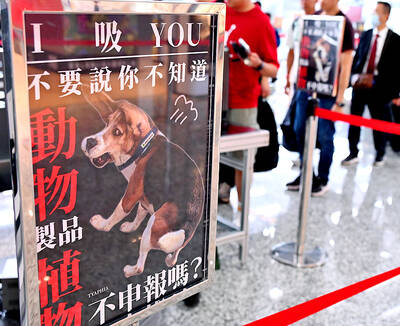
Quarantine awareness posters at Taiwan Taoyuan International Airport have gone viral for their use of wordplay. Issued by the airport branch of the Animal and Plant Health Inspection Agency, the posters feature sniffer dogs making a range of facial expressions, paired with advisory messages built around homophones. “We update the messages for holidays and campaign needs, periodically refreshing materials to attract people’s attention,” quarantine officials said. “The aim is to use the dogs’ appeal to draw focus to quarantine regulations.” A Japanese traveler visiting Taiwan has posted a photo on X of a poster showing a quarantine dog with a


 RSS
RSS