


The ban on feeding pigs kitchen waste would not be lifted until inspections of pig farms are completed and a legislation is put in place, Minister of Agriculture Chen Junne-jih (陳駿季) said yesterday.
The government lifted the ban on transporting pigs yesterday, and slaughtering and trading hogs today, as there has been no proof that the African swine fever (ASF) from the affected farm in Taichung has spread, he said.
Some fresh pork could be available at evening traditional markets today, but more would likely be available at tomorrow’s morning markets, Chen said.
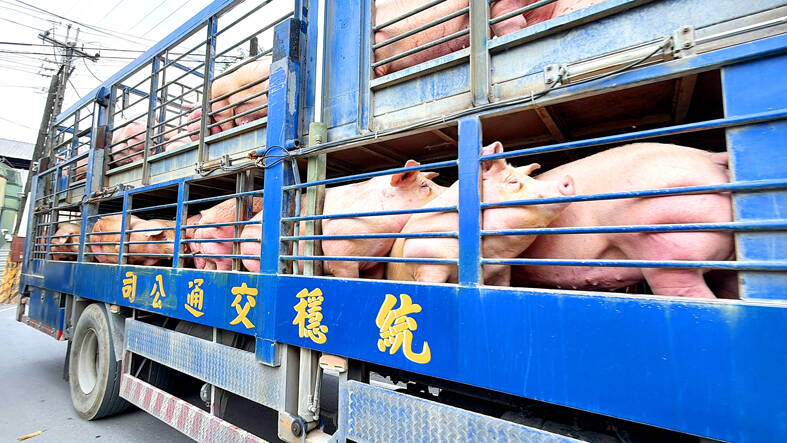
Photo: CNA
The nearly 390,000 pigs held up during the bans are expected to be consumed by March next year, he said.
The ministry would monitor pork prices and volume at meat markets, and help distribute excess pork to the frozen pork supply chain to ensure stable prices, he added.
The Taichung farm still tested positive for ASF yesterday, despite disinfection by the Chemical Corps, Chen said.
Veterinary Research Institute Director-General Deng Ming-chung (鄧明中) said samples were collected from the entrance of the farm, the floor where the fridge is placed and the pig nursery.
Chen said further testing is needed to confirm whether the virus is still active enough to cause an infection, adding that cleaning and disinfection of the farm would continue until samples test negative for ASF.
Feeding pigs kitchen waste is still prohibited, as inappropriately steamed leftovers were found to be the main cause of the ASF outbreak, he said.
The ban would not be relaxed until the 434 pig farms that use such feed nationwide are inspected and equipped with real-time monitoring systems, Chen said.
The inspections are to be conducted over the next two weeks, he said, adding that the ministry would also establish stricter penalties for improper kitchen waste steaming before lifting the ban.
Farmers who feed pigs kitchen waste during the period would be banned from transporting pigs and could have their operating license revoked, Chen said.
Asked what would happen to the ASF-affected farm, Chen said experts’ opinions would be compiled and given to the city government after samples from the farm test negative for the virus.
Data from the central ASF response unit showed that the 3,915 samples collected from pig farms nationwide — excluding the affected farm — and the 1,652 samples from the carcass transport vehicles of the nation’s eight rendering plants tested negative for ASF.

FUKUOKA SITUATION: Japanese media reported that the pathogen is expected to be identified by the summer, while the CDC downplayed the idea that it was hMPV A “mysterious cold-like illness” reported in Japan’s Fukuoka Prefecture does not seem to be a new disease, but Japanese authorities have been asked about the situation, the Centers for Disease Control (CDC) said yesterday. The Fukuoka Prefectural Medical Association on Wednesday told a news conference that a “mystery cold” that has become a hot topic on social media is “highly likely to be caused by some kind of viral infection,” Japan’s KBC News reported. “Many people are experiencing symptoms starting with a sore throat, followed by a runny nose, phlegm and a severe cough,” KBC News reported, citing association officials. Health authorities are

Nvidia Corp CEO Jensen Huang (黃仁勳) arrived in Taiwan yesterday ahead of upcoming AI and technology events, saying he plans to meet with clients and Taiwan Semiconductor Manufacturing Co Chairman C.C. Wei (魏哲家) during his visit. After landing at Taipei Songshan Airport, Huang posed for photos with fans and handed out Yakult drinks to reporters and supporters waiting at the scene, saying he has “a lot to do” during the trip. Asked about reports that Nvidia’s planned headquarters site in Taipei’s Beitou Shilin Technology Park could break ground on May 27, Huang said that if the company holds an event, he would

The Ministry of Finance this afternoon announced the winning numbers for the March-April uniform invoice lottery. The winning number for the NT$10 million (US$318,060) special prize is 19531471, and the winning number for the NT$2 million grand prize is 85941329. Three numbers were drawn for the NT$200,000 first prize: 07225810, 20231230 and 83518781. Those with receipts matching the last seven digits of any of the first-prize numbers will win the NT$40,000 second prize, while those matching the last six digits will win the NT$10,000 third prize. Those whose receipts match the last five digits of the first-prize numbers can claim the NT$4,000 fourth prize,
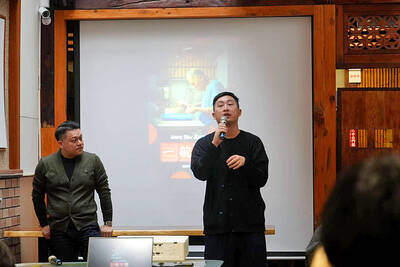
Taiwan Travelogue (臺灣漫遊錄), which earlier this week became the first Taiwanese novel to win the International Booker Prize, is to be adapted into a television series through a Taiwan-Japan coproduction, producer Chang Chen-yu (張辰漁) said yesterday. Chang, a producer at World Softest Production Film Co, wrote on Facebook that the company had been searching for projects with international appeal that retain a strong Taiwanese identity after colleagues and Japanese partners strongly recommended the novel. After reading the book, Chang said he immediately decided to pursue the screen rights. “A great story has the power to transcend time and borders, and connect countless people,”


 RSS
RSS