


Stability in the Taiwan Strait is key to peace and prosperity in the Indo-Pacific region, participants at the 11th Japan-Taiwan Exchange Summit said on Tuesday, adding that efforts should be made to foster a democratic supply chain.
The annual event, first held in 2015, brings together the two countries’ lawmakers, and this year’s event was the first to be held in Japan’s Kanto region. More than 300 members, including regional councilors and civic groups, attended the event.
President William Lai (賴清德), in a prerecorded video, said that passing of the host city from Tainan last year to Kamakura symbolizes a link between the two ancient cities, adding that the event marks the start of a new chapter for the two countries in regional collaboration.
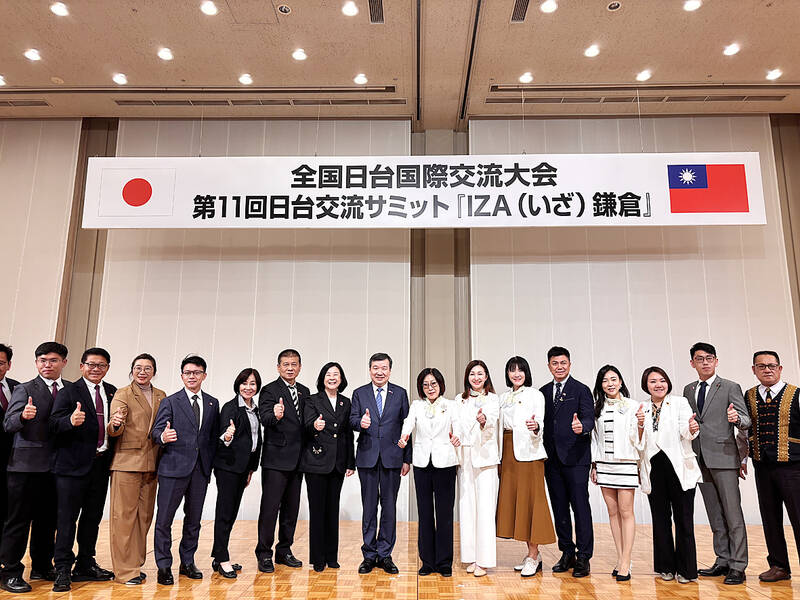
Photo: CNA
He also congratulated Japanese Prime Minister Sanae Takaichi, who took office last month.
The summit also mentioned that in talks between Lai and then-Japanese representative Takaichi in Taipei in April, the two leaders said their countries should contribute to founding of a democratic supply chain.
Taipei and Tokyo should collaborate on fields such as artificial intelligence research, renewable energy, drone design and manufacturing, low-orbit satellite design, robotics research, and the information, communication and technology sector, the summit said.
They should also step up partnerships on quantum technology research and other fields to bolster their economic security, it said.
UN General Assembly Resolution 2758 does not mention Taiwan and should not be distorted to exclude it from the international community, it said.
The Japanese government should take action to ensure Taiwan’s inclusion in the Comprehensive and Progressive Agreement for Trans-Pacific Partnership, it said.
Representative to Japan Lee Yi-yang (李逸洋) quoted Takaichi as saying during the 47th ASEAN Summit last month that peace and stability of the Taiwan Strait is closely linked to the entire region’s security.
Takaichi has clearly expressed her opposition to violence or coercion that would unilaterally change the “status quo,” Lee said.
He said that Takaichi had delivered the same message during her meeting with US President Donald Trump on Tuesday last week.
Taipei believes that Takaichi would play a crucial role in maintaining peace and stability in the Taiwan Strait and the Indo-Pacific region, Lee said.
Taiwan and Japan should continue to deepen their collaboration in regional peace, economic security, the high-technology industry, social resilience and deterring Chinese cognitive warfare, Lee said.
Next year’s summit is to take place in Nagoya, which is also to host the Asia Games the same year.
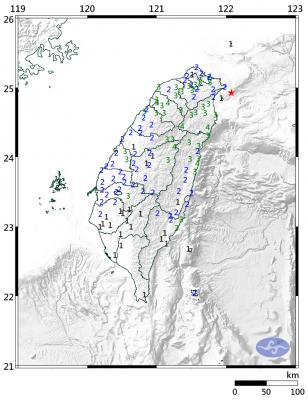
A magnitude 6.1 earthquake struck off the coast of Yilan County at 8:39pm tonight, the Central Weather Administration (CWA) said, with no immediate reports of damage or injuries. The epicenter was 38.7km east-northeast of Yilan County Hall at a focal depth of 98.3km, the CWA’s Seismological Center said. The quake’s maximum intensity, which gauges the actual physical effect of a seismic event, was a level 4 on Taiwan’s 7-tier intensity scale, the center said. That intensity level was recorded in Yilan County’s Nanao Township (南澳), Hsinchu County’s Guansi Township (關西), Nantou County’s Hehuanshan (合歡山) and Hualien County’s Yanliao (鹽寮). An intensity of 3 was
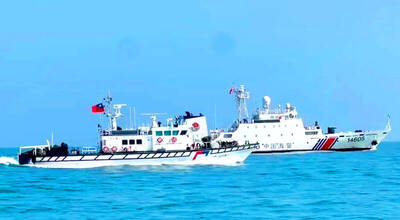
Instead of focusing solely on the threat of a full-scale military invasion, the US and its allies must prepare for a potential Chinese “quarantine” of Taiwan enforced through customs inspections, Stanford University Hoover fellow Eyck Freymann said in a Foreign Affairs article published on Wednesday. China could use various “gray zone” tactics in “reconfiguring the regional and ultimately the global economic order without a war,” said Freymann, who is also a nonresident research fellow at the US Naval War College. China might seize control of Taiwan’s links to the outside world by requiring all flights and ships entering or leaving Taiwan
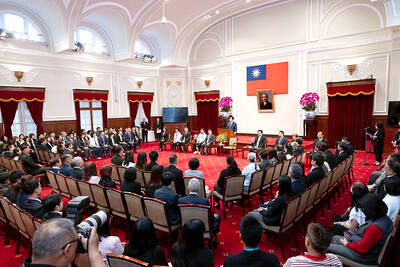
The next minimum wage hike is expected to exceed NT$30,000, President William Lai (賴清德) said yesterday during an award ceremony honoring “model workers,” including migrant workers, at the Presidential Office ahead of Workers’ Day today. Lai said he wished to thank the awardees on behalf of the nation and extend his most sincere respect for their hard work, on which Taiwan’s prosperity has been built. Lai specifically thanked 10 migrant workers selected for the award, saying that although they left their home countries to further their own goals, their efforts have benefited Taiwan as well. The nation’s industrial sector and small businesses lay
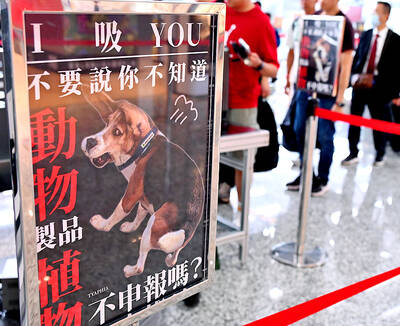
Quarantine awareness posters at Taiwan Taoyuan International Airport have gone viral for their use of wordplay. Issued by the airport branch of the Animal and Plant Health Inspection Agency, the posters feature sniffer dogs making a range of facial expressions, paired with advisory messages built around homophones. “We update the messages for holidays and campaign needs, periodically refreshing materials to attract people’s attention,” quarantine officials said. “The aim is to use the dogs’ appeal to draw focus to quarantine regulations.” A Japanese traveler visiting Taiwan has posted a photo on X of a poster showing a quarantine dog with a


 RSS
RSS