


Former president Tsai Ing-wen (蔡英文) and former minister of digital affairs Audrey Tang (唐鳳) are to speak at the Berlin Freedom Conference on Monday next week as part of the Berlin Freedom Week, which begins on Saturday.
The conference is to bring together more than 40 leaders from government, business, education, media, technology, civil society and defense for keynote speeches, debates and exchanges to discuss how democratic countries can work together under the resurging threat of authoritarianism, the organizer said.
The week is themed “freedom and democracy” and is hosted by the State of Berlin, the Axel-Springer Freedom Foundation and various global partners.

Photo courtesy of the city of Berlin via CNA
The event is to feature 130 forums, exhibits, screenings and cultural activities, including various events centered around Taiwan.
On Tuesday next week, German and Taiwanese academics are to host the discussion “How long is the shadow of dictatorship? Comparing the experience of Germany and Taiwan,” while on Wednesday, there is to be a public screening of the first episode of the Taiwanese series Zero Day Attack (零日攻擊) followed by an expert panel.
On Thursday, Berlin’s Markethalle Neun is to host a Taiwanese night market to showcase Taiwanese street food.
Alongside Tsai and Tang, additional conference speakers include German Bundestag President Julia Klockner, Ukrainian army lieutenant Yulia Mykytenko, World Liberty Congress secretary-general and cofounder Leopoldo Lopez and Oleksandra Matviichuk, a Nobel Peace Prize recipient and head of the Center for Civil Liberties.
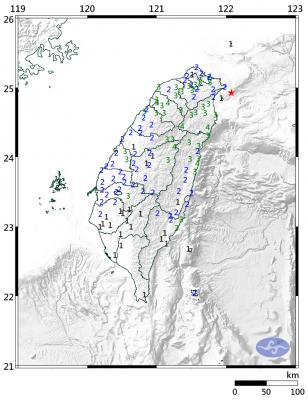
A magnitude 6.1 earthquake struck off the coast of Yilan County at 8:39pm tonight, the Central Weather Administration (CWA) said, with no immediate reports of damage or injuries. The epicenter was 38.7km east-northeast of Yilan County Hall at a focal depth of 98.3km, the CWA’s Seismological Center said. The quake’s maximum intensity, which gauges the actual physical effect of a seismic event, was a level 4 on Taiwan’s 7-tier intensity scale, the center said. That intensity level was recorded in Yilan County’s Nanao Township (南澳), Hsinchu County’s Guansi Township (關西), Nantou County’s Hehuanshan (合歡山) and Hualien County’s Yanliao (鹽寮). An intensity of 3 was
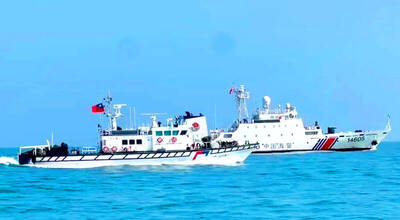
Instead of focusing solely on the threat of a full-scale military invasion, the US and its allies must prepare for a potential Chinese “quarantine” of Taiwan enforced through customs inspections, Stanford University Hoover fellow Eyck Freymann said in a Foreign Affairs article published on Wednesday. China could use various “gray zone” tactics in “reconfiguring the regional and ultimately the global economic order without a war,” said Freymann, who is also a nonresident research fellow at the US Naval War College. China might seize control of Taiwan’s links to the outside world by requiring all flights and ships entering or leaving Taiwan
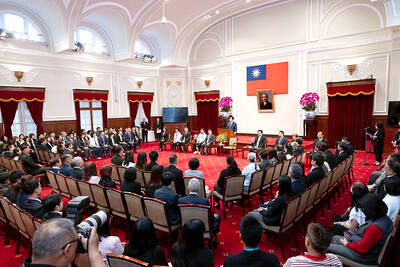
The next minimum wage hike is expected to exceed NT$30,000, President William Lai (賴清德) said yesterday during an award ceremony honoring “model workers,” including migrant workers, at the Presidential Office ahead of Workers’ Day today. Lai said he wished to thank the awardees on behalf of the nation and extend his most sincere respect for their hard work, on which Taiwan’s prosperity has been built. Lai specifically thanked 10 migrant workers selected for the award, saying that although they left their home countries to further their own goals, their efforts have benefited Taiwan as well. The nation’s industrial sector and small businesses lay
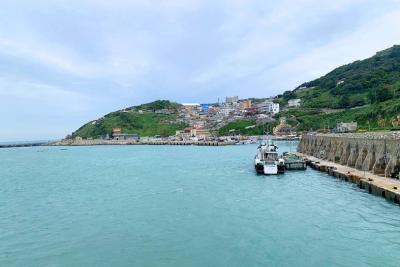
Taiwan has activated backup communications for its northernmost territory, the remote and strategically located island of Dongyin (東引), after poor weather conditions apparently shifted the wreckage of a ship onto an undersea cable causing it to break. The vulnerability of undersea communication cables linking Taiwan with its outlying islands has been a persistent cause of concern for Taipei, whose government has on several occasions blamed Chinese ships for intentionally causing damage. Dongyin, home to about 1,500 people, sits in a strategic position at the top of the Taiwan Strait and the island has a heavy military presence. It does not have an


 RSS
RSS