


Loopholes in the law highlighted by the detention of Chinese after they sailed into Taiwan illegally would be tightened, Minister of the Interior Liu Shyh-fang (劉世芳) said yesterday in response to questions by Democratic Progressive Party (DPP) Legislator Lee Kun-cheng (李坤城) during a plenary session at the Legislative Yuan.
The practice of allowing Chinese who have illegally entered the country to serve less time than legally mandated is creating a loophole in national security, Lee said.
According to the Act Governing Relations Between the People of the Taiwan Area and the Mainland Area (臺灣地區與大陸地區人民關係條例), Chinese illegally entering Taiwan should serve a maximum of five years, but the majority of those sentenced in such cases over the past five years have served only up to eight months before being transferred into the custody of the National Immigration Agency (NIA) for 150 days before being repatriated, Lee said.
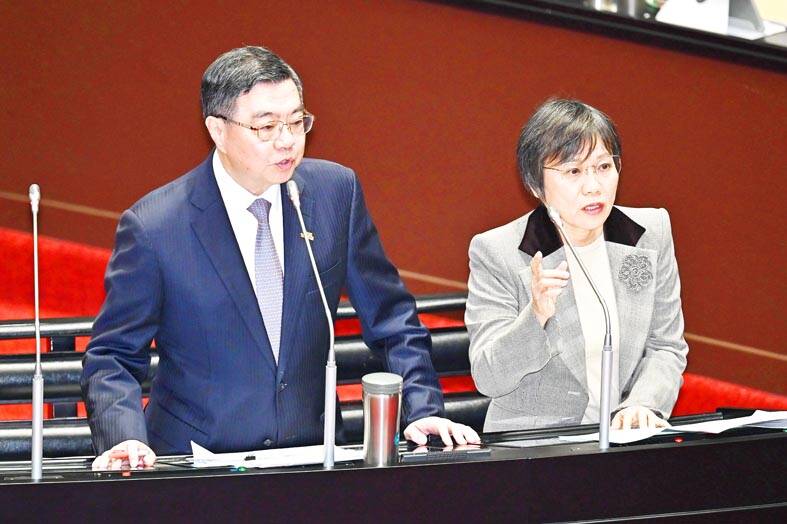
Photo: Tu Chien-jung, Taipei Times
A Chinese surnamed Yang (楊) posted a video on Chinese social media platform Douyin after being returned to China, in which he described renting a scooter and traveling throughout Taiwan, Lee said.
The Chinese-language United Daily News reported that Yang in the video described how police had been more concerned about whether people were correctly wearing a helmet than checking for identification, Lee said.
Lee also cited the case of Ruan Fangyong (阮芳勇), a self-described former member of the Chinese People’s Liberation Army Navy, who was interviewed by a local Chinese-language media firm about his time here.
Premier Cho Jung-tai (卓榮泰) told the hearing that the Immigration Act (入出國移民法) explicitly prohibits people who enter Taiwan illegally from accepting interviews with the press, although it was not clear which provision of the act he was referring to.
The NIA said that there was no specific law banning media interviews by such people, the Epoch Times reported on Aug. 11, shortly after DPP Legislator Wang Ting-yu (王定宇) criticized the agency over Ruan’s situation.
The Supreme Court on Jan. 23 sentenced Ruan to eight months in prison after he drove a speedboat into the Tamsui River (淡水河) from China on June 8 last year.
Cho at the hearing also said that the government would consider stricter standards if allowing people entering the country to speak to the media is permitted.
Liu said that there are prerequisites for people being released from detention, such as preventing them from spreading false information.
“We are looking to amend the law to require that the movements of such people are more controlled,” she said.
In other news, Taiwan Society North chairman Lo Chun-hsuan (羅浚晅) told a news conference at the legislature that the government must assess whether Chien Li (錢麗) poses a risk to national security and urged the government to set a national security standard for people seeking residency.
The NIA last month revoked Chien’s permanent residency over her alleged advocacy for China to use force to bring about unification with Taiwan.
Taiwan Society chairman Weng Ming-jang (翁銘章) said that the Ministry of the Interior should deport Chien immediately to set an example.
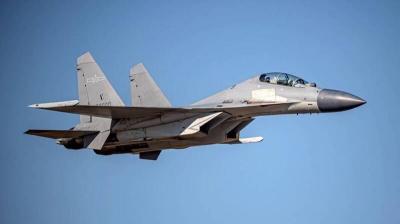
Eight Chinese naval vessels and 24 military aircraft were detected crossing the median line of the Taiwan Strait between 6am yesterday and 6am today, the Ministry of National Defense said this morning. The aircraft entered Taiwan’s northern, central, southwestern and eastern air defense identification zones, the ministry said. The armed forces responded with mission aircraft, naval vessels and shore-based missile systems to closely monitor the situation, it added. Eight naval vessels, one official ship and 36 aircraft sorties were spotted in total, the ministry said.
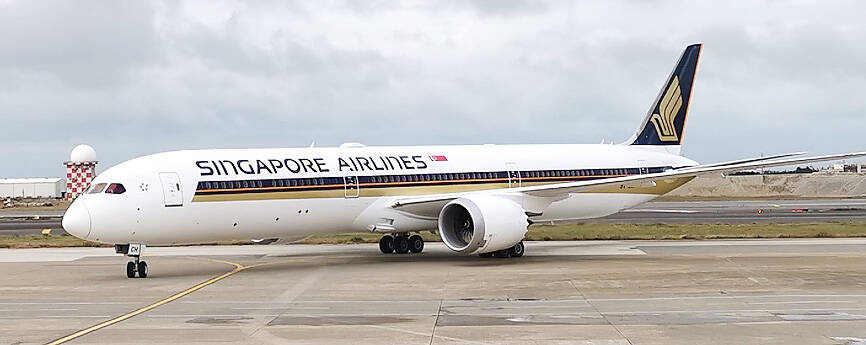
INCREASED CAPACITY: The flights on Mondays, Wednesdays, Fridays and Sundays would leave Singapore in the morning and Taipei in the afternoon Singapore Airlines is adding four supplementary flights to Taipei per week until May to meet increased tourist and business travel demand, the carrier said on Friday. The addition would raise the number of weekly flights it operates to Taipei to 18, Singapore Airlines Taiwan general manager Timothy Ouyang (歐陽漢源) said. The airline has recorded a steady rise in tourist and business travel to and from Taipei, and aims to provide more flexible travel arrangements for passengers, said Ouyang, who assumed the post in July last year. From now until Saturday next week, four additional flights would depart from Singapore on Monday, Wednesday, Friday
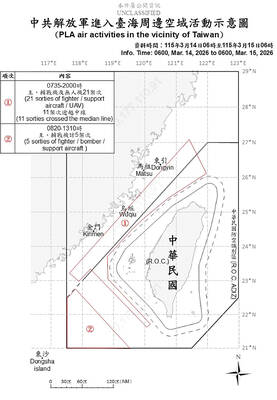
The Ministry of National Defense yesterday reported the return of large-scale Chinese air force activities after their unexplained absence for more than two weeks, which had prompted speculation regarding Beijing’s motives. China usually sends fighter jets, drones and other military aircraft around the nation on a daily basis. Interruptions to such routine are generally caused by bad weather. The Ministry of National Defense said it had detected 26 Chinese military aircraft in the Taiwan Strait over the previous 24 hours. It last reported that many aircraft on Feb. 25, when it spotted 30 aircraft, saying Beijing was carrying out another “joint combat
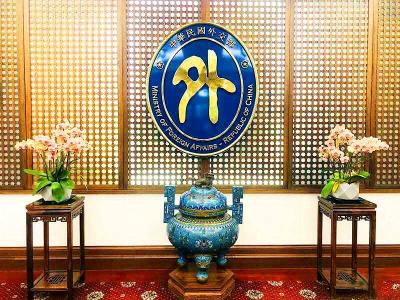
The Ministry of Foreign Affairs (MOFA) today said that if South Korea does not reply appropriately to its request to correct Taiwan’s name on its e-Arrival card system before March 31, it would take corresponding measures to alter how South Korea is labeled on the online Taiwan Arrival Card system. South Korea’s e-Arrival card system lists Taiwan as “China (Taiwan)” in the “point of departure” and “next destination” fields. The ministry said that it changed the nationality for South Koreans on Taiwan’s Alien Resident Certificates from “Korea” to “South Korea” on March 1, in a gesture of goodwill and based on the


 RSS
RSS