


A Tainan railway project recently unearthed roads in the city made partially with sugar dating back to the 19th century, the Tainan Municipal Administration of Cultural Heritage said on Thursday.
The remains of the roads, built into the ground and made of a plethora of materials, including sugar, were discovered around the area under Tainan’s Sin-Lau Hospital (新樓醫院), on Dongmen Road in Tainan’s East District (東區), the agency said on its Web site.
Archeologists determined that the ruins were parts of important roads in Tainan built during the first half of the 19th century, when Taiwan was loosely controlled by the Qing Dynasty (1644-1911) as a prefecture of Fujian Province.
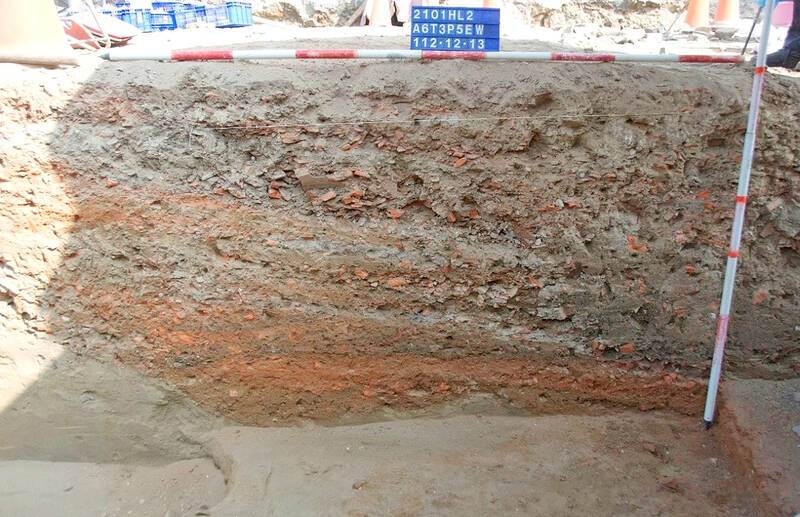
Photo courtesy of the Tainan City Government
While the main materials used for the roads were mixed-mud mortar, its crevices were filled with a mixture made from mortar and broken ceramic and tiles, as well as pieces of sugar, the agency said.
Additionally, referencing a map of Tainan from 1875, archeologists said the location of the ruin closely resembled that of the “Bullock Cart Road” (牛車路) that once served the area of the discovery.
They concluded that either the construction or renovation of the roads in question took place in about 1836, the 16th year of the reign of Emperor Daoguang (道光, 1821-1850).
Archeologists hypothesized that the workers constructing the roads used materials they could easily access, which was why sugar and broken pieces of ceramics and tiles were used, the agency said.
Historically, the area was once the heart of the sugar-making industry in old Tainan, which was known at the time as a major sugar center.
According to the Account on Visiting Taiwan (臺灣采訪冊), a historical work by officials from the Qing Dynasty who visited and evaluated Taiwan, the sugar-making industry was so robust that pieces of sugar could be found scattered all around the location.
The account also documented that during one summer, steam rose from the roads of the area, which reacted with the sugar mixed into the roads and other scattered sugar to fill the air with a sweet aroma.
The administration said the archeological team working on the site has completed documenting the location, and temporarily relocated the artifacts and ruins to allow for the project to move the railway line underground to continue.
Once the railway project is completed, the ruins and artifacts would become a part of a parkway cultural project to return the history and heritage of Qing-era Tainan to its people, the agency cited Tainan Mayor Huang Wei-che (黃偉哲) as saying.

LOUD AND PROUD Taiwan might have taken a drubbing against Australia and Japan, but you might not know it from the enthusiasm and numbers of the fans Taiwan might not be expected to win the World Baseball Classic (WBC) but their fans are making their presence felt in Tokyo, with tens of thousands decked out in the team’s blue, blowing horns and singing songs. Taiwanese fans have packed out the Tokyo Dome for all three of their games so far and even threatened to drown out home team supporters when their team played Japan on Friday. They blew trumpets, chanted for their favorite players and had their own cheerleading squad who dance on a stage during the game. The team struggled to match that exuberance on the field, with
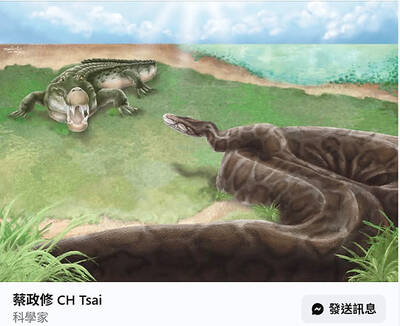
Taiwanese paleontologists have discovered fossil evidence that pythons up to 4m long inhabited Taiwan during the Pleistocene epoch, reporting their findings in the international scientific journal Historical Biology. National Taiwan University (NTU) Institute of Ecology and Evolutionary Biology associate professor Tsai Cheng-hsiu (蔡政修) led the team that discovered the largest snake fossil ever found in Taiwan. The single trunk vertebra was discovered in Tainan at the Chiting Formation, dated to between 400,000 and 800,000 years ago in the Middle Pleistocene, the paper said. The area also produced Taiwan’s first avian fossil, as well as crocodile, mammoth, saber-toothed cat and rhinoceros fossils, it said. Discoveries

Taiwanese paleontologists have discovered fossil evidence that pythons up to 4m long inhabited Taiwan during the Pleistocene epoch, reporting their findings in the international scientific journal Historical Biology. National Taiwan University (NTU) Institute of Ecology and Evolutionary Biology associate professor Tsai Cheng-hsiu (蔡政修) led the team that discovered the largest snake fossil ever found in Taiwan. A single trunk vertebra was discovered in Tainan at the Chiting Formation, dated to between 800,000 to 400,000 years ago in the Middle Pleistocene, the paper said. The area also produced Taiwan’s first avian fossil, as well as crocodile, mammoth, sabre-toothed cat and rhinoceros fossils, it said. Discoveries

Whether Japan would help defend Taiwan in case of a cross-strait conflict would depend on the US and the extent to which Japan would be allowed to act under the US-Japan Security Treaty, former Japanese minister of defense Satoshi Morimoto said. As China has not given up on the idea of invading Taiwan by force, to what extent Japan could support US military action would hinge on Washington’s intention and its negotiation with Tokyo, Morimoto said in an interview with the Liberty Times (sister paper of the Taipei Times) yesterday. There has to be sufficient mutual recognition of how Japan could provide


 RSS
RSS