


Taiwan’s resolve to defend itself using force has not changed, Chinese Nationalist Party (KMT) chairwoman-elect Cheng Li-wun (鄭麗文) said in an exclusive interview with German media firm Deutsche Welle published yesterday, although she opposed a proposal to increase Taiwan’s defense spending to 5 percent of GDP.
The KMT national congress commenced yesterday, with Cheng to officially become the party’s chairwoman today.
Cheng also spoke with the interviewer, Tsou Tsung-han (鄒宗翰), about Russia’s war in Ukraine.

Photo: Chen Yi-kuan, Taipei Times
Peace across the Taiwan Strait is the most important issue for Taiwan, Cheng said, adding that she would focus on resolving disagreements and conflicts, and offer an olive branch if she were to meet with Chinese President Xi Jinping (習近平).
Cross-strait differences could be reconciled via peaceful means, and remarks or actions that might provoke military conflict should be avoided, she said.
Asked about her take on the likelihood of unification, Cheng said that most Taiwanese prefer to maintain the “status quo.”
The proportions of those favoring unification and independence has not changed much, she said.
Talk about cross-strait issues would be castles in the air if the relationship cannot be normalized and stabilized, she added.
Asked about a potential Chinese attempt to take Taiwan by force, Cheng said: “We have not abandoned our resolve to defend Taiwan by force either.”
Asked whether her claim contradicts her stance against boosting the nation’s defense budget, she said: “Not at all.”
Neither Germany nor NATO would be willing to increase their defense budgets to 5 percent of GDP, but President William Lai (賴清德) agreed under pressure from the US, Cheng said, adding that there are many methods to maintain peace other than military approaches.
Taiwan would never become a second Hong Kong, although it might end up as a second Ukraine, she said.
Russian President Vladimir Putin is not a dictator, as he was elected by Russia’s people, she said.
Asked whether Russia’s war in Ukraine was Putin’s fault, Cheng said that is definitely not true.
The problem would not have arisen if NATO had refrained from “expanding into the east” and had rejected Ukraine’s application to become a member state, she said.
Taiwan’s power over its own fate should not be handed over to Beijing or Washington, Cheng said, adding that this is an issue over which she disagrees with Lai.
Separately, Democratic Progressive Party Legislator Chen Kuan-ting (陳冠廷) said that Cheng’s remarks not only deviate from the consensus among most countries, but could undermine Taiwan’s credibility and reputation in the democratic alliance.
Putin has long been manipulating elections, persecuting political enemies, and controlling the media and the judicial system in Russia, Chen said.
Democracy-coated authoritarianism has for a long time been considered dictatorship in the international community, he said.
Chen also disapproved of Cheng’s statements about defending Taiwan and increasing defense budgets.
“Such a self-contradictory attitude would only weaken the world’s trust in Taiwan’s strategic integrity,” he said.

FUKUOKA SITUATION: Japanese media reported that the pathogen is expected to be identified by the summer, while the CDC downplayed the idea that it was hMPV A “mysterious cold-like illness” reported in Japan’s Fukuoka Prefecture does not seem to be a new disease, but Japanese authorities have been asked about the situation, the Centers for Disease Control (CDC) said yesterday. The Fukuoka Prefectural Medical Association on Wednesday told a news conference that a “mystery cold” that has become a hot topic on social media is “highly likely to be caused by some kind of viral infection,” Japan’s KBC News reported. “Many people are experiencing symptoms starting with a sore throat, followed by a runny nose, phlegm and a severe cough,” KBC News reported, citing association officials. Health authorities are

Nvidia Corp CEO Jensen Huang (黃仁勳) arrived in Taiwan yesterday ahead of upcoming AI and technology events, saying he plans to meet with clients and Taiwan Semiconductor Manufacturing Co Chairman C.C. Wei (魏哲家) during his visit. After landing at Taipei Songshan Airport, Huang posed for photos with fans and handed out Yakult drinks to reporters and supporters waiting at the scene, saying he has “a lot to do” during the trip. Asked about reports that Nvidia’s planned headquarters site in Taipei’s Beitou Shilin Technology Park could break ground on May 27, Huang said that if the company holds an event, he would

The Ministry of Finance this afternoon announced the winning numbers for the March-April uniform invoice lottery. The winning number for the NT$10 million (US$318,060) special prize is 19531471, and the winning number for the NT$2 million grand prize is 85941329. Three numbers were drawn for the NT$200,000 first prize: 07225810, 20231230 and 83518781. Those with receipts matching the last seven digits of any of the first-prize numbers will win the NT$40,000 second prize, while those matching the last six digits will win the NT$10,000 third prize. Those whose receipts match the last five digits of the first-prize numbers can claim the NT$4,000 fourth prize,
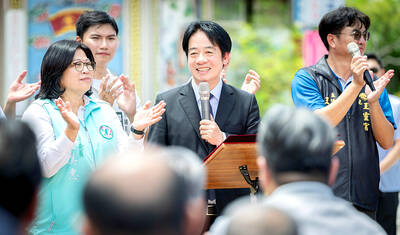
SIX SUBSIDIES: The monthly allowance for older farmers is to increase to NT$10,000, and NT$5,000 is to be given to homemakers under the national pension system, Lai said The government is to implement major welfare policies for disadvantaged groups, including raising the monthly allowance for older farmers to NT$10,000 and providing homemakers with NT$5,000 per month, President William Lai (賴清德) said yesterday. Lai made the remarks during a visit to Wangling Temple in Chiayi County, saying that the planned increases were being introduced amid economic growth and an increase in tax revenue. Touting a policy, in which the government plans to provide a monthly allowance of NT$5,000 for every child under the age of 18 in a bid to address Taiwan’s low birthrate, Lai said that if received for the


 RSS
RSS