


The circular economy roadmap for 2050 is to be unveiled next year at the earliest, with resilience corridors built to address various challenges, President William Lai (賴清德) said at the fifth National Climate Change Countermeasures Committee meeting yesterday.
Typhoons Danas and Ragasa caused catastrophes such as flooding and landslides in Taiwan this year, and abnormally high temperatures continued nationwide, he said.
Those are clear warnings that climate-related disasters would become more frequent and severe, Lai said.
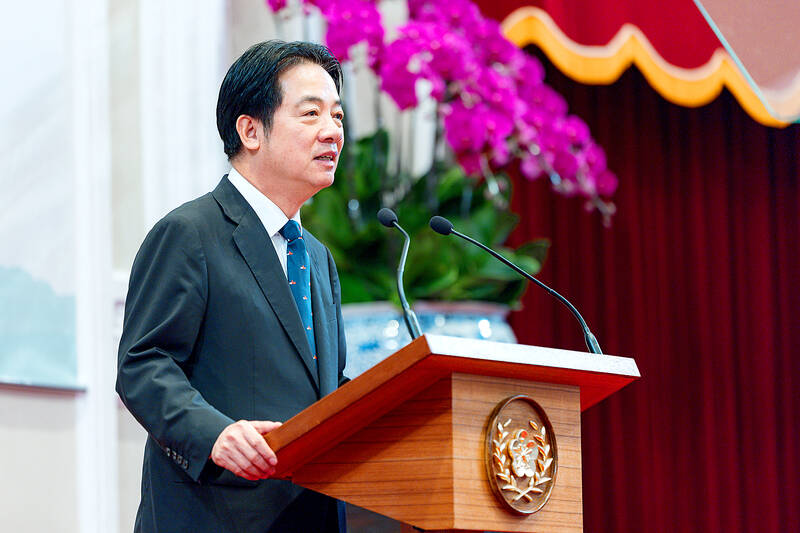
Photo courtesy of the Presidential Office
Extreme weather has become more frequent globally and is impacting the society and economy of almost every country, he said.
The international trade landscape is also restructuring drastically, with new tariff barriers and emerging green supply chain requirements posing challenges to Taiwan’s export-oriented economy, he added.
The pressure from climate and economic changes has caused unease in society and increased uncertainty about the future, Lai said, adding that the government has a clear attitude toward these issues and would back Taiwanese and the nation’s industries.
Taiwan must be consistent in its green transition, he said.
A more resilient Taiwan that can better adapt to climate change would be more prosperous and economically independent, Lai said.
The Ministry of Environment has unveiled the draft bill for its circular economy roadmap for 2050, with the official version to be announced next year at the earliest, Lai said, adding that the ministry is also working on amendments to resource circulation regulations.
The added value created by the domestic green technology sector surpassed NT$500 billion (US$16.3 billion) last year, accounting for 2 percent of GDP, he said.
Meanwhile, added value from the circular economy, energy efficiency and renewable energy systems accounted for 73 percent of the sector’s total added value, which showed that these fields are crucial and that green growth is a driving force for overall national development, Lai said.
That is the fruit of the government’s efforts in promoting circular economy and energy transition policies, he added.
The government would also encourage more net zero initiatives in society, Lai said.
The Ministry of the Interior’s goal would be to reduce carbon emissions of the residential and commercial sector by 35 percent by 2030, aiming to promote energy-saving housing, he said.
The Ministry of Environment would propose ways to meet net zero targets while lowering air pollution to ensure clean air and improve public health, he added.
The road to net zero would have many challenges, but Taiwan should not change direction due to temporary difficulties, Lai said.
The government would work with the private sector to bolster the nation’s ability to deal with disasters, he said, adding that it would also set up more comprehensive climate adaptation mechanisms and construct resilience corridors to tackle different challenges.
The committee has two new members: National Cheng Kung University architecture professor Lin Tzu-ping (林子平) and Executive Yuan Youth Advisory Committee member Lei Ya-chi (雷雅淇), who is also managing director of Science Media Center Taiwan.
Executive Yuan Secretary-General Xavier Chang (張惇涵) and Minister of Environment Peng Chi-ming (彭啟明) are the committee’s executive secretaries.
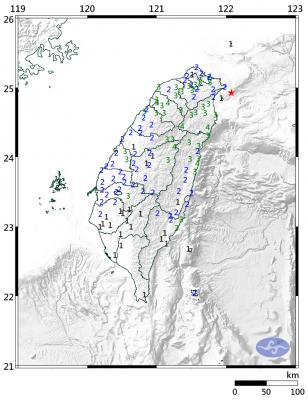
A magnitude 6.1 earthquake struck off the coast of Yilan County at 8:39pm tonight, the Central Weather Administration (CWA) said, with no immediate reports of damage or injuries. The epicenter was 38.7km east-northeast of Yilan County Hall at a focal depth of 98.3km, the CWA’s Seismological Center said. The quake’s maximum intensity, which gauges the actual physical effect of a seismic event, was a level 4 on Taiwan’s 7-tier intensity scale, the center said. That intensity level was recorded in Yilan County’s Nanao Township (南澳), Hsinchu County’s Guansi Township (關西), Nantou County’s Hehuanshan (合歡山) and Hualien County’s Yanliao (鹽寮). An intensity of 3 was
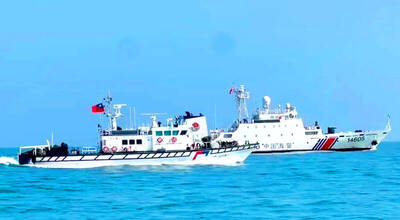
Instead of focusing solely on the threat of a full-scale military invasion, the US and its allies must prepare for a potential Chinese “quarantine” of Taiwan enforced through customs inspections, Stanford University Hoover fellow Eyck Freymann said in a Foreign Affairs article published on Wednesday. China could use various “gray zone” tactics in “reconfiguring the regional and ultimately the global economic order without a war,” said Freymann, who is also a nonresident research fellow at the US Naval War College. China might seize control of Taiwan’s links to the outside world by requiring all flights and ships entering or leaving Taiwan
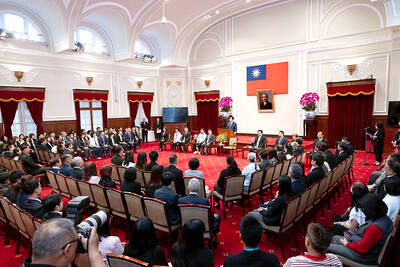
The next minimum wage hike is expected to exceed NT$30,000, President William Lai (賴清德) said yesterday during an award ceremony honoring “model workers,” including migrant workers, at the Presidential Office ahead of Workers’ Day today. Lai said he wished to thank the awardees on behalf of the nation and extend his most sincere respect for their hard work, on which Taiwan’s prosperity has been built. Lai specifically thanked 10 migrant workers selected for the award, saying that although they left their home countries to further their own goals, their efforts have benefited Taiwan as well. The nation’s industrial sector and small businesses lay
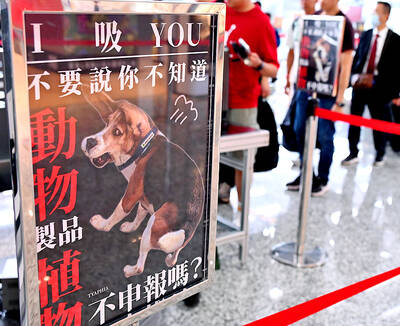
Quarantine awareness posters at Taiwan Taoyuan International Airport have gone viral for their use of wordplay. Issued by the airport branch of the Animal and Plant Health Inspection Agency, the posters feature sniffer dogs making a range of facial expressions, paired with advisory messages built around homophones. “We update the messages for holidays and campaign needs, periodically refreshing materials to attract people’s attention,” quarantine officials said. “The aim is to use the dogs’ appeal to draw focus to quarantine regulations.” A Japanese traveler visiting Taiwan has posted a photo on X of a poster showing a quarantine dog with a


 RSS
RSS