


The National Immigration Agency has revoked the permanent residency and household registration of a Chinese spouse for allegedly advocating for China to annex Taiwan by force and reporting coworkers’ activities to Beijing, the Mainland Affairs Council (MAC) said yesterday.
Chinese national Qian Li (錢麗) reportedly works at Asustek Computer Inc where she is a key member of its workers’ union, the council said.
She allegedly reported her supervisors and coworkers to Beijing for contravening the laws of the People’s Republic of China, and set up a Facebook page to advocate for China’s use of force to take over Taiwan and intimidate Taiwanese, it said, adding that immigration and cross-strait officials were informed about the case.
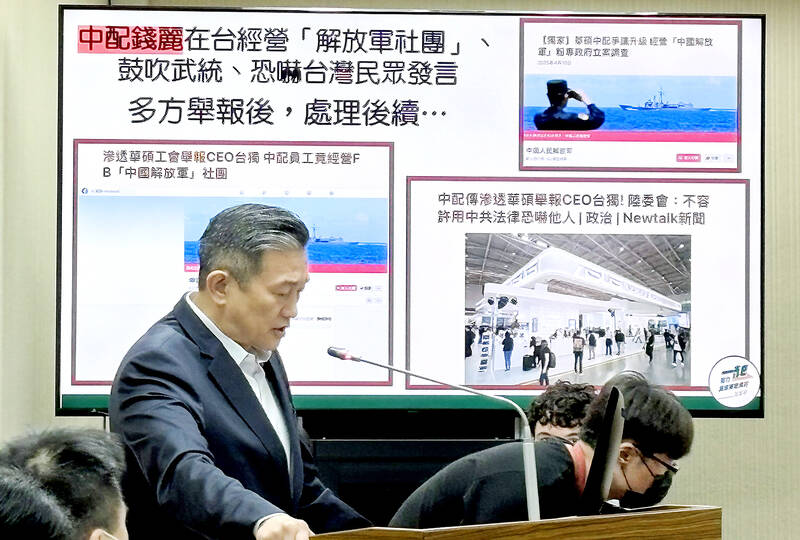
Photo: CNA
MAC Deputy Minister Shen Yu-chung (沈有忠) told lawmakers at a meeting of the legislature’s Foreign Affairs and National Defense Committee that Qian’s permanent residency and household registration were revoked on Aug. 28 following multiple discussions among government agencies.
MAC Deputy Minister Liang Wen-chieh (梁文傑) told a news conference that Qian’s permanent residency and household registration were revoked in accordance with the Act Governing Relations Between the People of the Taiwan Area and the Mainland Area (臺灣地區與大陸地區人民關係條例), after authorities determined that her actions endangered national security and risked destabilizing society.
Unlike three Chinese spouses who were ordered to leave the country soon after their household registrations were canceled earlier this year, Qian can continue to stay in Taiwan, work and use the National Health Insurance and Labor Insurance systems, as the reason for her residency — she is married to a Taiwanese — has not changed, Liang said.
Qian is appealing the ruling to the Executive Yuan and possibly the administrative courts, Liang said, adding that she can use Taiwanese laws to defend her rights.
Meanwhile, Democratic Progressive Party Legislator Puma Shen (沈柏洋) is being investigated by the Chinese Ministry of Public Security for allegedly “undermining national unity.”
Shen said he could be arrested by Chinese security personnel while overseas.
Since 2017, China has handled about 3,000 cases through the Interpol, of which 500 were “red notices,” a request that law enforcement authorities arrest a person pending extradition, Liang said.
A Uighur activist was arrested and detained in Morocco in 2021 after China issued a red notice for him, he said.
Shen’s arrest could happen in countries particularly close to China, although extradition treaties that China signed with 60 countries generally exclude the extradition of political prisoners, Liang said.
Under UN treaties, a person can only be extradited when both countries believe them to have committed a criminal offense.
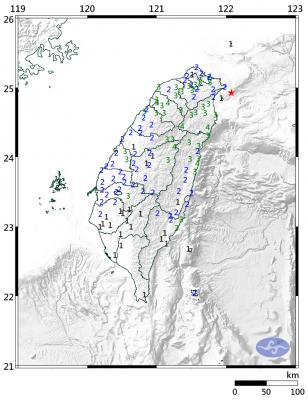
A magnitude 6.1 earthquake struck off the coast of Yilan County at 8:39pm tonight, the Central Weather Administration (CWA) said, with no immediate reports of damage or injuries. The epicenter was 38.7km east-northeast of Yilan County Hall at a focal depth of 98.3km, the CWA’s Seismological Center said. The quake’s maximum intensity, which gauges the actual physical effect of a seismic event, was a level 4 on Taiwan’s 7-tier intensity scale, the center said. That intensity level was recorded in Yilan County’s Nanao Township (南澳), Hsinchu County’s Guansi Township (關西), Nantou County’s Hehuanshan (合歡山) and Hualien County’s Yanliao (鹽寮). An intensity of 3 was

Instead of focusing solely on the threat of a full-scale military invasion, the US and its allies must prepare for a potential Chinese “quarantine” of Taiwan enforced through customs inspections, Stanford University Hoover fellow Eyck Freymann said in a Foreign Affairs article published on Wednesday. China could use various “gray zone” tactics in “reconfiguring the regional and ultimately the global economic order without a war,” said Freymann, who is also a nonresident research fellow at the US Naval War College. China might seize control of Taiwan’s links to the outside world by requiring all flights and ships entering or leaving Taiwan
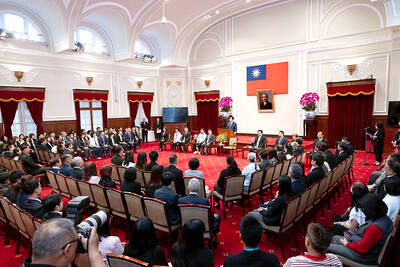
The next minimum wage hike is expected to exceed NT$30,000, President William Lai (賴清德) said yesterday during an award ceremony honoring “model workers,” including migrant workers, at the Presidential Office ahead of Workers’ Day today. Lai said he wished to thank the awardees on behalf of the nation and extend his most sincere respect for their hard work, on which Taiwan’s prosperity has been built. Lai specifically thanked 10 migrant workers selected for the award, saying that although they left their home countries to further their own goals, their efforts have benefited Taiwan as well. The nation’s industrial sector and small businesses lay
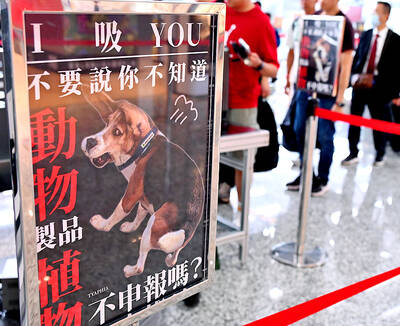
Quarantine awareness posters at Taiwan Taoyuan International Airport have gone viral for their use of wordplay. Issued by the airport branch of the Animal and Plant Health Inspection Agency, the posters feature sniffer dogs making a range of facial expressions, paired with advisory messages built around homophones. “We update the messages for holidays and campaign needs, periodically refreshing materials to attract people’s attention,” quarantine officials said. “The aim is to use the dogs’ appeal to draw focus to quarantine regulations.” A Japanese traveler visiting Taiwan has posted a photo on X of a poster showing a quarantine dog with a


 RSS
RSS