


China is seeking to project an illusion of “long-arm jurisdiction” over Taiwan, in a bid to sow division and fear among Taiwanese, three government bodies said yesterday.
That approach is evident in China’s efforts to prosecute Taiwanese in absentia for what Beijing calls secessionist activities, officials at the National Security Bureau (NSB), the Mainland Affairs Council (MAC) and the Ministry of Foreign Affairs (MOFA) said at a meeting of the legislature’s Foreign Affairs and National Defense Committee.
They were responding to lawmakers’ questions on what actions could be taken in response to a China-based report that Beijing is investigating Democratic Progressive Party (DPP) Legislator Puma Shen (沈伯洋) for promoting “Taiwan’s independence.”
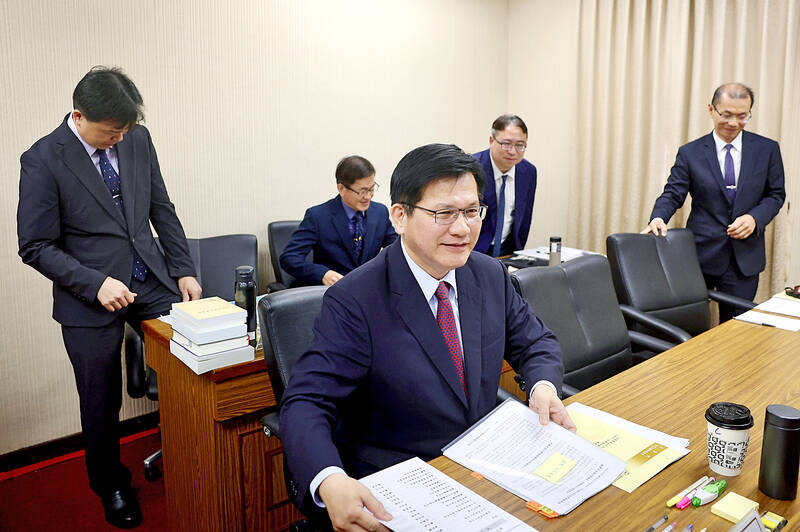
Photo: CNA
China’s state-run Xinhua news agency on Tuesday reported that the Chongqing Municipal Public Security Bureau is investigating Shen over allegations of “secessiion-related” criminal activities, including launching the civil defense organization the Kuma Academy.
The investigation is being carried out under the terms of the Criminal Law of the People’s Republic of China (PRC) and a set of judicial guidelines from last year on how to penalize “Taiwanese independence separatists,” the report said.
Yesterday, MOFA, NSB and MAC officials told legislators that such actions by China were meant to “create the illusion of long-arm jurisdiction over Taiwan.”
Beijing’s aim is to “sow divisions and instill fear” among Taiwanese and to further isolate Taiwan on the international stage, the officials said.
Noting that China has extradition treaties with more than 60 countries, Minister of Foreign Affairs Lin Chia-lung (林佳龍) said it is not unlikely that Beijing would exert pressure on those countries to deport Taiwanese deemed as criminal suspects to China.
In addition to “trials in absentia,” the PRC could request that Interpol issue a “red notice” for the arrest of Taiwanese listed as wanted by China, with a view to extradition, Lin said.
In view of those presumptive threats, the ministry has asked its overseas missions to bolster communication with the governments, judicial divisions and law enforcement authorities of host countries, he said.
The ministry is also expanding its emergency assistance to Taiwanese travelers, and enhancing intelligence sharing with friendly countries, Lin added.
MAC Deputy Minister Shen Yu-chung (沈有忠) said his agency has issued a travel warning for China, urging Taiwanese to be on high alert over their personal safety.
Since January last year, 233 Taiwanese have gone missing, been detained or interrogated or had their personal liberties restricted in China, he said.
Puma Shen, who was banned in October last year from entering China, Hong Kong or Macau, and listed as a “stubbornly pro-Taiwan independence” person, said he was being investigated purely for political reasons.
Ordinary Taiwanese could face similar charges in the future, Puma Shen said at the meeting, adding that extradition treaties in most countries are usually implemented for the return of suspects or convicts in major criminal cases.
In response, Shen Yu-chung told the DPP lawmaker that his agency was considering tightening entry permit requirements for Chinese officials in charge of Taiwan affairs, following Beijing’s actions targeting a Taiwanese politician.
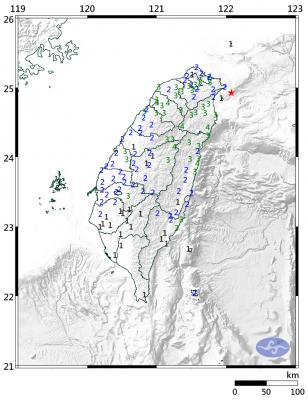
A magnitude 6.1 earthquake struck off the coast of Yilan County at 8:39pm tonight, the Central Weather Administration (CWA) said, with no immediate reports of damage or injuries. The epicenter was 38.7km east-northeast of Yilan County Hall at a focal depth of 98.3km, the CWA’s Seismological Center said. The quake’s maximum intensity, which gauges the actual physical effect of a seismic event, was a level 4 on Taiwan’s 7-tier intensity scale, the center said. That intensity level was recorded in Yilan County’s Nanao Township (南澳), Hsinchu County’s Guansi Township (關西), Nantou County’s Hehuanshan (合歡山) and Hualien County’s Yanliao (鹽寮). An intensity of 3 was
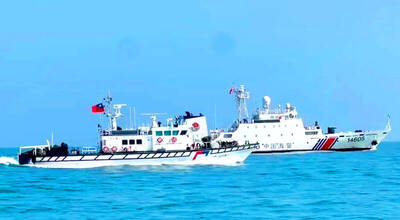
Instead of focusing solely on the threat of a full-scale military invasion, the US and its allies must prepare for a potential Chinese “quarantine” of Taiwan enforced through customs inspections, Stanford University Hoover fellow Eyck Freymann said in a Foreign Affairs article published on Wednesday. China could use various “gray zone” tactics in “reconfiguring the regional and ultimately the global economic order without a war,” said Freymann, who is also a nonresident research fellow at the US Naval War College. China might seize control of Taiwan’s links to the outside world by requiring all flights and ships entering or leaving Taiwan
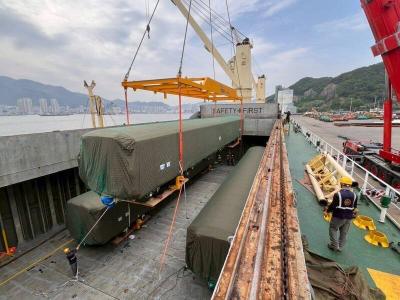
The first of 10 new high-capacity trains purchased from South Korea’s Hyundai Rotem arrived at the Port of Taipei yesterday to meet the demands of an expanding metro network, Taipei Rapid Transit Corp (TRTC) said yesterday. The train completed a three-day, 1,200km voyage from the Port of Masan in South Korea, the company said. Costing NT$590 million (US$18.79 million) each, the new six-carriage trains feature a redesigned interior based on "human-centric" transportation concepts, TRTC said. The design utilizes continuous longitudinal seating to widen the aisles and optimize passenger flow, while also upgrading passenger information displays and driving control systems for a more comfortable
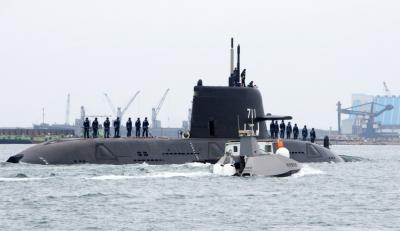
Taiwan's first indigenous defense submarine, the SS-711 Hai Kun (海鯤, or Narwhal), departed for its 13th sea trial at 7am today, marking its seventh submerged test, with delivery to the navy scheduled for July. The outing also marked its first sea deployment since President William Lai (賴清德) boarded the submarine for an inspection on March 19, drawing a crowd of military enthusiasts who gathered to show support. The submarine this morning departed port accompanied by CSBC Corp’s Endeavor Manta (奮進魔鬼魚號) uncrewed surface vessel and a navy M109 assault boat. Amid public interest in key milestones such as torpedo-launching operations and overnight submerged trials,


 RSS
RSS