


The legislature’s Economics Committee today passed a preliminary review of proposed amendments to seven laws to protect critical underwater infrastructure that would apply the same penalties for damaging water and natural gas pipelines to damaging submarine cables.
Under the draft amendments, individuals convicted of intentional damage to submarine water pipelines, natural gas pipelines or undersea power cables face up to seven years in prison.
The legislation would also allow the confiscation of vessels used in the commission of the crime.
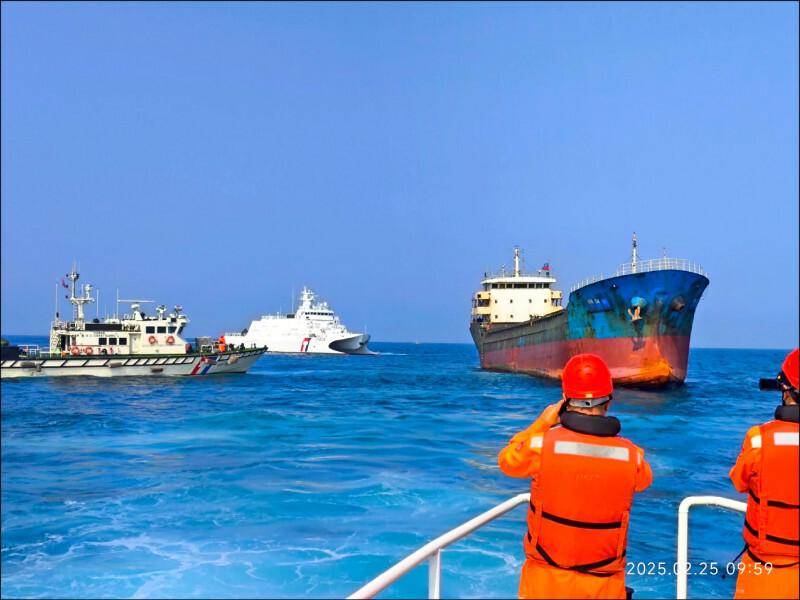
Photo courtesy of the Coast Guard Administration
The Executive Yuan last month advanced amendments to seven laws, including the Telecommunications Management Act (電信管理法), the Electricity Act (電業法), the Natural Gas Enterprise Act (天然氣事業法), the Tap Water Act (自來水法) and the Meteorological Act (氣象法), the Commercial Port Act (商港法) and the Shipping Act (船舶法).
The proposed amendments came after a spate of undersea cable disruptions around Taiwan.
In April, prosecutors for the first time charged a Chinese ship captain with intentionally damaging undersea cables off Taiwan in February.
The Legislative Yuan’s Research Bureau in March published a report urging the government to stipulate a specific law to manage the installation and protection of undersea cables, which should also be in sync with international laws.
The Economics Committee today discussed amendment bills concerning Article 71-1 of the Electricity Act, Article 55-1 of the Natural Gas Enterprise Act and Article 97-1 of the Tap Water Act.
The committee passed a preliminary review of articles stipulating that individuals who threaten the normal functioning of natural gas unloading and storage equipment, undersea water supply pipelines or undersea power cables through theft, destruction or other illegal means face a prison sentence of one to seven years and a maximum fine of NT$10 million (US$332,149), while negligence is punishable by up to six months in prison, detention or a fine of up to NT$2 million.
A resolution was also passed to request the Ministry of the Interior to publicly release maps of the undersea cables and pipelines and to cooperate with relevant agencies.
This is to step up public awareness before the amendments are passed and to prevent offenders from claiming ignorance, thereby aiding law enforcement, the committee said.
Additional reporting by Reuters, Chen Chih-yu and Shelley Shan
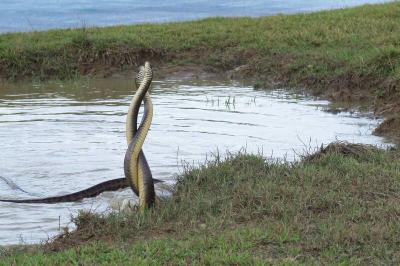
Kenting National Park service technician Yang Jien-fon (楊政峰) won a silver award in World Grand Prix Photography Awards Spring Season for his photograph of two male rat snakes intertwined in combat. Yang’s colleagues at Kenting National Park said he is a master of nature photography who has been held back by his job in civil service. The awards accept entries in all four seasons across six categories: architectural and urban photography, black-and-white and fine art photography, commercial and fashion photography, documentary and people photography, nature and experimental photography, and mobile photography. Awards are ranked according to scores and divided into platinum, gold and

More than half of the bamboo vipers captured in Tainan in the past few years were found in the city’s Sinhua District (新化), while other districts had smaller catches or none at all. Every year, Tainan captures about 6,000 snakes which have made their way into people’s homes. Of the six major venomous snakes in Taiwan, the cobra, the many-banded krait, the brown-spotted pit viper and the bamboo viper are the most frequently captured. The high concentration of bamboo vipers captured in Sinhua District is puzzling. Tainan Agriculture Bureau Forestry and Nature Conservation Division head Chu Chien-ming (朱健明) earlier this week said that the
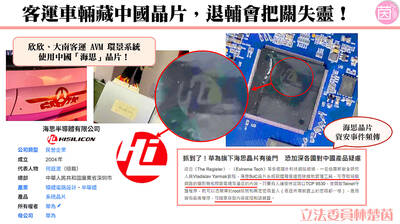
BREACH OF CONTRACT: The bus operators would seek compensation and have demanded that the manufacturer replace the chips with ones that meet regulations Two bus operators found to be using buses with China-made chips are to demand that the original manufacturers replace the systems and provide compensation for breach of contract, the Veterans Affairs Council said yesterday. Democratic Progressive Party Legislator Michelle Lin (林楚茵) yesterday said that Da Nan Bus Co and Shin-Shin Bus Co Ltd have fielded a total of 82 buses that are using Chinese chips. The bus models were made by Tron-E, while the systems provider was CYE Electronics, Lin said. Lin alleged that the buses were using chips manufactured by Huawei subsidiary HiSilicon Co, which presents a national security risk if the

The National Immigration Agency has banned two Chinese from returning to Taiwan, after they published social media content it described as disrespectful to national sovereignty. The agency imposed a two-month ban on a Chinese man surnamed Liang (梁) and a permanent ban on a woman surnamed Yang (楊), an influencer with 23 million followers, in October last year and last week respectively. Minister of the Interior Liu Shyh-fang (劉世芳) yesterday said on the sidelines of a legislative meeting that Chinese visitors to Taiwan are required to comply with the rules and regulations governing their entry permits. The government has handled the ban and


 RSS
RSS