


Taiwan cannot trust China to maintain peace in the Taiwan Strait, Democratic Progressive Party (DPP) Legislator Chung Chia-pin (鍾佳濱) said yesterday in response to incoming Chinese Nationalist Party (KMT) chairwoman Cheng Li-wun’s (鄭麗文) opposition to increasing the military budget.
Cheng, who is on Saturday to start her four-year term as leader of the KMT, said that Taiwan cannot afford President William Lai’s (賴清德) proposal to raise military spending to 3.32 percent of GDP.
However, Chung said the increased spending is needed, as US President Donald Trump has pressured countries aligned with the US to take greater responsibility for their own defense.
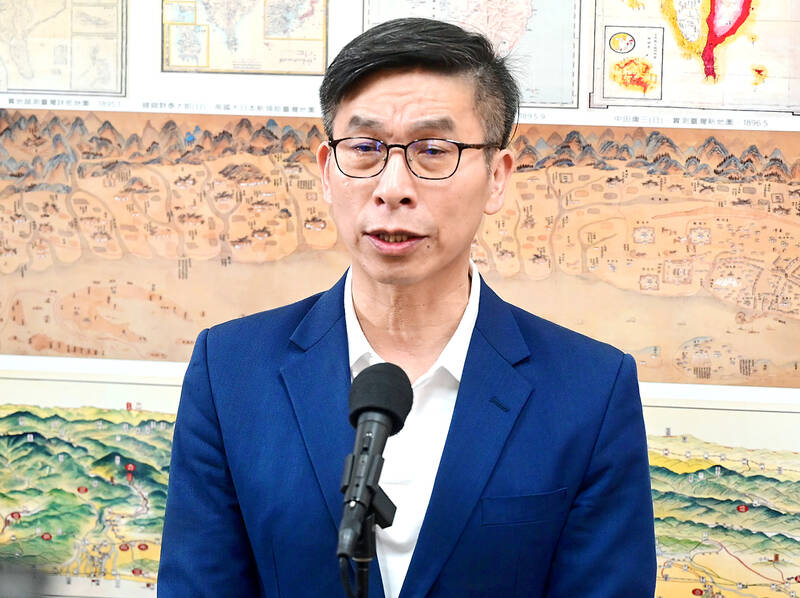
Photo: Wang Yi-song, Taipei Times
If the KMT hopes to return to power after years in the opposition, it needs to understand the importance of maintaining good relations with democratic allies, he said.
“It is especially important for Taiwan’s leader to maintain friendly ties with the US,” he said.
Taiwan cannot place all of its faith in preserving peace in the goodwill of China, Chung added.
Domestic and international media have suggested that Cheng’s opposition to raising the military budget could upset Washington and Trump.
It is the responsibility of all Taiwanese to safeguard peace and national security, DPP Legislator Wang Ting-yu (王定宇) said.
“It is important that all of us face up to the military threat from communist China,” Wang said.
Cheng’s opposition to increasing military spending would anger Trump, but those who should really be upset are Taiwanese, he said.
China has raised its military expenditure every year to 1.78 trillion yuan (US$249.95 billion) this year, Wang said.
“We see Beijing bolstering its budget to upgrade weapons and the training of its armed forces. We are facing this increasing military threat, and we must also spend more on defense to safeguard our homeland,” he said.
Beijing opposes Taiwanese sovereignty and any voice advocating for Taiwanese independence, he said.
“They do not want Taiwan’s 23 million people to have any form of national sovereignty, whether we call ourselves ‘Taiwan’ or the ‘Republic of China,’” he added. “It does not matter what term we use. China only wants Taiwanese to accept its ‘one country, two systems’ framework, under which Beijing rules Taiwan.”
Taiwan can only hope to deter a military conflict by preparing for war, and only when Taiwan possesses sufficient military strength can it negotiate peace, Wang said.
If Taiwan weakens its military and undermines national security, it would be at the mercy of an enemy state, which would force Taiwanese to pay a terrible price, he added.
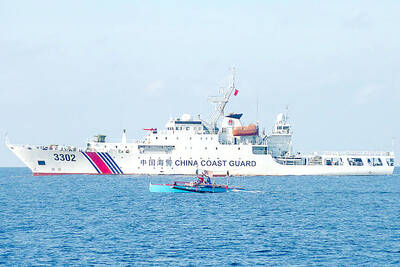
EXPANSIONIST: China deploys an average of 40 to 50 warships and coast guard vessels daily in the South China Sea, despite pledges not to militarize the region, an official said China is attempting to expand its influence across the First Island Chain and increase pressure on Japan by sending coast guard vessels into waters off of Taiwan under the pretext of maritime negotiations with Japan and the Philippines, a national security official said yesterday. China’s recent actions in the waters east of Taiwan and Japan and the Philippines’ exclusive economic zones (EEZ) are attempts to establish dominance in First Island Chain waters, said the official who declined to be named, adding that this is “expansion disguised as law enforcement.” Framing China’s actions solely as a cross-strait issue is a serious misjudgment that
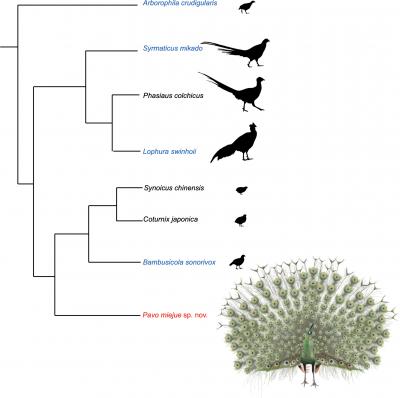
Through analyzing fossil evidence, a research team at National Taiwan University (NTU) discovered the largest endemic bird to have lived in Taiwan, naming it Pavo miejue, or extinct peafowl (滅絕孔雀). The Mikado pheasant, which is printed on the back of the NT$1,000 bank note, was previously believed to be the biggest endemic bird to Taiwan. The research team’s findings suggest that Pavo miejue lived during the Pleistocene epoch tens of thousands of years ago. It is the first endemic extinct bird species discovered and formally named in Taiwan. The study was coauthored by NTU Institute of Ecology and Evolutionary Biology professor Tsai Cheng-hsiu (蔡政修),
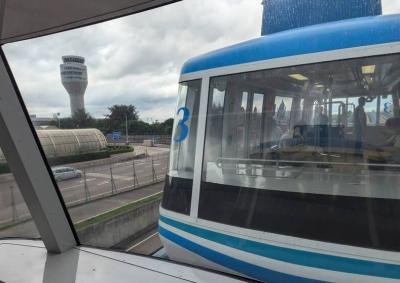
Taiwan Taoyuan International Airport is to suspend its automated Skytrain service connecting Terminal 1 and Terminal 2 starting on July 1 to facilitate connection works for the upcoming Terminal 3, the airport operator said today. Passengers and staff who need to travel between the two terminals after the suspension can instead use the Taoyuan MRT or the airport's 24-hour shuttle bus service, Taoyuan International Airport Corp said. The Taoyuan MRT Airport Line directly links the two terminals, while the shuttle buses are to operate around the clock, the company added. The Skytrain provides free transportation between the airport’s two terminals for travelers and
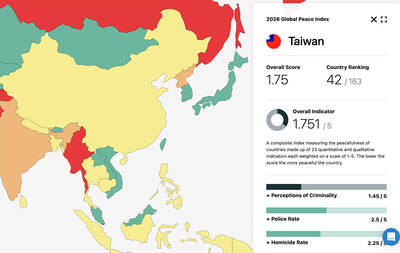
Taiwan ranked 42nd in terms of peacefulness among 163 countries, down five places from last year, according to this year’s Global Peace Index. With an overall score of 1.751, Taiwan dropped from 37th last year, the report published by the global Institute for Economics and Peace showed. The overall score measures a country’s level of peacefulness using 23 quantitative and qualitative indicators across three domains — ongoing domestic and international conflict, societal safety and security, and militarization. While Taiwan ranked 42nd worldwide, it was listed in ninth place among the 19 Asian-Pacific countries in the report, after New Zealand, Singapore, Japan, Malaysia,


 RSS
RSS