


The High Court yesterday upheld a lower court ruling that former president Chen Shui-bian (陳水扁) cannot be prosecuted for money laundering in a case linked to the appointment of former Taipei 101 chairperson Diana Chen (陳敏薰), citing the expiration of the statute of limitations.
The court found that the statute of limitations expired on Dec. 25, 2022, and dismissed prosecutors’ appeal against the Taipei District Court’s decision to exempt Chen from prosecution without holding oral arguments.
The ruling can be appealed.
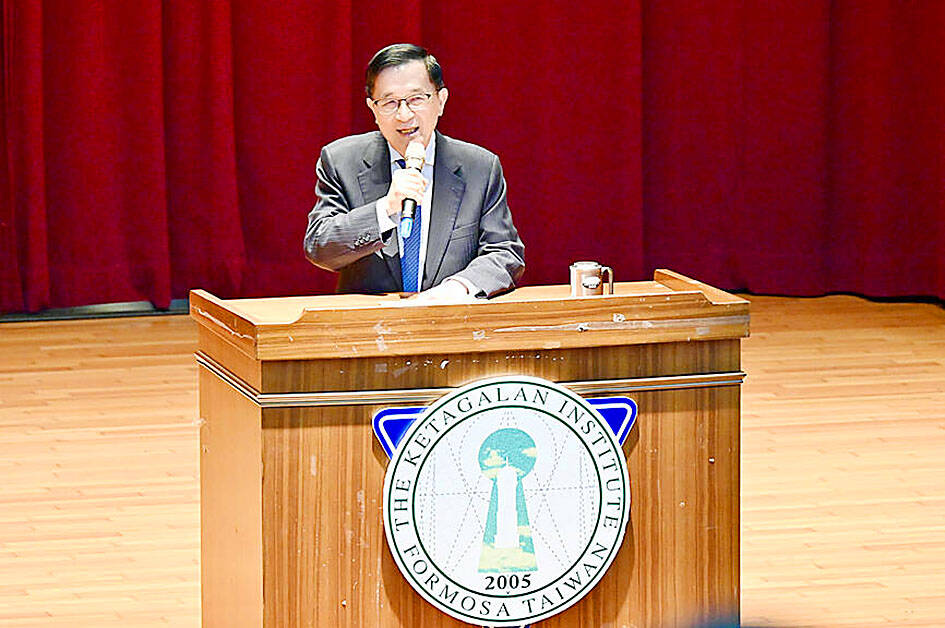
Photo: George Tsorng, Taipei Times
The case stemmed from a bribery case in which Chen and his wife, Wu Shu-jen (吳淑珍), were convicted of accepting NT$10 million (US$324,726) from Diana Chen in exchange for helping her secure the Taipei 101 chairmanship.
Both were sentenced to eight years in prison, with the verdict finalized years ago.
During the bribery proceedings, the High Court found that Chen Shui-bian had also been an accomplice to money laundering, prompting Taipei prosecutors to reopen the case and file new charges.
The Taipei District Court suspended the trial in 2015 after doctors concluded that the former president, who suffers from multiple health issues, was unfit to appear in court.
The court said that under the former Money Laundering Control Act (洗錢防制法), the offense carried a maximum prison sentence of five years and a 10-year statute of limitations, which was extended by one-quarter (2.5 years) due to the suspension of proceedings.
The trial panel calculated that the alleged offense ended on Jan. 25, 2006.
Including the 10-year statutory period, the two-and-a-half-year suspension, four years and seven days of prosecutorial proceedings, and three months and 18 days of court hearings before the suspension, the total prosecution period came to 16 years and nine months.
As the time limit has long expired, the court ruled that Chen Shui-bian cannot be prosecuted.
Prosecutors appealed, arguing that the district court had erred by ruling without giving both parties an opportunity to be heard.
The High Court agreed and remanded the case for retrial.
In the retrial in May last year, the Taipei District Court again concluded that the prosecution period had already lasted 16 years and 10 months, far exceeding the legal limit, and ruled in favor of non-prosecution.
Prosecutors appealed again, arguing procedural errors and that the time limit had been miscalculated, but the High Court yesterday rejected the claims, confirming that the statute of limitations had expired and maintaining the ruling ending the prosecution.
Citing medical reports from Kaohsiung Chang Gung Memorial Hospital, the High Court added that Chen’s health condition remains unchanged, making it impossible to resume proceedings.
Chen, who served as president from 2000 to 2008, was sentenced to 20 years in prison for multiple corruption cases and released on medical parole in 2015.

FUKUOKA SITUATION: Japanese media reported that the pathogen is expected to be identified by the summer, while the CDC downplayed the idea that it was hMPV A “mysterious cold-like illness” reported in Japan’s Fukuoka Prefecture does not seem to be a new disease, but Japanese authorities have been asked about the situation, the Centers for Disease Control (CDC) said yesterday. The Fukuoka Prefectural Medical Association on Wednesday told a news conference that a “mystery cold” that has become a hot topic on social media is “highly likely to be caused by some kind of viral infection,” Japan’s KBC News reported. “Many people are experiencing symptoms starting with a sore throat, followed by a runny nose, phlegm and a severe cough,” KBC News reported, citing association officials. Health authorities are

Nvidia Corp CEO Jensen Huang (黃仁勳) arrived in Taiwan yesterday ahead of upcoming AI and technology events, saying he plans to meet with clients and Taiwan Semiconductor Manufacturing Co Chairman C.C. Wei (魏哲家) during his visit. After landing at Taipei Songshan Airport, Huang posed for photos with fans and handed out Yakult drinks to reporters and supporters waiting at the scene, saying he has “a lot to do” during the trip. Asked about reports that Nvidia’s planned headquarters site in Taipei’s Beitou Shilin Technology Park could break ground on May 27, Huang said that if the company holds an event, he would

Carrefour Taiwan is to begin using a new name from the start of July, but it cannot divulge the name until then, the chairman of the supermarket chain's parent company said today. President Chain Store Co chairman Lo Chih-hsien (羅智先) was asked by reporters after a shareholders' meeting to confirm whether the company has settled on a new name for the supermarket brand. In March, the government-registered name of two Carrefour Taiwan branches was quietly changed to "Le Chia Kang" (樂家康) in Chinese, raising speculation that has been selected as the name. Lo said that because of local regulations and contractual obligations, the

The Philippines would likely be involved in any conflict over Taiwan due to its proximity to the democracy claimed by China, President Ferdinand Marcos Jr said, reiterating a stance that risks angering Beijing. “In the Philippines, we do not have a choice because Taiwan is so close to the Philippines and we have almost 200,000 Filipino nationals living and working in Taiwan,” Marcos said in an interview with Japanese media in Manila on Monday. The Philippine leader’s comments come ahead of a state visit to Japan next week, where he is to meet with Japanese Prime Minister Sanae Takaichi to discuss security


 RSS
RSS