


One likely reason for an African swine fever (ASF) outbreak at a hog farm in Taichung is Taiwan People’s Party (TPP) Chairman Huang Kuo-chang (黃國昌) slashing the budget for border inspections of food items, green camp politicians said.
Taiwan was able to keep out ASF for many years thanks to strict border inspections of food items from abroad, but Chinese Nationalist Party (KMT) and TPP lawmakers pushed an amendment to freeze NT$40 million (US$1.3 million) in border inspection funding, Democratic Progressive Party (DPP) New Taipei City Councilor Cho Kuan-ting (卓冠廷) said yesterday.
It was Huang who introduced the proposal to freeze the Food and Drug Administration’s unit for border inspections of food, Cho wrote on social media, attaching a copy of the original amendment with Huang’s signature.

Photo: Lin Che-yuan, Taipei Times
“That amendment was forced through the legislature through the collaboration between KMT and TPP lawmakers, and eventually they cut the budget by NT$20 million,” he added.
From Jan. 1, 2018, to Wednesday, border inspection units found and seized 13,583 pork items totaling 22.372 tonnes, Cho said, citing Customs Administration data, adding that more than 60 percent of the items came from China, Hong Kong and Macau.
Of the 9,511 products tested for ASF, 997 came back positive, which is more than 10 percent, he said, adding that 849 of the items that had ASF, or 85 percent of the total, were from China.
“Border inspection units have been working very hard for many years to safeguard Taiwan from ASF and other pork diseases, but their budget got slashed by lawmakers,” Cho said.
“The local country government in charge has also been slow to respond to the crisis,” he added.
“Are Taiwanese not angry?” he said.
DPP Legislator Michelle Lin (林楚茵) accused the opposition parties of working together to dismantle Taiwan’s border control.
“Pork is a very important part of preparing dishes for daily meals. An ASF outbreak would lead to a pork shortage and hike the prices of all meat products,” she said.
“The KMT and the TPP are collaborating to wreck our border inspections, which were safeguarding the nation against smuggling and contaminated pork products,” she added.
TPP officials rejected accusations that Huang’s amendment was to blame.
“The green camp is pointing to the NT$20 million budget cut as the main reason for the ASF breach,” they said. “It is a serious situation and our nation should unite to combat it together, but the green camp is instead attacking the TPP.”
“When bad things happen, the DPP resorts to crying about funding shortages due to budget cuts,” the officials said.
“The budget for border inspections has actually increased, but the ASF outbreak still occurred,” the TPP said, adding that it showed the central government was not doing a good job.
Meanwhile, the KMT caucus said the DPP was “trying to manipulate public opinion” through the ASF outbreak.
“Our government’s agriculture officials have been fighting against ASF since 2018 and the budget for such work has not been reduced,” KMT caucus deputy secretary-general Lin Pei-hsiang (林沛祥) said. “The DPP is brainwashing the public, the same way it is washing away Taiwan’s industrial sectors.”
“We need to enhance border control and have stricter inspections. We urge the DPP not to play politics on this matter and shoulder responsibility as the ruling party, and not shift the blame to others,” Lin added.

The Ministry of Finance this afternoon announced the winning numbers for the March-April uniform invoice lottery. The winning number for the NT$10 million (US$318,060) special prize is 19531471, and the winning number for the NT$2 million grand prize is 85941329. Three numbers were drawn for the NT$200,000 first prize: 07225810, 20231230 and 83518781. Those with receipts matching the last seven digits of any of the first-prize numbers will win the NT$40,000 second prize, while those matching the last six digits will win the NT$10,000 third prize. Those whose receipts match the last five digits of the first-prize numbers can claim the NT$4,000 fourth prize,

SIX SUBSIDIES: The monthly allowance for older farmers is to increase to NT$10,000, and NT$5,000 is to be given to homemakers under the national pension system, Lai said The government is to implement major welfare policies for disadvantaged groups, including raising the monthly allowance for older farmers to NT$10,000 and providing homemakers with NT$5,000 per month, President William Lai (賴清德) said yesterday. Lai made the remarks during a visit to Wangling Temple in Chiayi County, saying that the planned increases were being introduced amid economic growth and an increase in tax revenue. Touting a policy, in which the government plans to provide a monthly allowance of NT$5,000 for every child under the age of 18 in a bid to address Taiwan’s low birthrate, Lai said that if received for the
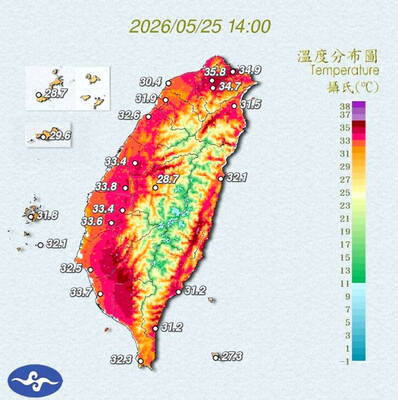
STAY COOL: The HPA recommended that people stay hydrated, use air-conditioning or fans while indoors, wear loose-fitting clothes and walk in the shade while outdoors Employers must implement measures such as installing cooling equipment, and providing drinking water and rest breaks for outdoor workers starting from Monday next week, the Taipei Department of Labor said on Sunday. Employers who fail to comply could face fines of NT$30,000 to NT$300,000 under the Occupational Safety and Health Act (職業安全衛生法), the department said. Businesses in Taipei employing fewer than 100 workers, as well as registered self-employed workers with labor insurance coverage, could receive on-site assessments and guidance from occupational safety consultants to help them apply for central government subsidies to implement or improve heat-protection measures, it said. Under the Ministry of

NATIONAL SECURITY: Authorities are working to confirm the identities of the military personnel involved and investigating possible illegal conduct and regulatory violations Authorities are probing possible national security implications after Kinmen police and immigration officers on Sunday found a Chinese woman allegedly posing as a tourist while engaging in prostitution involving more than 10 military personnel. The woman, surnamed Chen (陳), has since been deported, authorities said, adding that investigators are still working to confirm the identities of those implicated, as the records only listed code names and aliases. The case stemmed from a report received by the Kinmen District Prosecutors’ Office on Friday last week from the Jinhu Precinct of the Kinmen County Police Bureau. On Sunday, police, along with the National Immigration


 RSS
RSS