


Marian Duhapa kisses her quietly sleeping baby daughter Quinn goodbye as she prepares for the 16-hour bus trip from her remote village in the Philippines to Manila airport before flying to Taiwan for work.
“I pray for myself, the baby and my family. I pray I can find a job so I can help my daughter and my family. This is my only choice now,” Duhapa said.
For hundreds of thousands of migrant workers like 32-year-old Duhapa, moving overseas to work is a painful decision.

Photo: Ann Wang, Reuters
While a job abroad will give them enough money to support their families, they will also have to leave their children, often for years at a time, but if they stay at home, they might struggle to get by.
“Life in the Philippines is so difficult. Every move you make requires money. It’s poverty. Even if you earn, it’s still not enough,” said Duhapa, who is the main breadwinner for her extended family of 11.
Taipei, only a two-hour flight from Manila, is home to more than 150,000 Philippine migrant workers.
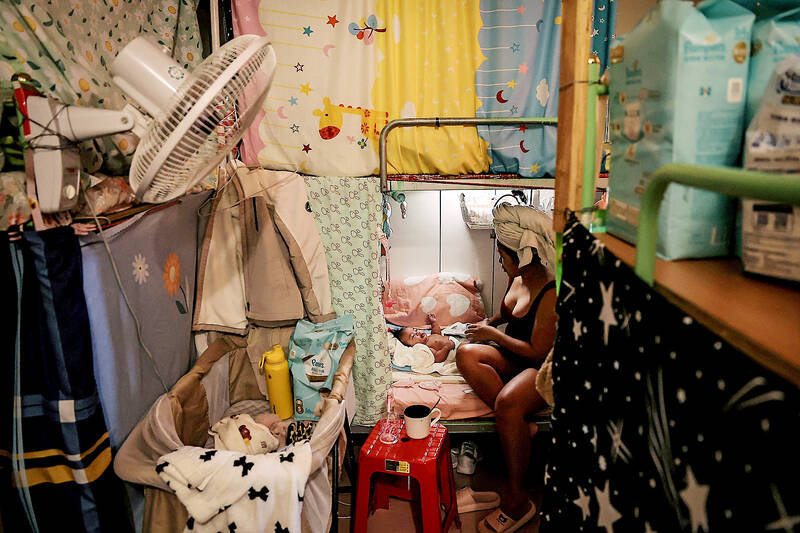
Photo: Ann Wang, Reuters
They mostly work in factories and as domestic helpers, caring for children and elderly people, taking on jobs many Taiwanese do not want to do in a nation with a declining birthrate.
About 2 million Filipinos, more than half of them women, work overseas, Philippine government data showed.
For some, Taiwan is a better choice than the Middle East, where rights groups say that many are mistreated.
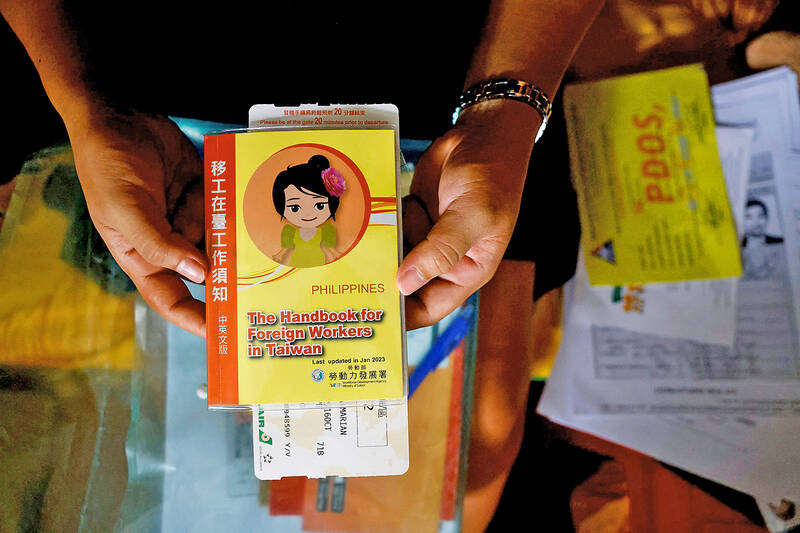
Photo: Ann Wang, Reuters
However, campaigners say that Taiwan must also improve protections for migrant workers and grant them rights such as being able to bring family members with them.
Duhapa lost her job when she became pregnant and lived in a shelter in Taiwan until she gave birth.
“They treat migrant workers as second-class people, who aren’t entitled to basic human rights. This is utterly inhumane,” said Lennon Wang (汪英達), migrant worker policy director at the Taoyuan-based migrant worker group Serve the People Association.
“Taiwan fundamentally fails to recognize migrant workers as being fully human beings,” Wang said.
Workforce Development Agency official Su Yu-kuo (蘇裕國) said earlier this year that Taipei issued guidelines to protect the rights of female migrant workers and their children, underscoring government concern about the issue.
“Under the current legal framework, we ensure equal treatment — what we call national treatment,” Su said.
“Some workers may choose, after discussion with their families, to return home to give birth or raise their children,” he said. “This is understandable, because the environment for childbirth and parenting in Taiwan differs from that of their home countries, especially due to language and cultural differences. Ultimately, such decisions are deeply personal and made together with family.”
Most of the Filipinos who work overseas head to the Middle East.
Duhapa’s eldest sister, Loriza, worked as a domestic helper in Dubai, United Arab Emirates, for seven years, but said conditions were hard with little time for rest, and she ultimately decided to return to her home in the Philippines.
“What I missed most in Dubai was my family — and the ability to rest. It was so hard. Every day, I worked with no break. I cooked, cleaned and repeated it daily. Now, I can rest. I have peace of mind,” she said.
The family home in Irosin, on the far southeastern tip of Luzon, is surrounded by rice fields and volcanoes, and is prone to typhoons.
Unlike many other houses in the village, it is built of concrete rather than straw, and there are plans to add a kitchen and bathroom thanks to the money Marian sends home.
She earns about US$900 a month, triple what she could get in the Philippines. The sisters’ parents are subsistence farmers.
Marian said it is hard being separated from her daughter, but it is crucial for her future, even if it may be several years before she can see her again given the cost of travel.
“I was crying. My mother told me: ‘Your daughter will be okay. She will forgive you.’ But I said no. No, she won’t forgive me. My heart was so heavy. I wanted to go back, but I kept thinking: This is for my baby. This is for my family. I want to help them live a smoother life,” she said.

FUKUOKA SITUATION: Japanese media reported that the pathogen is expected to be identified by the summer, while the CDC downplayed the idea that it was hMPV A “mysterious cold-like illness” reported in Japan’s Fukuoka Prefecture does not seem to be a new disease, but Japanese authorities have been asked about the situation, the Centers for Disease Control (CDC) said yesterday. The Fukuoka Prefectural Medical Association on Wednesday told a news conference that a “mystery cold” that has become a hot topic on social media is “highly likely to be caused by some kind of viral infection,” Japan’s KBC News reported. “Many people are experiencing symptoms starting with a sore throat, followed by a runny nose, phlegm and a severe cough,” KBC News reported, citing association officials. Health authorities are

Nvidia Corp CEO Jensen Huang (黃仁勳) arrived in Taiwan yesterday ahead of upcoming AI and technology events, saying he plans to meet with clients and Taiwan Semiconductor Manufacturing Co Chairman C.C. Wei (魏哲家) during his visit. After landing at Taipei Songshan Airport, Huang posed for photos with fans and handed out Yakult drinks to reporters and supporters waiting at the scene, saying he has “a lot to do” during the trip. Asked about reports that Nvidia’s planned headquarters site in Taipei’s Beitou Shilin Technology Park could break ground on May 27, Huang said that if the company holds an event, he would

The Ministry of Finance this afternoon announced the winning numbers for the March-April uniform invoice lottery. The winning number for the NT$10 million (US$318,060) special prize is 19531471, and the winning number for the NT$2 million grand prize is 85941329. Three numbers were drawn for the NT$200,000 first prize: 07225810, 20231230 and 83518781. Those with receipts matching the last seven digits of any of the first-prize numbers will win the NT$40,000 second prize, while those matching the last six digits will win the NT$10,000 third prize. Those whose receipts match the last five digits of the first-prize numbers can claim the NT$4,000 fourth prize,

SIX SUBSIDIES: The monthly allowance for older farmers is to increase to NT$10,000, and NT$5,000 is to be given to homemakers under the national pension system, Lai said The government is to implement major welfare policies for disadvantaged groups, including raising the monthly allowance for older farmers to NT$10,000 and providing homemakers with NT$5,000 per month, President William Lai (賴清德) said yesterday. Lai made the remarks during a visit to Wangling Temple in Chiayi County, saying that the planned increases were being introduced amid economic growth and an increase in tax revenue. Touting a policy, in which the government plans to provide a monthly allowance of NT$5,000 for every child under the age of 18 in a bid to address Taiwan’s low birthrate, Lai said that if received for the


 RSS
RSS