


Democracies should unite to establish global democratic supply chains, with Taiwan as a trustworthy and key partner for Europe and the world, the Ministry of Foreign Affairs (MOFA) said yesterday, responding to a European think tank’s report suggesting that EU members help bolster Taiwan’s resilience in the face of China’s hybrid tactics.
The International Crisis Group, a Brussels-based independent think tank, biannually releases an EU Watch List, which identifies where the EU and its members can enhance prospects for peace and stability.
In its Autumn Update published on Thursday last week, the report included a section titled “Taiwan Strait: Managing Europe’s Risk in a Global Hotspot,” which said that China is exerting greater pressure on Taiwan, and that cross-strait tensions have increased.
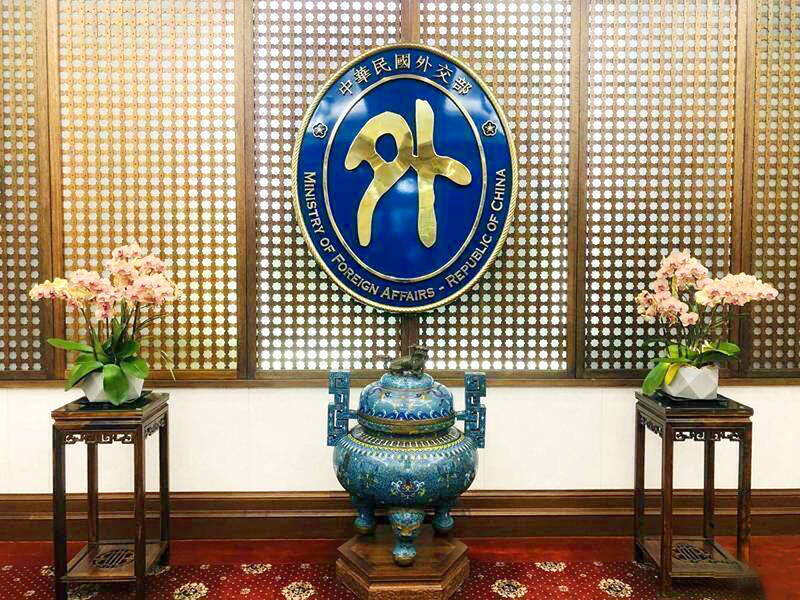
Photo: Taipei Times
To mitigate “the escalatory potential of a cross-strait conflict and the devastating impact such a clash would likely have on global trade,” the group urged EU members to take five actions.
These included “working to align its contingency planning for a Taiwan crisis with that of regional governments and deepening cooperations with them” and “help bolster Taiwan’s resilience in the face of China’s hybrid tactics in the Taiwan Strait by adapting lessons learned from Russian operations on Europe’s eastern flank — and, conversely, learning from Taipei’s experience with China to bolster European capabilities.”
The report also recommended deploying naval assets to the Indo-Pacific and urged EU members to “consider conducting freedom of navigation operations through the Taiwan Strait more regularly.”
At the ministry yesterday, MOFA spokesman Hsiao Kuang-wei (蕭光偉) was asked whether Taiwan would be willing to cooperate with EU members on the actions suggested in the report.
Hsiao said it is natural and necessary for democratic countries to support and help each other.
“Facing authoritarian regimes constantly damaging and challenging the rules-based international order, the government’s long-term attitude has been that democratic countries should come together in solidarity and jointly respond to it,” he said.
Hsiao added that in a speech delivered by Minister of Foreign Affairs Lin Chia-lung (林佳龍) at the Warsaw Security Forum last month, Lin had called on European countries to build closer partnerships with Taiwan.
At a time of changing geopolitics, democratic countries should cooperate to establish global democratic supply chains, Hsiao cited Lin as saying.
Taiwan is a trustworthy and key partner for Europe and the world, Lin said.
“The ministry is glad to see organizations, think tanks and people of different fields in Europe show concern for the security issues in the Taiwan Strait and Indo-Pacific region,” Hsiao said.
The ministry hopes Taiwan and Europe can build on their strong foundation of cooperation to deepen exchanges on information security, cognitive warfare, foreign information manipulation and interference, and democratic governance, he said.

Considering that most countries issue more than five denominations of banknotes, the central bank has decided to redesign all five denominations, the bank said as it prepares for the first major overhaul of the banknotes in more than 24 years. Central bank Governor Yang Chin-lung (楊金龍) is expected to report to the Legislative Yuan today on the bank’s operations and the redesign’s progress. The bank in a report sent to the legislature ahead of today’s meeting said it had commissioned a survey on the public’s preferences. Survey results showed that NT$100 and NT$1,000 banknotes are the most commonly used, while NT$200 and NT$2,000

The Centers for Disease Control (CDC) yesterday reported the first case of a new COVID-19 subvariant — BA.3.2 — in a 10-year-old Singaporean girl who had a fever upon arrival in Taiwan and tested positive for the disease. The girl left Taiwan on March 20 and the case did not have a direct impact on the local community, it said. The WHO added the BA.3.2 strain to its list of Variants Under Monitoring in December last year, but this was the first imported case of the COVID-19 variant in Taiwan, CDC Deputy Director-General Lin Ming-cheng (林明誠) said. The girl arrived in Taiwan on

South Korea is planning to revise its controversial electronic arrival card, a step Taiwanese officials said prompted them to hold off on planned retaliatory measures, a South Korean media report said yesterday. A Yonhap News Agency report said that the South Korean Ministry of Foreign Affairs is planning to remove the “previous departure place” and “next destination” fields from its e-arrival card system. The plan, reached after interagency consultations, is under review and aims to simplify entry procedures and align the electronic form with the paper version, a South Korean ministry official said. The fields — which appeared only on the electronic form

The Ministry of Foreign Affairs (MOFA) is suspending retaliation measures against South Korea that were set to take effect tomorrow, after Seoul said it is updating its e-arrival system, MOFA said today. The measures were to be a new round of retaliation after Taiwan on March 1 changed South Korea's designation on government-issued alien resident certificates held by South Korean nationals to "South Korea” from the "Republic of Korea," the country’s official name. The move came after months of protests to Seoul over its listing of Taiwan as "China (Taiwan)" in dropdown menus on its new online immigration entry system. MOFA last week


 RSS
RSS