


Producing defense equipment in Taiwan would counter the “red” supply chain and secure defense industries in both Taiwan and the US, Deputy Defense Minister of Armaments Chung Shu-ming (鍾樹明) said yesterday at a conference in the US, making the case for deeper cooperation between the two nation’s defense industries.
The 24th US-Taiwan Defense Industry Conference is running from Sunday to today in Ellicott, Maryland.
Chung spoke at the conference yesterday, emphasizing the importance of peace and stability in the Taiwan Strait.
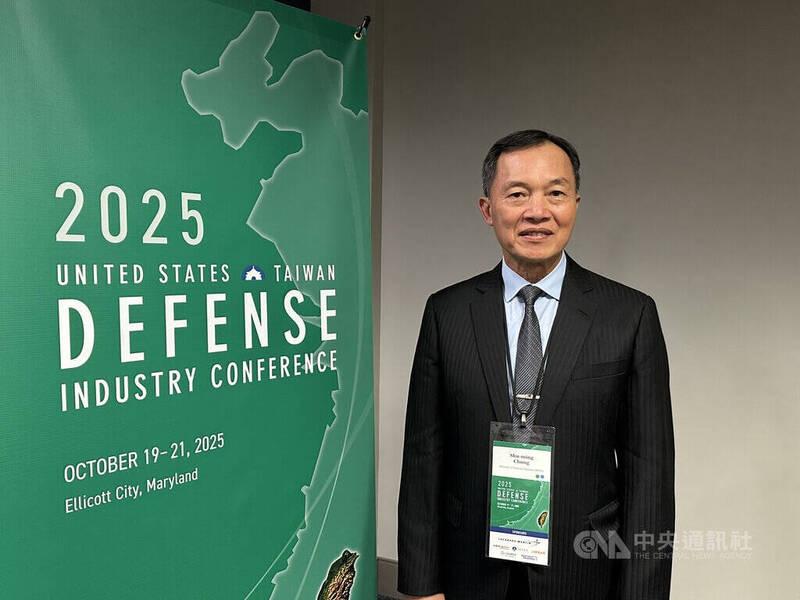
Photo: CNA
Chung called for the US to assist Taiwan in integrating its defense and information systems under its new “T-Dome” initiative, a large-scale project that would establish a comprehensive protection network capable of intercepting Chinese missiles.
Currently, the Ministry of National Defense is studying how to integrate Taiwan’s existing air defense, communications and information management systems, according to Chung.
Taiwan hopes that the US would assist with that effort to enhance overall defense coordination, he told reporters yesterday.
Chung also called for stronger links in the US-Taiwan defense industry supply chain and to strengthen cooperation in the Indo-Pacific region.
Taiwan bears the brunt of China’s growing aggression and military pressure as Beijing seeks to expand its regional influence, Chung said.
Chung compared China to a spear trying to break through the Pacific island chains and expand its maritime power, while the US, Japan, Taiwan, the Philippines and Australia form a shield to defend regional stability.
Taiwan is at the contact point between spear and shield, serving as the key to regional security and heart of the global supply chain, he said.
Taiwan is strengthening its national defense by enhancing its asymmetric warfare, defense resilience, reserve combat capabilities and “gray zone” responses, he said.
Chung said Taiwan would boost civilian production and partner with other countries to build a “non-red” drone supply chain, mobilizing society-wide resources to strengthen defense resilience and self-reliance.
Taiwan has already passed a special resilience budget in response to China’s growing “gray zone” incursions, which raised the national defense budget to over three percent of the GDP, he said.
Chung pointed out the US and Taiwan defense industries could cooperate on software development, system design and local production and maintenance so that Taiwan can become a trusted partner in the global defense industry supply chain.
Producing defense equipment in Taiwan is not only a strategic move but an opportunity to upgrade the industry, as it would block risks of the “red” supply chain and ensure the security and technological autonomy of the US and Taiwan defense industries, Chung said.
The US and Taiwan could cooperate more in trade, defense and technology innovation to build a “non-red” supply chain, he said.
Meanwhile, the US has shown goodwill in addressing the delays in arms deliveries to Taiwan, which “are gradually being resolved,” Chung said.
Taiwan has provided the US with a list of pending items for follow-up, and a dedicated American team is now handling the issue, he said.
Democratic Progressive Party lawmaker Wang Ting-yu (王定宇) also spoke at the meeting, saying that Taiwan’s government plans to present a new seven-year special defense budget of NT$1.3 trillion (US$39 billion) by early next month.
It would focus on four priorities: the T-Dome initiative, asymmetric warfare capabilities, expanded strategic reserves and greater self-sufficiency in domestic arms production, Wang said.
About 200 participants attended the annual bilateral defense industry conference this year, which gathers officials, defense industry representatives and think tank experts from Taiwan and the US.


UPGRADE: The Kang Ding-class frigate is replacing its Chaparall missiles with Tien Chien II and Hua Yang VLS, which would provide it with long-range, 360° air defense Taiwan plans to produce 1,200 to 1,376 Hai Chien II missiles (海劍二, Sea Sword II) — also known as TC-2N — to serve as the standard air defense system of the navy’s surface combatant fleet, a source said yesterday. Last week, the Hai Chien II, the naval version of the Tien Kung II missile (天劍二, Sky Sword II), completed a live-fire test in waters off the National Chungshan Institute of Science and Technology’s Jiupeng facility (九鵬) in Pingtung County’s Manjhou Township (滿州). The MIM72 Chaparral and other dated air defense missiles that currently arm Taiwanese ships have inadequate range to combat Chinese

REASONS FOR TRAVEL: An assistant professor said that proposed amendments to penalize drivers if they used drugs overseas would not deter people from traveling People who operate a motor vehicle under the influence of marijuana would have their driver’s license revoked, even if they used the substance while overseas, the Ministry of Transportation and Communications said yesterday, citing proposed amendments to the Road Traffic Management and Penalty Act (道路交通管理處罰條例). The amendments would also authorize the government to revoke the licenses of people determined to have used Category 1 or Category 2 narcotics, even if they were not operating a vehicle while under the influence of drugs, as well as ban them from taking the license test for three years, the ministry said. People aged 18 or
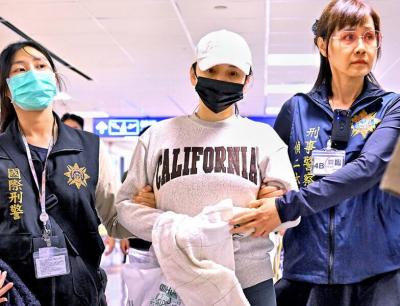
Johanne Liou (劉喬安), a Taiwanese woman who shot to unwanted fame during the Sunflower movement protests in 2014, returned to Taiwan last night after being deported from the US. She is to stand trial in Taiwan for charges involving embezzlement, fraud and drug crimes. The Criminal Investigation Bureau (CIB) said it took her into custody at Taiwan Taoyuan International Airport and would first question her before transferring her to the New Taipei District Prosecutors’ Office. She was arrested upon disembarking a flight from San Francisco that landed shortly before 7pm. Liou absconded to the US in 2019 after jumping bail
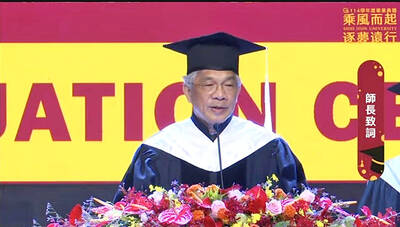
Shih Hsin University President Chen Ching-he (陳清河) yesterday issued a public apology for comments made in his commencement speech last week, stating that he has asked the school to suspend his duties and halt his wages for two months as a show of contrition. At the commencement ceremony on May 30, Chen said, “If you don’t manage your time well, or your own emotions, or your health, then I am telling every one of you — put a quick end to ‘you,’ because the world has no need for ‘you.’” The comments have sparked significant controversy online, and Chen through an open


 RSS
RSS