


Incoming Chinese Nationalist Party (KMT) chairwoman Cheng Li-wun (鄭麗文) would be taking over a party full of old wounds, and her main challenge is to rebuild the KMT and political trust, an academic said on Sunday.
Cheng on Saturday won the party chairperson election with 65,122 votes, or 50.15 percent of the vote.
She is to succeed incumbent Eric Chu (朱立倫) on Saturday next week for a four-year term.
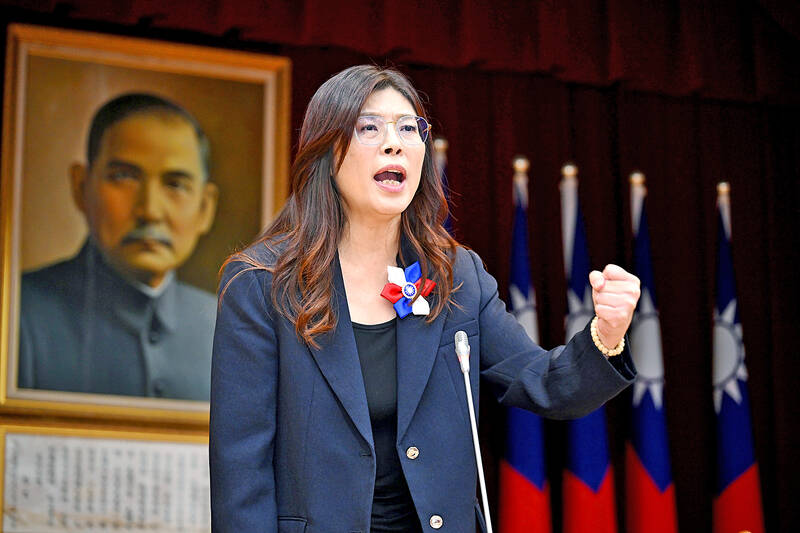
Photo: Chen Yi-kuan, Taipei Times
The KMT not only must contend with division and an aging membership, but a structural problem which emphasizes top-down obedience, hierarchy and a reliance on closed-door negotiations, said Du Sheng-tsung (杜聖聰), chair of Ming Chuan University’s Department of Radio and Television.
The KMT has a political DNA that evolved from a Leninist-style revolutionary party system, making any reformer inside the party feel like they are “breathing in a stone chamber,” he said.
If Cheng wants to advocate for change, she has to confront two enemies: the party’s systemic inertia and the party factions’ need for self-preservation, Du said.
She would be on precarious footing, as the party’s resource allocation and policy priorities are tied up with local factions, he said.
She has to avoid repeating the mistakes of former KMT chairwoman Hung Hsiu-chu (洪秀柱), who attempted to redefine the political narrative of “the Republic of China in Taiwan,” but ultimately became isolated and lost support, Du said.
Without a strong political acumen and broad coordination, Cheng could find her authority confined to her office, he added.
If her team does not reshape the narrative, but merely plays defense, the KMT’s cross-strait role could completely devolve into a historical relic, he said.
The political trust that her team has to rebuild involves addressing deep-blue voters’ loyalty concerns, local factions’ pragmatic calculations, younger voters’ emotional disconnect with politics and the Democratic Progressive Party’s fortified media narrative, he said.
Any one of these forces could derail her leadership, he said.
She faces not only a political test, but a quest for a third path centered on trust and generations, he said.
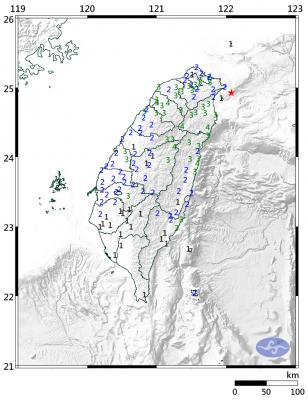
A magnitude 6.1 earthquake struck off the coast of Yilan County at 8:39pm tonight, the Central Weather Administration (CWA) said, with no immediate reports of damage or injuries. The epicenter was 38.7km east-northeast of Yilan County Hall at a focal depth of 98.3km, the CWA’s Seismological Center said. The quake’s maximum intensity, which gauges the actual physical effect of a seismic event, was a level 4 on Taiwan’s 7-tier intensity scale, the center said. That intensity level was recorded in Yilan County’s Nanao Township (南澳), Hsinchu County’s Guansi Township (關西), Nantou County’s Hehuanshan (合歡山) and Hualien County’s Yanliao (鹽寮). An intensity of 3 was
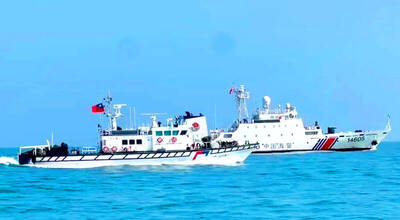
Instead of focusing solely on the threat of a full-scale military invasion, the US and its allies must prepare for a potential Chinese “quarantine” of Taiwan enforced through customs inspections, Stanford University Hoover fellow Eyck Freymann said in a Foreign Affairs article published on Wednesday. China could use various “gray zone” tactics in “reconfiguring the regional and ultimately the global economic order without a war,” said Freymann, who is also a nonresident research fellow at the US Naval War College. China might seize control of Taiwan’s links to the outside world by requiring all flights and ships entering or leaving Taiwan
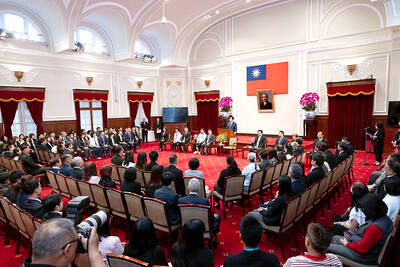
The next minimum wage hike is expected to exceed NT$30,000, President William Lai (賴清德) said yesterday during an award ceremony honoring “model workers,” including migrant workers, at the Presidential Office ahead of Workers’ Day today. Lai said he wished to thank the awardees on behalf of the nation and extend his most sincere respect for their hard work, on which Taiwan’s prosperity has been built. Lai specifically thanked 10 migrant workers selected for the award, saying that although they left their home countries to further their own goals, their efforts have benefited Taiwan as well. The nation’s industrial sector and small businesses lay
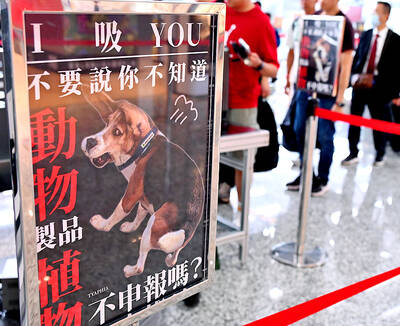
Quarantine awareness posters at Taiwan Taoyuan International Airport have gone viral for their use of wordplay. Issued by the airport branch of the Animal and Plant Health Inspection Agency, the posters feature sniffer dogs making a range of facial expressions, paired with advisory messages built around homophones. “We update the messages for holidays and campaign needs, periodically refreshing materials to attract people’s attention,” quarantine officials said. “The aim is to use the dogs’ appeal to draw focus to quarantine regulations.” A Japanese traveler visiting Taiwan has posted a photo on X of a poster showing a quarantine dog with a


 RSS
RSS