


A Chinese Nationalist Party (KMT) proposal to roll back Democratic Progressive Party-led (DPP) civil servant pension reforms could jeopardize government finances, with younger civil servants and public school teachers bearing the brunt of the impact, the DPP said yesterday.
The KMT legislative caucus introduced amendments to the Act Governing Retirement, Severance and Bereavement Compensation for the Teaching and Other Staff Members of Public Schools (公立學校教職員退休資遣撫卹條例), proposed by KMT lawmakers Weng Hsiao-ling (翁曉玲), Lai Shyh-bao (賴士葆) and others.
The bill, one of the KMT’s legislative priorities this session, seeks to suspend gradual pension reductions for civil servants, teachers and military personnel implemented by former president Tsai Ing-wen’s (蔡英文) administration, Weng said.
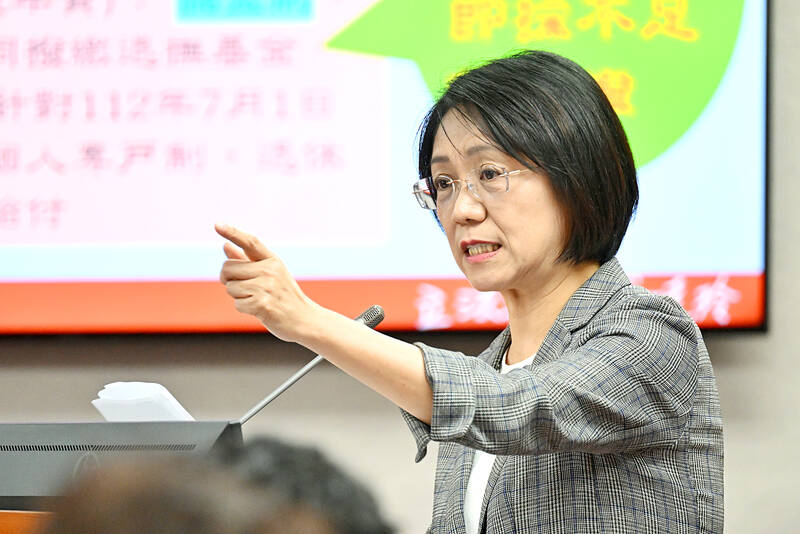
Photo: Chen Yi-kuan, Taipei Times
“The KMT is once again fighting against pension reform. It is attempting to reverse the progress made in restoring fiscal health and ensuring long-term financial stability,” the DPP said in a statement on social media.
Reform was necessary because the old system had allowed civil servants to contribute little, retire early and receive generous benefits, leading the Public Service Pension Fund to the brink of bankruptcy, it said.
The Tsai administration introduced pension reforms in 2017, which included abolishing the preferential 18 percent interest rate on retirees’ bank deposits and lowering the income replacement rate, the statement said.
The reforms stabilized the pension fund, securing its long-term viability and ensuring that younger civil servants would be able to receive their fair share of benefits upon retirement.
The KMT’s proposed amendments aim to halt pension cuts and link pension adjustments to salary increases, the DPP said.
The income replacement rate — the ratio of pension to preretirement salary — was gradually reduced to a maximum of 62.5 percent, meaning the previous 80 percent level was no longer possible, it said.
The measures were designed to promote fairness, so that all civil service pensioners receive their fair share, it said, adding that the reform faced strong resistance at the time.
“Now the KMT wants to turn back the clock. If their proposal passes, it would once again push the country toward a financial crisis,” the DPP added.
“We must not allow such pension injustice, in which retired civil servants receive overly generous benefits, while the financial burden falls on younger generations,” it said.
Ministry of Civil Service officials said that the KMT’s proposal to halt the gradual reduction of the income replacement rate would accelerate the imbalance in the pension system, causing the Public Service Pension Fund to be depleted earlier than projected.
Total contributions to the pension fund from the second half of 2018 to last year amounted to NT$259.1 billion (US$8.45 billion), data compiled by the ministry in a report submitted to the legislature showed.
An additional NT$80 billion was injected as part of military pension reforms linked to the transition toward a smaller, professional armed force, bringing the fund’s total balance to NT$339.1 billion to date, the report said.
However, if the KMT’s amendments pass, they would end the ongoing reductions in the income replacement rate, cutting expected contributions by NT$278.2 billion and causing the fund to run out sooner, the report added.
The reforms had extended the fund’s solvency from a projected 2030 to 2045, but under the KMT’s proposed changes, the fund could be exhausted by 2040, it said.
Additional reporting by CNA
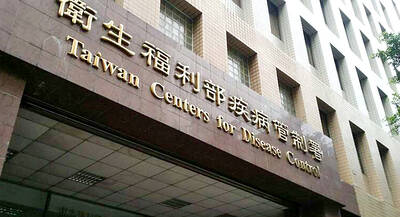
FUKUOKA SITUATION: Japanese media reported that the pathogen is expected to be identified by the summer, while the CDC downplayed the idea that it was hMPV A “mysterious cold-like illness” reported in Japan’s Fukuoka Prefecture does not seem to be a new disease, but Japanese authorities have been asked about the situation, the Centers for Disease Control (CDC) said yesterday. The Fukuoka Prefectural Medical Association on Wednesday told a news conference that a “mystery cold” that has become a hot topic on social media is “highly likely to be caused by some kind of viral infection,” Japan’s KBC News reported. “Many people are experiencing symptoms starting with a sore throat, followed by a runny nose, phlegm and a severe cough,” KBC News reported, citing association officials. Health authorities are

Nvidia Corp CEO Jensen Huang (黃仁勳) arrived in Taiwan yesterday ahead of upcoming AI and technology events, saying he plans to meet with clients and Taiwan Semiconductor Manufacturing Co Chairman C.C. Wei (魏哲家) during his visit. After landing at Taipei Songshan Airport, Huang posed for photos with fans and handed out Yakult drinks to reporters and supporters waiting at the scene, saying he has “a lot to do” during the trip. Asked about reports that Nvidia’s planned headquarters site in Taipei’s Beitou Shilin Technology Park could break ground on May 27, Huang said that if the company holds an event, he would
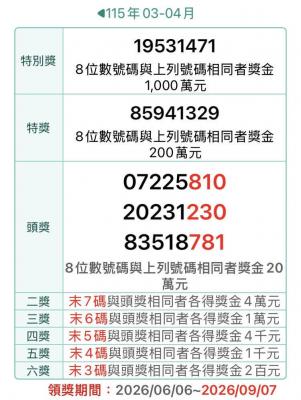
The Ministry of Finance this afternoon announced the winning numbers for the March-April uniform invoice lottery. The winning number for the NT$10 million (US$318,060) special prize is 19531471, and the winning number for the NT$2 million grand prize is 85941329. Three numbers were drawn for the NT$200,000 first prize: 07225810, 20231230 and 83518781. Those with receipts matching the last seven digits of any of the first-prize numbers will win the NT$40,000 second prize, while those matching the last six digits will win the NT$10,000 third prize. Those whose receipts match the last five digits of the first-prize numbers can claim the NT$4,000 fourth prize,

SIX SUBSIDIES: The monthly allowance for older farmers is to increase to NT$10,000, and NT$5,000 is to be given to homemakers under the national pension system, Lai said The government is to implement major welfare policies for disadvantaged groups, including raising the monthly allowance for older farmers to NT$10,000 and providing homemakers with NT$5,000 per month, President William Lai (賴清德) said yesterday. Lai made the remarks during a visit to Wangling Temple in Chiayi County, saying that the planned increases were being introduced amid economic growth and an increase in tax revenue. Touting a policy, in which the government plans to provide a monthly allowance of NT$5,000 for every child under the age of 18 in a bid to address Taiwan’s low birthrate, Lai said that if received for the


 RSS
RSS