


A scuffle erupted yesterday at a memorial organized by the Formosa Republican Association for an assassinated US conservative speaker that prompted a small protest at National Taiwan University.
The Taiwan Solidarity Party (TSP), the Taiwan Teachers’ Union and the Presbyterian Church in Taiwan cohosted the event, titled “Love, Faith and Courage: Memorial for Charlie Kirk” on the university’s campus. Kirk, a cofounder of Turning Point USA, was shot and killed during an address at Utah Valley University on Sept. 10.
Three young people who said that they were students at National Chengchi University, National Taiwan Normal University and Soochow University went to the front of the hall as TSP Chairwoman Chou Ni-an (周倪安) was about to speak at the event in Taipei.
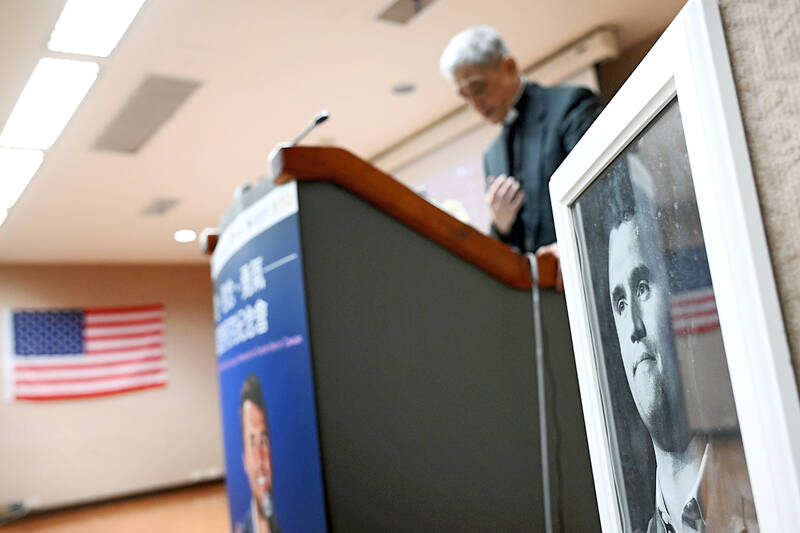
Photo: Chen Yi-kuan, Taipei Times
They held banners that read: “Conservatives are sounding the death knell of democracy,” “the Gaza peace plan is fake” and one that accused Chou of discrimination against transgender people.
Another person in the audience tackled one of the three protesters on the stage, initiating a scuffle that was broken up by event organizers.
The protesters were escorted out of the hall and the event continued, with several speakers addressing the audience.
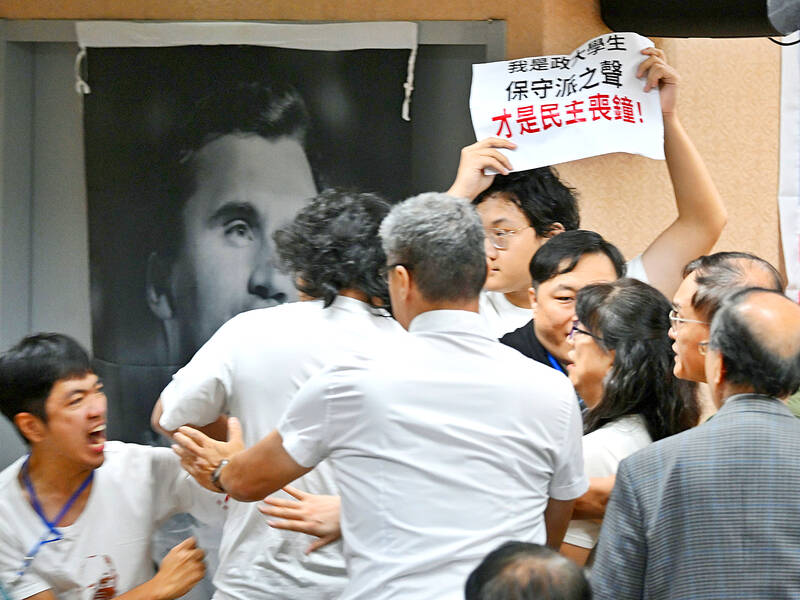
Photo: Chen Yi-kuan, Taipei Times
Association director Lucy Liu (劉玉皙) told the event that her group “does not stand for extremism and is opposed to violence.”
“We are Charlie Kirk,” said Guermantes Lailari, a retired US Air Force lieutenant colonel who is an international academic in residence at the Institute for National Defense and Security Research, adding that confronting communism and the threat emanating from China is a mission shared by Taiwan and the US.
Kirk would have encouraged Taiwanese to defend the freedoms guaranteed by the Constitution, refuse to yield to China and courageously seek truth through debate if he were in Taiwan, Lailari said.
Steve Bannon, former chief of strategy in the first administration of US President Donald Trump, said in a prerecorded video at the event that Kirk had visited South Korea and Japan shortly before he died out of concern for the geopolitical situation in East Asia.
Bannon called Kirk “an iconic anti-communist leader,” saying that his message would remain forever if “we keep the faith.”
Israeli Representative to Taiwan Maya Yaron said via videoconference that Kirk’s message reverberated in Taiwan and her nation.
Kirk showed that communication was the best way forward amid divisions in opinion, Yaron said.
Japanese House of Councilors member Sohei Kamiya, who leads the Sanseito Party, said in a video that Kirk in his final visit to Japan had warned of the risks posed by social division and urged Japanese conservatives to protect core national values.
Sanseito and the association should work together to advance conservatism in Taiwan, Kamiya said.
Formosa Republican Association chairman Jason Chen (陳彥升) said that Kirk was a champion of the Christian values of truth, peace and freedom, which are aligned with Taiwan’s struggles for democracy.
The association would continue to promote rational discourse and events revolving around the freedom of speech to facilitate social understanding and progress in Taiwan, Chen said.

FUKUOKA SITUATION: Japanese media reported that the pathogen is expected to be identified by the summer, while the CDC downplayed the idea that it was hMPV A “mysterious cold-like illness” reported in Japan’s Fukuoka Prefecture does not seem to be a new disease, but Japanese authorities have been asked about the situation, the Centers for Disease Control (CDC) said yesterday. The Fukuoka Prefectural Medical Association on Wednesday told a news conference that a “mystery cold” that has become a hot topic on social media is “highly likely to be caused by some kind of viral infection,” Japan’s KBC News reported. “Many people are experiencing symptoms starting with a sore throat, followed by a runny nose, phlegm and a severe cough,” KBC News reported, citing association officials. Health authorities are

Nvidia Corp CEO Jensen Huang (黃仁勳) arrived in Taiwan yesterday ahead of upcoming AI and technology events, saying he plans to meet with clients and Taiwan Semiconductor Manufacturing Co Chairman C.C. Wei (魏哲家) during his visit. After landing at Taipei Songshan Airport, Huang posed for photos with fans and handed out Yakult drinks to reporters and supporters waiting at the scene, saying he has “a lot to do” during the trip. Asked about reports that Nvidia’s planned headquarters site in Taipei’s Beitou Shilin Technology Park could break ground on May 27, Huang said that if the company holds an event, he would

The Ministry of Finance this afternoon announced the winning numbers for the March-April uniform invoice lottery. The winning number for the NT$10 million (US$318,060) special prize is 19531471, and the winning number for the NT$2 million grand prize is 85941329. Three numbers were drawn for the NT$200,000 first prize: 07225810, 20231230 and 83518781. Those with receipts matching the last seven digits of any of the first-prize numbers will win the NT$40,000 second prize, while those matching the last six digits will win the NT$10,000 third prize. Those whose receipts match the last five digits of the first-prize numbers can claim the NT$4,000 fourth prize,

SIX SUBSIDIES: The monthly allowance for older farmers is to increase to NT$10,000, and NT$5,000 is to be given to homemakers under the national pension system, Lai said The government is to implement major welfare policies for disadvantaged groups, including raising the monthly allowance for older farmers to NT$10,000 and providing homemakers with NT$5,000 per month, President William Lai (賴清德) said yesterday. Lai made the remarks during a visit to Wangling Temple in Chiayi County, saying that the planned increases were being introduced amid economic growth and an increase in tax revenue. Touting a policy, in which the government plans to provide a monthly allowance of NT$5,000 for every child under the age of 18 in a bid to address Taiwan’s low birthrate, Lai said that if received for the


 RSS
RSS