


The High Court today handed down a prison sentence of two years and eight months to former independent legislative candidate Ma Chih-wei (馬治薇) who was accused of accepting funding from China to run for office.
The court ruled that Ma has contravened the Anti-Infiltration Act (反滲透法).
The ruling can be appealed.
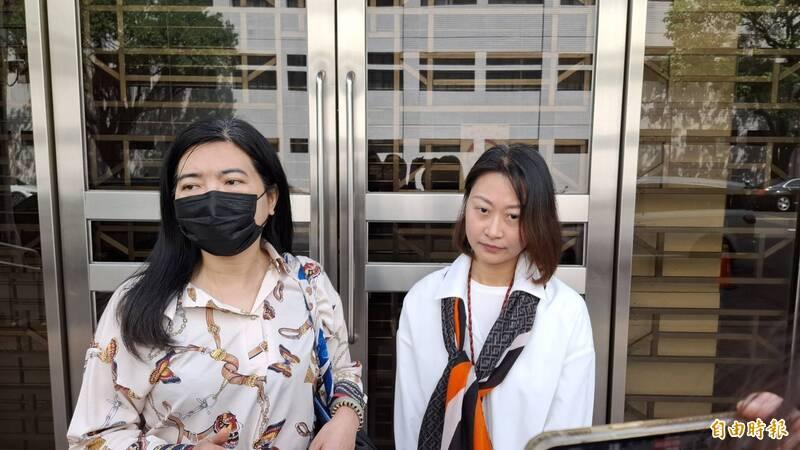
Photo: Taipei Times
A lawyer representing Ma said she admitted contravening the Personal Data Protection Act (個人資料保護法), but denied contravening National Security Act (國家安全法) and the Anti-infiltration Act.
Ma did not appear in court today.
In the first trial in the Taoyuan District Court in August last year, she was sentenced to an eight-month prison term for contravening the Personal Data Protection Act by receiving money in exchange for “a large amount of personal contact information” that she had collected.
However, the court ruled that there was no evidence that Ma had breached national security laws since the information she gave to the Chinese individuals was not confidential.
The court also acquitted Ma of contravening the Anti-Infiltration Act, citing a lack of evidence.
Prosecutors filed an appeal against the ruling.
Ma contravened the Anti-Infiltration Act — enacted to prevent the intervention of “foreign hostile forces” in Taiwan — by taking money from an “infiltrative entity” to fund her election bid, prosecutors claim.
She breached the National Security Act by passing on “Taiwanese intelligence and other election-related information to her benefactors,” they said.
The Taoyuan District Prosecutors’ Office in March last year indicted her for contravening the Anti-infiltration Act, National Security Act and Personal Data Protection Act.
Following a preliminary investigation, prosecutors alleged that Ma had received funds in US dollars and tether, a cryptocurrency.
The amount of cryptocurrency that Ma received was equivalent to about NT$1.05 million (US$34,267.25), prosecutors said.
In exchange for these payments, Ma gave her Chinese handlers nicknamed “Sister Bing” (冰姐) and “Ah-Hau” (阿浩) a list of contacts for central government agencies, as well as business cards for personnel involved in national security, they said.
Ma, a former spokeswoman for the Taiwan People’s Party (TPP) Taoyuan chapter, was expelled by the party on Jan. 6 last year after she was investigated and detained for allegedly receiving campaign donations in the form of cryptocurrency from China.
She ran as an independent in Taoyuan in the Jan. 13 legislative elections.

The military has spotted two Chinese warships operating in waters near Penghu County in the Taiwan Strait and sent its own naval and air forces to monitor the vessels, the Ministry of National Defense (MND) said. Beijing sends warships and warplanes into the waters and skies around Taiwan on an almost daily basis, drawing condemnation from Taipei. While the ministry offers daily updates on the locations of Chinese military aircraft, it only rarely gives details of where Chinese warships are operating, generally only when it detects aircraft carriers, as happened last week. A Chinese destroyer and a frigate entered waters to the southwest

The eastern extension of the Taipei MRT Red Line could begin operations as early as late June, the Taipei Department of Rapid Transit Systems said yesterday. Taipei Rapid Transit Corp said it is considering offering one month of free rides on the new section to mark its opening. Construction progress on the 1.4km extension, which is to run from the current terminal Xiangshan Station to a new eastern terminal, Guangci/Fengtian Temple Station, was 90.6 percent complete by the end of last month, the department said in a report to the Taipei City Council's Transportation Committee. While construction began in October 2016 with an

NON-RED SUPPLY: Boosting the nation’s drone industry is becoming increasingly urgent as China’s UAV dominance could become an issue in a crisis, an analyst said Taiwan’s drone exports to Europe grew 41.7-fold from 2024 to last year, with demand from Ukraine’s fight against Russian aggression the most likely driver of growth, a study showed. The Institute for Democracy, Society and Emerging Technology (DSET) in a statement on Wednesday said it found that many of Taiwan’s uncrewed aerial vehicle (UAV) sales were from Poland and the Czech Republic. These countries likely transferred the drones to Ukraine to aid it in its fight against the Russian invasion that started in 2022, it said. Despite the gains, Taiwan is not the dominant drone exporter to these markets, ranking second and fourth

Japanese Prime Minister Sanae Takaichi’s comment last year on Tokyo’s potential reaction to a Taiwan-China conflict has forced Beijing to rewrite its invasion plans, a retired Japanese general said. Takaichi told the Diet on Nov. 7 last year that a Chinese naval blockade or military attack on Taiwan could constitute a “survival-threatening situation” for Japan, potentially allowing Tokyo to exercise its right to collective self-defense. Former Japan Ground Self-Defense Force general Kiyofumi Ogawa said in a recent speech that the remark has been interpreted as meaning Japan could intervene in the early stages of a Taiwan Strait conflict, undermining China’s previous assumptions


 RSS
RSS