


The National Security Bureau (NSB) yesterday confirmed that it had launched an investigation into whether foreign funding is involved in scandals embroiling Taiwan People’s Party (TPP) Chairman Huang Kuo-chang (黃國昌), who allegedly organized “surveillance teams” to tail politicians and hackers to collect and leak data.
The move follows the Democratic Progressive Party (DPP) caucus on Tuesday filing a request with the Control Yuan to probe allegations of foreign funding to support Huang’s covert operations in contravention of the Political Donations Act (政治獻金法).
Speaking to reporters before a meeting of the legislature’s Foreign Affairs and National Defense Committee, NSB Director-General Tsai Ming-yen (蔡明彥) said that national security agencies are investigating incidents of key government officials and politicians being tailed and photographed, and have enhanced protection at official residences and government buildings.
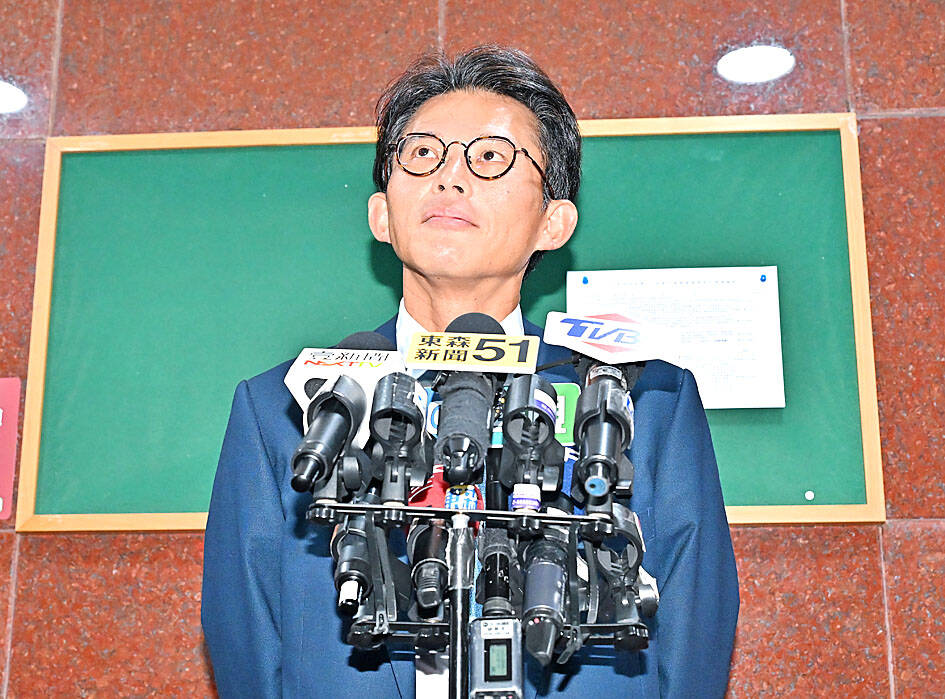
Photo: Chen Chih-chu, Taipei Times
Asked about reports that Huang had hired journalists to form “paparazzi groups,” Tsai said that public prosecutors and judiciary agencies have started criminal investigations into the incident and he could not comment on ongoing developments.
However, Tsai confirmed that the NSB investigation is focused on whether the alleged activities were funded from abroad in contravention of the National Security Act (國家安全法), as well as breaches of the Personal Data Protection Act (個資保護法) relating to offenses such as infringing on personal privacy, collecting personal data, and covertly tailing and photographing officials and politicians.
The NSB has issued notifications to security escorts and police officers who are in charge of the personal safety of key government officials to be on the alert against surveillance or stalking actions, and to report such incidents so law enforcement units can take immediate action, he said.
In response to media queries for comment, Huang said yesterday that the NSB should also thoroughly investigate where the over NT$ 800 million in overseas funds of the Mirror Media (精鏡傳媒) came from.
According to Huang, back in 2019 a group of Tainan lawmakers supporting President William Lai's (賴清德) bid as the Democratic Progressive Party's (DPP) candidate for the 2020 presidential election were being surveillanced by Mirror Media.
By the DPP's definition, this is the real act of political surveillance, he said.
The shell company in question has a capital of just over US$14 million and yet could lend more than US$28 million to Taiwan's Mirror Media group, he said, stating "this overseas funding is clearly what’s truly problematic."
Separately, DPP Legislator Puma Shen (沈伯洋) said the public is worried that China, which has boosted its capacity to produce uncrewed aerial vehicles, “could suddenly launch fleets of drones in a saturation attack against Taiwan.”
“We want people to know that what is most worrying now is we are already under attack by an enemy drone in the form of a legislator here in the legislature,” Shen said.
“Through the unlawful actions of Huang’s hackers and surveillance teams, he had stolen classified data and sensitive personal information. These are also materials that China wants... It is already known that the personal data of government officials and politicians had been hacked and put on sale on the dark Web. Then we see Huang taking these materials, asking questions to smear public officials during legislative sessions,” he said.
DPP Legislator Wang Yi-chuan (王義川) accused Huang of continuing to cover up, evading questions by lawmakers and reporters about his funding sources.
“We just want Huang to clarify where his funds came from. Are they from foreign sources? We have asked him repeatedly, but he has either avoided or evaded the question. Does he have something to hide?” Wang asked.
DPP Legislator Michelle Lin (林楚茵) said that statements from those involved in the operations, along with uncovered evidence, pointed to Huang as the mastermind behind the efforts to sabotage the government and undermine national security.
“We see Huang’s two main weapons that have been operating for years, covertly surveilling prominent politicians and taking so-called unsavory photos, and lately, evidence that he also has a group of hackers,” Lin said.
Through these groups, Huang has managed to infiltrate two state media — the Central News Agency and Radio Taiwan International, she added.
Additional reporting by Lin Che-yuan
This story has been amended since it was first published.
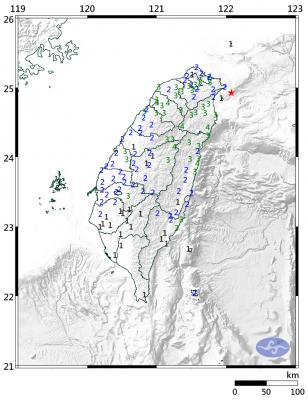
A magnitude 6.1 earthquake struck off the coast of Yilan County at 8:39pm tonight, the Central Weather Administration (CWA) said, with no immediate reports of damage or injuries. The epicenter was 38.7km east-northeast of Yilan County Hall at a focal depth of 98.3km, the CWA’s Seismological Center said. The quake’s maximum intensity, which gauges the actual physical effect of a seismic event, was a level 4 on Taiwan’s 7-tier intensity scale, the center said. That intensity level was recorded in Yilan County’s Nanao Township (南澳), Hsinchu County’s Guansi Township (關西), Nantou County’s Hehuanshan (合歡山) and Hualien County’s Yanliao (鹽寮). An intensity of 3 was
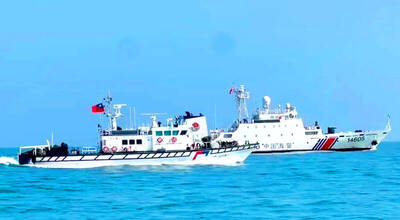
Instead of focusing solely on the threat of a full-scale military invasion, the US and its allies must prepare for a potential Chinese “quarantine” of Taiwan enforced through customs inspections, Stanford University Hoover fellow Eyck Freymann said in a Foreign Affairs article published on Wednesday. China could use various “gray zone” tactics in “reconfiguring the regional and ultimately the global economic order without a war,” said Freymann, who is also a nonresident research fellow at the US Naval War College. China might seize control of Taiwan’s links to the outside world by requiring all flights and ships entering or leaving Taiwan
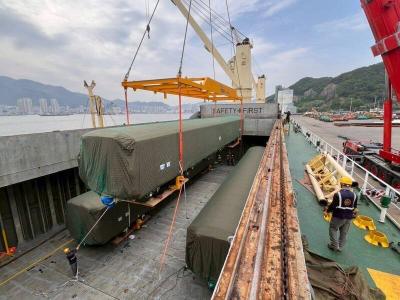
The first of 10 new high-capacity trains purchased from South Korea’s Hyundai Rotem arrived at the Port of Taipei yesterday to meet the demands of an expanding metro network, Taipei Rapid Transit Corp (TRTC) said yesterday. The train completed a three-day, 1,200km voyage from the Port of Masan in South Korea, the company said. Costing NT$590 million (US$18.79 million) each, the new six-carriage trains feature a redesigned interior based on "human-centric" transportation concepts, TRTC said. The design utilizes continuous longitudinal seating to widen the aisles and optimize passenger flow, while also upgrading passenger information displays and driving control systems for a more comfortable
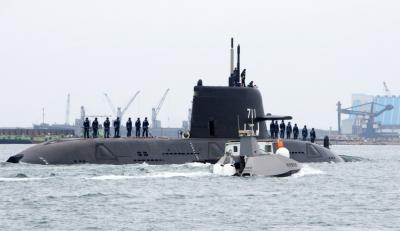
Taiwan's first indigenous defense submarine, the SS-711 Hai Kun (海鯤, or Narwhal), departed for its 13th sea trial at 7am today, marking its seventh submerged test, with delivery to the navy scheduled for July. The outing also marked its first sea deployment since President William Lai (賴清德) boarded the submarine for an inspection on March 19, drawing a crowd of military enthusiasts who gathered to show support. The submarine this morning departed port accompanied by CSBC Corp’s Endeavor Manta (奮進魔鬼魚號) uncrewed surface vessel and a navy M109 assault boat. Amid public interest in key milestones such as torpedo-launching operations and overnight submerged trials,


 RSS
RSS