


President William Lai (賴清德) today reiterated that he hoped Taiwan’s defense spending would reach 5 percent of GDP before 2030 when he met with guests taking part in this year’s Taipei Security Dialogue.
Taiwan is to continue to strengthen its defense capabilities, proactively develop its asymmetric warfare capacity and build an intelligent defense combat system, Lai said.
Taiwan is also to promote a more competitive national defense industry and strengthen whole-society resilience, he said.
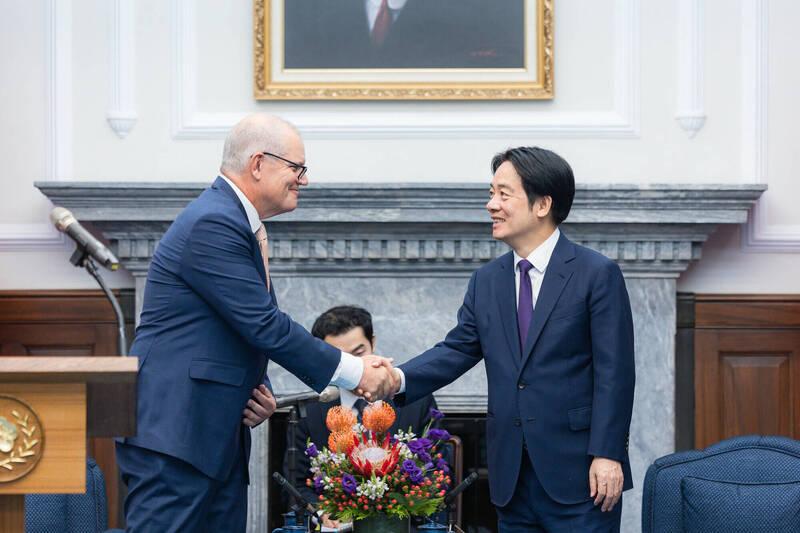
Photo courtesy of the Presidential Office
This is to ensure Taiwan can safeguard its democratic values and become a security cooperation partner trusted by its allies to jointly maintain regional peace and stability, demonstrating the nation’s firm commitment to self-defense and fulfilling its responsibility to maintain peace and stability across the Taiwan Strait, he said.
He made the remarks during his meeting with former Australian prime minister Scott Morrison and other guests from the US, the UK, Germany, Australia, Denmark and Latvia, accompanied by National Security Council Secretary-General Joseph Wu (吳釗燮) and Institute for National Defense and Security Research chairman Huo Shou-ye (霍守業).
Global order faces severe challenges due to the continuous expansion of authoritarianism and rapid technological development, testing the unity and responsiveness of the democratic camp, he said.
The Taipei Security Dialogue is "exceptionally important," he said.
The year's theme, "Integrated Deterrence: Maintaining Indo-Pacific Peace through Strength," focused on the international situation, the impact of emerging technology, strengthening social resilience and Taiwan's strategic role, he said.
It is not just an academic exchange but a crucial opportunity for like-minded nations to collaborate on challenges and pursue peace, he said.
China poses the greatest threat to peace and stability across the Taiwan Strait and the Asia-Pacific region, Mainland Affairs Council (MAC) Minister Chiu Chui-cheng (邱垂正) said yesterday during his closing speech at the Taipei Security Dialogue.
China's political development has shown three extreme trends since Chinese President Xi Jinping (習近平) took power, Chiu said.
First, China is shifting to highly centralized leadership, or even one-man rule, from collective leadership, increasing the risk of erroneous policy-making, he said.
Second, China is pursuing “fanatic nationalism,” military hegemony, “wolf-warrior diplomacy” and the militarization of the South China Sea, while suppressing democracy in Hong Kong, increasing pressure on Taiwan and expanding its global influence through its Belt and Road Initiative, he said.
Third, Xi is seeking to create legitimacy for his prolonged tenure by setting “unifying with Taiwan” and “replacing the US” as goals for the “great rejuvenation of the Chinese nation,” he said.
China has become a “new totalitarian” state, applying pressure on Taiwan through military threats, diplomatic isolation, economic coercion, social infiltration, legal warfare and cognitive warfare, he said.
China poses the largest threat to the status quo of peace and stability in cross-strait and the Asia-Pacific region, he said.
"Peace in the Taiwan Strait is a key to maintaining world security and prosperity," he said.
Taiwan is at the core of the first island chain, and 50 percent of the world's container ships must sail through the Taiwan Strait, making it vital for maintaining a peaceful and prosperous international order, he said.
Taiwan is also a global high-tech center, manufacturing 90 percent of the world's advanced computer chips, making it an indispensable partner in the high-tech supply chain, he said.
Taiwan is a mature and free democracy that can inspire people in China who share the same cultural and linguistic background to pursue freedom and a better life, he said.
Maintaining security and peace in the Taiwan Strait is of vital interest to every country, he said.
A Taiwan contingency is a global contingency, he said.
The US, Japan, the EU, the UK, Canada and Australia have expressed their concern for peace and stability in the Strait, he said.
A consensus has been reached among the international community on how to work together to curb China's expansionist ambitions and preserve cross-strait and regional peace and prosperity, he said.
Meanwhile, the Chinese government said yesterday that Lai is "prostituting" himself to foreigners to try and win their favor but his schemes are doomed to fail after he gave an interview lauding US President Donald Trump.
In an interview released this week with a conservative US radio show and podcast, Lai said Trump should get the Nobel Peace Prize if he could convince Xi to abandon the use of force against Taiwan.
Trump and Xi are expected to meet this month at a regional summit in South Korea.
Responding to the interview, where Lai also talked about China's military threats and increased defense spending, China's Taiwan Affairs Office said Lai was "spouting nonsense," showing his true nature as a manufacturer of crises and destroyer of peace.
Since taking office last year, Lai has been "rampantly propagating separatist fallacies," it said.
Using unusually strong wording, the statement added: "He has engaged in unprincipled foreign pandering and bottomless selling out of Taiwan, squandering the flesh and blood of the people, prostituting himself and throwing in his lot with foreign forces."
The statement also came just two days before Lai gives his key national day speech tomorrow.
There was no immediate response from Taiwan's government.
Additional reporting by Reuters

The Ministry of Finance this afternoon announced the winning numbers for the March-April uniform invoice lottery. The winning number for the NT$10 million (US$318,060) special prize is 19531471, and the winning number for the NT$2 million grand prize is 85941329. Three numbers were drawn for the NT$200,000 first prize: 07225810, 20231230 and 83518781. Those with receipts matching the last seven digits of any of the first-prize numbers will win the NT$40,000 second prize, while those matching the last six digits will win the NT$10,000 third prize. Those whose receipts match the last five digits of the first-prize numbers can claim the NT$4,000 fourth prize,

SIX SUBSIDIES: The monthly allowance for older farmers is to increase to NT$10,000, and NT$5,000 is to be given to homemakers under the national pension system, Lai said The government is to implement major welfare policies for disadvantaged groups, including raising the monthly allowance for older farmers to NT$10,000 and providing homemakers with NT$5,000 per month, President William Lai (賴清德) said yesterday. Lai made the remarks during a visit to Wangling Temple in Chiayi County, saying that the planned increases were being introduced amid economic growth and an increase in tax revenue. Touting a policy, in which the government plans to provide a monthly allowance of NT$5,000 for every child under the age of 18 in a bid to address Taiwan’s low birthrate, Lai said that if received for the
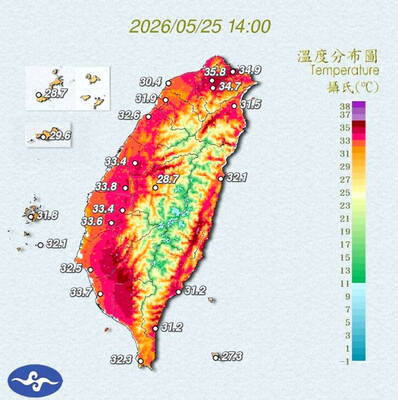
STAY COOL: The HPA recommended that people stay hydrated, use air-conditioning or fans while indoors, wear loose-fitting clothes and walk in the shade while outdoors Employers must implement measures such as installing cooling equipment, and providing drinking water and rest breaks for outdoor workers starting from Monday next week, the Taipei Department of Labor said on Sunday. Employers who fail to comply could face fines of NT$30,000 to NT$300,000 under the Occupational Safety and Health Act (職業安全衛生法), the department said. Businesses in Taipei employing fewer than 100 workers, as well as registered self-employed workers with labor insurance coverage, could receive on-site assessments and guidance from occupational safety consultants to help them apply for central government subsidies to implement or improve heat-protection measures, it said. Under the Ministry of
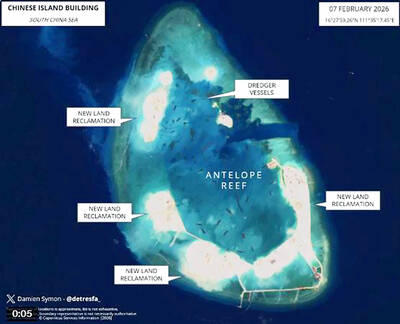
ISOLATION: The outposts would serve as support and backup bases, forcing US forces to either face China head-on or reroute, increasing travel time and operational costs China’s outposts in the South China Sea could be used to delay and constrain foreign forces during a conflict in the Taiwan Strait, giving Beijing a critical window to carry out amphibious landing and blockade operations, a report said. The Chinese Communist Party’s (CCP) forward operating bases on islands and reclaimed features in the South China Sea could delay foreign forces long enough for the Chinese People’s Liberation Army (PLA) to secure a key 48-to-72-hour window in the Taiwan Strait, a report commissioned by the Mainland Affairs Council found. The report, conducted by the Institute for National Defense and Security Research, examined


 RSS
RSS