


The leading candidates for the Chinese Nationalist Party’s (KMT) chairperson election next week underestimate China’s threat and mistakenly view the so-called “1992 consensus” as a protective umbrella, a US think tank wrote.
The front-runners — former KMT lawmaker Cheng Li-wen (鄭麗文), former KMT vice chairman Hau Lung-bin (郝龍斌) and KMT Legislator Lo Chih-chiang (羅智強) — show that the KMT has little awareness of Beijing’s intentions and would likely resist US calls to boost defense spending or bolster deterrence, former CIA analyst and Jamestown Foundation president Peter Mattis wrote in his analysis titled Mainlander Narratives Dominate Kuomintang Leadership Race.
All three contenders base cross-strait policy on the “1992 consensus,” he wrote.
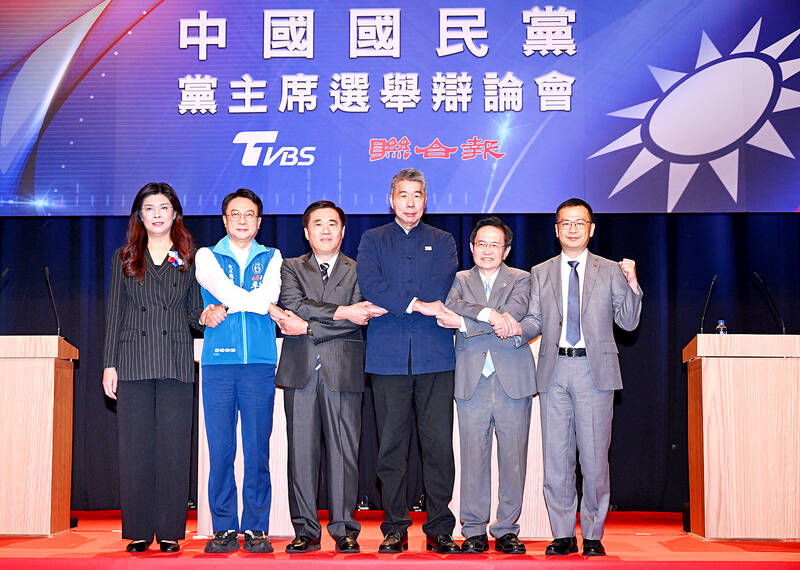
Photo: Fang Pin-chao, Taipei Times
The “1992 consensus” is a term former Mainland Affairs Council chairman Su Chi (蘇起) in 2006 admitted making up in 2000. It refers to a tacit understanding between the KMT and the Chinese government that both sides of the Strait acknowledge there is “one China,” with each side having its own interpretation of what “China” means.
The Democratic Progressive Party (DPP) does not acknowledge the existence of that “consensus.”
The candidates tend to view the People’s Republic of China (PRC) positively, while expressing skepticism toward the US and the ruling DPP government’s US policy, particularly on trade, Mattis said.
They see Taiwan’s security as dependent on its relationship with Beijing rather than with Washington, as evidenced by their belief that the “1992 consensus” ensures peace, he wrote.
Mattis cited examples that showed the candidates’ position on cross-strait relations, such as Lo referring to the administration of former president Ma Ying-jeou (馬英九) as an era in which Taiwan was very secure, and Cheng saying that “crushing Taiwan independence and fascism” and adhering to the “1992 consensus” would bring a “century of peace.”
Hau took a more cautious line, saying that Beijing must recognize that the “1992 consensus” is not equivalent to accepting China’s “one country, two systems,” and pledging to form a national defense think tank focused on the defense of the Republic of China (ROC) if he were elected, Mattis said.
All three candidates oppose raising defense spending to 5 percent of GDP, instead favoring stable cross-strait relations as the foundation of national security, he said.
Cheng said that “reconciliation” with China is the best defense, Lo called a 5 percent budget “unaffordable,” while Hau said Taiwan must “prepare for war to avoid war,” and emphasized peace and opposition to independence, Mattis said, adding that none proposed alternative defense measures.
The three candidates share a waisheng (外省) background, which refers to people who followed the KMT army to Taiwan after World War II, he said.
Cheng and Hau are children of military officers, and Lo is from a family who evacuated from Dachen Island in 1955 — reflecting a lack of internal debate over the party’s direction, he added.
Mattis quoted Cheng as saying that under KMT leadership, Taiwanese should “proudly say, ‘I am Chinese,’” while Lo said: “I am Taiwanese, I am Chinese — my China is the Republic of China.”
Meanwhile, Hau has urged retired generals not to attend Chinese military parades and stressed that the ROC’s role in WWII “must not be erased,” Mattis said, adding that Hau had called on Beijing to acknowledge the ROC’s existence.
All three candidates are wary of Washington, the report said.
Cheng has warned that excessive reliance on the US could turn Taiwan into a “bargaining chip” between Beijing and Washington, while Hau has advocated a “three nots” policy: “Pro-US, but not submissive; engaging China, but not servile; and friendly with Japan, but not obsequious,” he said.
Hau appears to be the preferred choice of the party, having received endorsements from local faction leaders and media personality Jaw Shaw-kong (趙少康), the report said, adding that Lo was backed by Ma, while Cheng, seen as the “dark horse,” was endorsed by former legislative speaker Wang Jin-pyng (王金平).
Under these candidates, the KMT is unlikely to align with US expectations on defense or preparedness, Mattis said.
“For the KMT, the best way to resist US pressure would be to deepen ties with Beijing,” Mattis wrote, urging Washington to avoid fueling anti-US sentiment and to better understand the party’s internal power dynamics.
In response to the report, Cheng yesterday said that Taiwan faces turbulent times and uncertainty, and that the priority should be to ease hostility, bolster unity and cooperation, and restore hope for the nation’s future.
“The most pressing and fundamental task is to ensure peace across the Taiwan Strait,” she said. “Without peace, young people have no future. Only through cross-strait cooperation can we generate greater strength.”
Meanwhile, Lo said that Taiwan’s best path for survival and development is to maintain engagement with the US and China, being “neither servile nor arrogant” in its relationship with the two.
Hau’s office said it had no comment about the report.
Additional reporting by Lin Hsin-han

Considering that most countries issue more than five denominations of banknotes, the central bank has decided to redesign all five denominations, the bank said as it prepares for the first major overhaul of the banknotes in more than 24 years. Central bank Governor Yang Chin-lung (楊金龍) is expected to report to the Legislative Yuan today on the bank’s operations and the redesign’s progress. The bank in a report sent to the legislature ahead of today’s meeting said it had commissioned a survey on the public’s preferences. Survey results showed that NT$100 and NT$1,000 banknotes are the most commonly used, while NT$200 and NT$2,000

The Centers for Disease Control (CDC) yesterday reported the first case of a new COVID-19 subvariant — BA.3.2 — in a 10-year-old Singaporean girl who had a fever upon arrival in Taiwan and tested positive for the disease. The girl left Taiwan on March 20 and the case did not have a direct impact on the local community, it said. The WHO added the BA.3.2 strain to its list of Variants Under Monitoring in December last year, but this was the first imported case of the COVID-19 variant in Taiwan, CDC Deputy Director-General Lin Ming-cheng (林明誠) said. The girl arrived in Taiwan on

ANNUAL EVENT: Two massive Pokemon balloons are to be set up in Daan Park, with an event zone operating from 10am to 6pm This year’s Taipei Floral Picnic is to be held at Daan Park today and tomorrow, featuring an exclusive Pokemon Go event, a themed food market, a coffee rave picnic area and stage performances, the Taipei Department of Information and Tourism said yesterday. Two massive Pokemon balloons are to be set up in the park as attractions, with an exclusive event zone operating from 10am to 6pm, it said. Participants who complete designated tasks on-site would have a chance to receive limited-edition souvenirs, it added. People could also try the newly launched game Pokemon Pokopia in the trial area, the department said. Three PokeStops are

South Korea is planning to revise its controversial electronic arrival card, a step Taiwanese officials said prompted them to hold off on planned retaliatory measures, a South Korean media report said yesterday. A Yonhap News Agency report said that the South Korean Ministry of Foreign Affairs is planning to remove the “previous departure place” and “next destination” fields from its e-arrival card system. The plan, reached after interagency consultations, is under review and aims to simplify entry procedures and align the electronic form with the paper version, a South Korean ministry official said. The fields — which appeared only on the electronic form


 RSS
RSS