


The Chinese People’s Liberation Army (PLA) Rocket Force has increased its stockpile by almost 50 percent in four years, to about 3,500 missiles, while rocket brigades on China’s east coast have built bigger bases with more launchpads, the New York Times reported on Monday.
This buildup is part of Chinese President Xi Jinping’s (習近平) “ambitions to bring Taiwan under Beijing’s control and counter US power in Asia through the threat of overwhelming force,” the report said.
The bases are deploying increasingly advanced missiles such as the Dongfeng-17, a maneuverable hypersonic missile, and the Dongfeng-26, nicknamed the “Guam express” for its ability to strike US military bases in that region, it said.
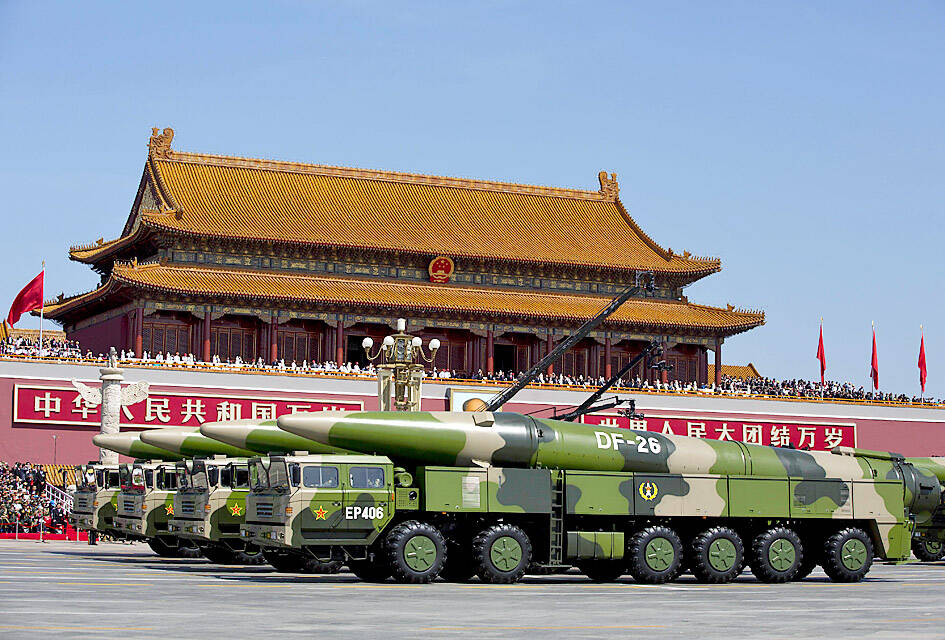
Photo: AFP
Missiles are “the starting point for any type of military coercion campaign that China would use against Taiwan,” the Times quoted Jennifer Kavanagh, director of military analysis at the research group Defense Priorities, as saying.
For China, “having an overwhelming number of missiles is also intended as a political signal — to Taiwan that there’s no point in fighting back, to the US that you can’t intervene,” she said.
China relies on its missile arsenal to intimidate Taiwan and its allies during peacetime and would use it to threaten Taiwanese and US forces in the event of a conflict, the article said.
Xi showed his commitment to the rocket force, which controls nuclear and conventional missiles, by visiting Brigade 611 in China’s Anhui Province last year, it said.
Satellite images show that Brigade 611, 708km from Taiwan, has doubled in size in the past few years, it said.
The unit is now deploying Dongfeng-26 missiles, which can be armed with conventional or nuclear warheads, and the Pentagon estimates that China has about 500 of them, it added.
Brigade 616 in China’s Jiangxi Province, about 580km from Taiwan, has also grown rapidly and is being prepared to handle Dongfeng-17 missiles, the report said.
“If there is a Taiwan conflict, particularly if there’s some level of US involvement or the threat of US involvement, then from the start it has a nuclear dimension,” said Kelly Grieco, a senior fellow at the Stimson Center, a Washington-based foreign affairs think tank.
“A system like the Dongfeng-26 makes this potentially even more dangerous,” the article quoted Grieco as saying.
Despite these advances, “China’s rapid buildup of its missile systems has not been without problems,” the New York Times reported, citing a Pentagon assessment that said corruption in the rocket force might have compromised China’s new nuclear missile silos.
In addition, while China’s missile accuracy has improved, experts question how its missiles would perform in real combat conditions, it said.
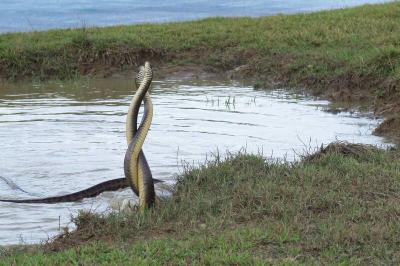
Kenting National Park service technician Yang Jien-fon (楊政峰) won a silver award in World Grand Prix Photography Awards Spring Season for his photograph of two male rat snakes intertwined in combat. Yang’s colleagues at Kenting National Park said he is a master of nature photography who has been held back by his job in civil service. The awards accept entries in all four seasons across six categories: architectural and urban photography, black-and-white and fine art photography, commercial and fashion photography, documentary and people photography, nature and experimental photography, and mobile photography. Awards are ranked according to scores and divided into platinum, gold and

More than half of the bamboo vipers captured in Tainan in the past few years were found in the city’s Sinhua District (新化), while other districts had smaller catches or none at all. Every year, Tainan captures about 6,000 snakes which have made their way into people’s homes. Of the six major venomous snakes in Taiwan, the cobra, the many-banded krait, the brown-spotted pit viper and the bamboo viper are the most frequently captured. The high concentration of bamboo vipers captured in Sinhua District is puzzling. Tainan Agriculture Bureau Forestry and Nature Conservation Division head Chu Chien-ming (朱健明) earlier this week said that the
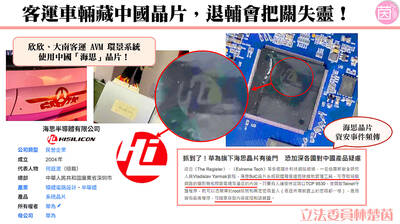
BREACH OF CONTRACT: The bus operators would seek compensation and have demanded that the manufacturer replace the chips with ones that meet regulations Two bus operators found to be using buses with China-made chips are to demand that the original manufacturers replace the systems and provide compensation for breach of contract, the Veterans Affairs Council said yesterday. Democratic Progressive Party Legislator Michelle Lin (林楚茵) yesterday said that Da Nan Bus Co and Shin-Shin Bus Co Ltd have fielded a total of 82 buses that are using Chinese chips. The bus models were made by Tron-E, while the systems provider was CYE Electronics, Lin said. Lin alleged that the buses were using chips manufactured by Huawei subsidiary HiSilicon Co, which presents a national security risk if the

The National Immigration Agency has banned two Chinese from returning to Taiwan, after they published social media content it described as disrespectful to national sovereignty. The agency imposed a two-month ban on a Chinese man surnamed Liang (梁) and a permanent ban on a woman surnamed Yang (楊), an influencer with 23 million followers, in October last year and last week respectively. Minister of the Interior Liu Shyh-fang (劉世芳) yesterday said on the sidelines of a legislative meeting that Chinese visitors to Taiwan are required to comply with the rules and regulations governing their entry permits. The government has handled the ban and


 RSS
RSS