


Proposals to make people who feed stray animals assume responsibility for the animals would be discussed and considered based on public opinion, the Ministry of Agriculture said on Friday.
Some people online have proposed that people who feed strays should be responsible for the animals, which sparked a backlash from animal rights groups who on Friday protested a potential ban on feeding stray and called for stricter enforcement of laws to prevent the original owners from abandoning or losing their pets.
Democratic Progressive Party Legislator Chiu Chih-wei (邱志偉) said he would promote an amendment to the Animal Protection Act (動物保護法) to ban feeding strays in public areas, an idea Minister of Agriculture Chen Junne-jih (陳駿季) has expressed support for.
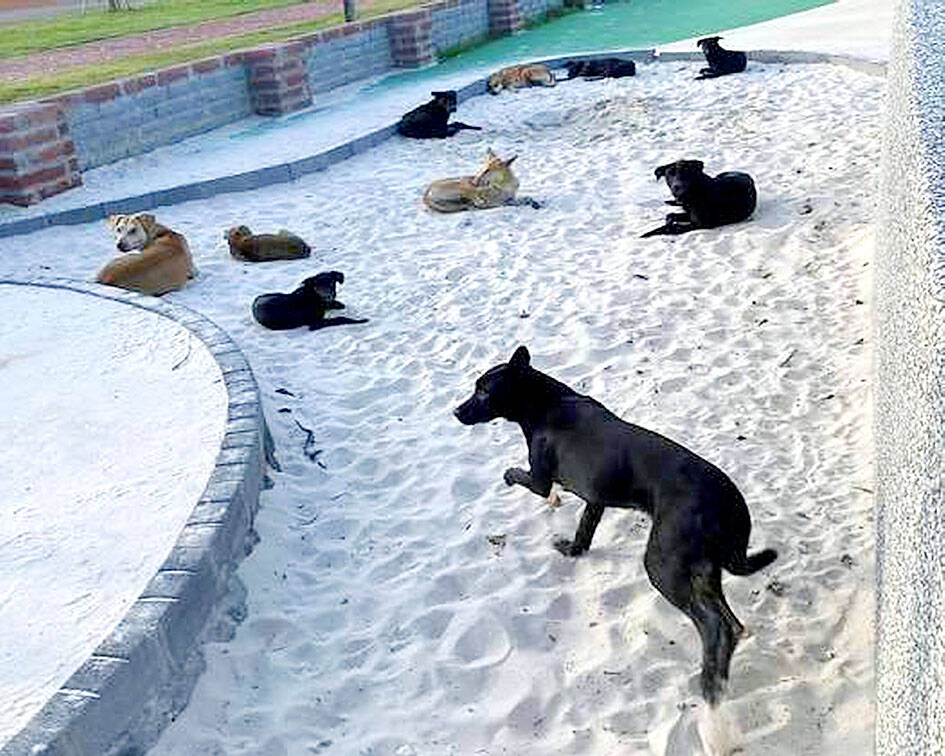
Photo courtesy of a member of the public
The proposed ban follows incidents of dog attacks, including one in June that resulted in a 76-year-old man dying while swimming off Kaohsiung’s Yongan District (永安) in June.
A person in July posted a proposal on the National Development Council’s Public Policy Online Participation Network Platform calling for the enforcement of euthanasia at animal shelters and ensuring that people who feed strays are held accountable.
However, animal rights groups said that the original pet owners should bear the responsibility and be penalized for abandoning their cats or dogs instead.
Kaohsiung Concern for Stray Animals Association founder Wang Hsiao-hua (王小華) said that pet microchip registration requirements has never been fully enforced since it came into effect in 1998.
Wang said that she and Kaohsiung Animal Protection Department personnel visited the owner of dogs who were roaming without a registered microchip.
The personnel asked the owner to take corrective action instead of imposing a fine, she said.
“However, the owner two weeks later told the department that their dog was missing,” Wang said.
The NT$20,000 fine should be levied immediately when the owners of cats or dogs that are not chip registration are identified, she said.
The government should enforce microchip registration with the help of borough wardens, who are supposed to know the number of dogs kept by each household within their jurisdiction, she said, adding that free microchipping could be offered to incentivize participation.
People who abandon animals should be held accountable, she said.
However, the government appears to be afraid of offending borough wardens, pet breeders and animal sellers, Wang said.
“We would not feed stray animals if there were no stray animals,” she said.
Department of Animal Welfare Director Chiang Wen-chuan (江文全) on Friday said tnhat the ministry would continue to seek a consensus the matter before proposing amendments.
The ministry does not encourage the feeding of strays or other animals, he said.
The ministry later said in a statement that the management of free-roaming and stray dogs is a complicated issue involving animal welfare, public safety and ecological conservation, and cannot be resolved with a single change.
To protect wildlife and sensitive environments, the ministry has promulgated regulations to ban public feeding in areas such as wildlife refuges and natural reserves, it said.
The ministry in April announced it would seek to enhance regulations on pet ownership, law enforcement, pet supply management and animal abuse.

FUKUOKA SITUATION: Japanese media reported that the pathogen is expected to be identified by the summer, while the CDC downplayed the idea that it was hMPV A “mysterious cold-like illness” reported in Japan’s Fukuoka Prefecture does not seem to be a new disease, but Japanese authorities have been asked about the situation, the Centers for Disease Control (CDC) said yesterday. The Fukuoka Prefectural Medical Association on Wednesday told a news conference that a “mystery cold” that has become a hot topic on social media is “highly likely to be caused by some kind of viral infection,” Japan’s KBC News reported. “Many people are experiencing symptoms starting with a sore throat, followed by a runny nose, phlegm and a severe cough,” KBC News reported, citing association officials. Health authorities are

Nvidia Corp CEO Jensen Huang (黃仁勳) arrived in Taiwan yesterday ahead of upcoming AI and technology events, saying he plans to meet with clients and Taiwan Semiconductor Manufacturing Co Chairman C.C. Wei (魏哲家) during his visit. After landing at Taipei Songshan Airport, Huang posed for photos with fans and handed out Yakult drinks to reporters and supporters waiting at the scene, saying he has “a lot to do” during the trip. Asked about reports that Nvidia’s planned headquarters site in Taipei’s Beitou Shilin Technology Park could break ground on May 27, Huang said that if the company holds an event, he would

The Ministry of Finance this afternoon announced the winning numbers for the March-April uniform invoice lottery. The winning number for the NT$10 million (US$318,060) special prize is 19531471, and the winning number for the NT$2 million grand prize is 85941329. Three numbers were drawn for the NT$200,000 first prize: 07225810, 20231230 and 83518781. Those with receipts matching the last seven digits of any of the first-prize numbers will win the NT$40,000 second prize, while those matching the last six digits will win the NT$10,000 third prize. Those whose receipts match the last five digits of the first-prize numbers can claim the NT$4,000 fourth prize,

SIX SUBSIDIES: The monthly allowance for older farmers is to increase to NT$10,000, and NT$5,000 is to be given to homemakers under the national pension system, Lai said The government is to implement major welfare policies for disadvantaged groups, including raising the monthly allowance for older farmers to NT$10,000 and providing homemakers with NT$5,000 per month, President William Lai (賴清德) said yesterday. Lai made the remarks during a visit to Wangling Temple in Chiayi County, saying that the planned increases were being introduced amid economic growth and an increase in tax revenue. Touting a policy, in which the government plans to provide a monthly allowance of NT$5,000 for every child under the age of 18 in a bid to address Taiwan’s low birthrate, Lai said that if received for the


 RSS
RSS