


Retired admiral Huang Shu-kuang (黃曙光), who supervised the critical initial stages of the Indigenous Defense Submarine (IDS) program, has resigned as an adviser to the National Security Council for family reasons, the Presidential Office said yesterday.
Presidential Office spokeswoman Karen Kuo (郭雅慧) said President William Lai (賴清德) praised Huang for his decades of service to the nation’s defense and for leading the challenging effort to build its first domestically produced submarine.
Huang joined the National Security Council in 2021, two years after he was appointed convener of the IDS program in 2019. He also briefly served as chief of the general staff from January 2020 to January 2021.
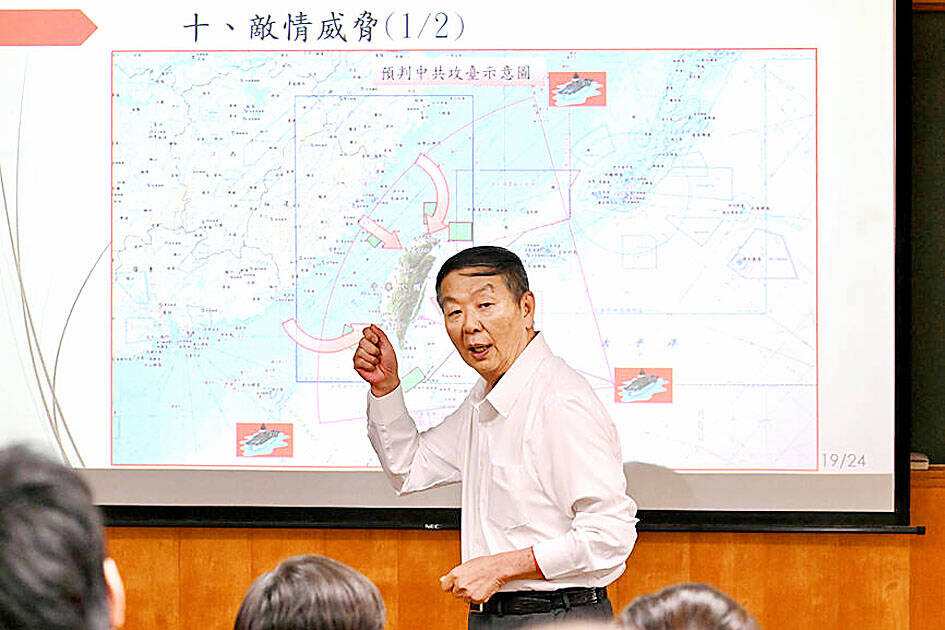
Photo: George Tsorng, Taipei Times
As head of the IDS program, Huang oversaw the early stages, including negotiating foreign procurement, securing restricted components and finalizing the submarine’s design.
His leadership culminated in the launch of the Hai Kun (海鯤), or “Narwhal,” Taiwan’s first indigenous submarine, in September 2023.
Lai described the launch as a milestone in strengthening the nation’s defense self-reliance and said that subsequent work has since advanced smoothly.
Given his central role in developing the submarine program, Huang’s resignation sparked speculation about any potential impact on the Hai Kun’s ongoing sea trials and the building of further submarines.
Naval officials said Huang had already stepped down as convener in April last year, staying on only as a consultant while Navy Commander Admiral Tang Hua (唐華) assumed responsibility for the project’s management.
A source familiar with the program said Huang remained in the advisory role at Lai’s request for more than a year, but eventually felt his contributions were limited as the project had entered a more stable phase.
The IDS program is a collective effort undertaken by the Navy and shipbuilder CSBC Corp, Taiwan; National Defense and Security Research fellow Su Tzu-yun (蘇紫雲) said.
Huang’s greatest contribution was providing direction and steering the program through its most difficult initial stage, he added.
CSBC yesterday did not elaborate on whether Huang’s resignation is to affect the Hai Kun’s sea trials or delivery schedule.
It said it had never hired Huang for any position, including director or consultant, adding that it had no comment on whether he would be hired to help matters concerning the Hai Kun.
The submarine reportedly is to conduct its fourth sea acceptance tests (SAT) by the end of this month.
The submarine, which has carried out its third SAT, has to pass surface navigation trials, submerged tests and other tests before delivery.
CSBC Corp has not announced the dates for the submarine’s sea trials.
CSBC chairman Chen Cheng-hung (陳政宏) said earlier this month that the company would do everything within its power to ensure that the submarine meets the delivery deadline of November.
The company must proceed step by step to ensure the submarine’s functionality meets standards before conducting submerged and other tests, said Chen, an associate professor of the Department of Systems and Naval Mechatronic Engineering at National Cheng Kung University.
The company is to first perform shallow-water tests, followed by deep-sea tests, and is to also conduct torpedo launch trials, he said.
Despite variables such as sea conditions, the company would try its best to avoid penalties by meeting the contract delivery deadline, he added.
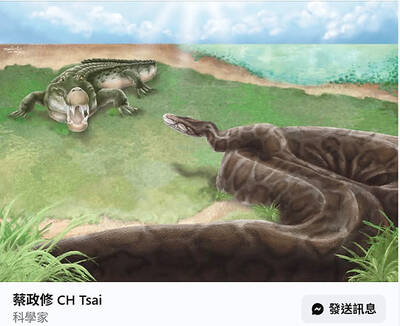
Taiwanese paleontologists have discovered fossil evidence that pythons up to 4m long inhabited Taiwan during the Pleistocene epoch, reporting their findings in the international scientific journal Historical Biology. National Taiwan University (NTU) Institute of Ecology and Evolutionary Biology associate professor Tsai Cheng-hsiu (蔡政修) led the team that discovered the largest snake fossil ever found in Taiwan. The single trunk vertebra was discovered in Tainan at the Chiting Formation, dated to between 400,000 and 800,000 years ago in the Middle Pleistocene, the paper said. The area also produced Taiwan’s first avian fossil, as well as crocodile, mammoth, saber-toothed cat and rhinoceros fossils, it said. Discoveries

Taiwanese paleontologists have discovered fossil evidence that pythons up to 4m long inhabited Taiwan during the Pleistocene epoch, reporting their findings in the international scientific journal Historical Biology. National Taiwan University (NTU) Institute of Ecology and Evolutionary Biology associate professor Tsai Cheng-hsiu (蔡政修) led the team that discovered the largest snake fossil ever found in Taiwan. A single trunk vertebra was discovered in Tainan at the Chiting Formation, dated to between 800,000 to 400,000 years ago in the Middle Pleistocene, the paper said. The area also produced Taiwan’s first avian fossil, as well as crocodile, mammoth, sabre-toothed cat and rhinoceros fossils, it said. Discoveries
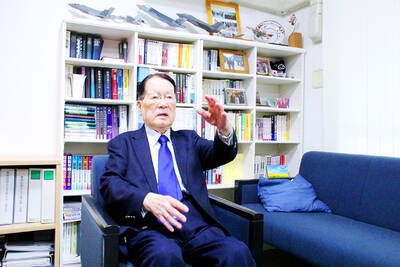
Whether Japan would help defend Taiwan in case of a cross-strait conflict would depend on the US and the extent to which Japan would be allowed to act under the US-Japan Security Treaty, former Japanese minister of defense Satoshi Morimoto said. As China has not given up on the idea of invading Taiwan by force, to what extent Japan could support US military action would hinge on Washington’s intention and its negotiation with Tokyo, Morimoto said in an interview with the Liberty Times (sister paper of the Taipei Times) yesterday. There has to be sufficient mutual recognition of how Japan could provide
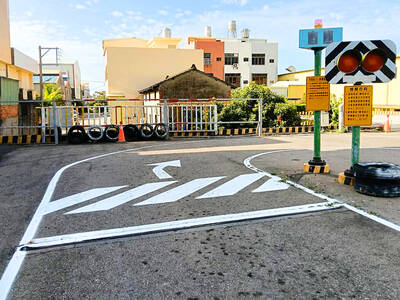
UPDATED TEST: The new rules aim to assess drivers’ awareness of risky behaviors and how they respond under certain circumstances, the Highway Bureau said Driver’s license applicants who fail to yield to pedestrians at intersections or to check blind spots, or omit pointing-and-calling procedures would fail the driving test, the Highway Bureau said yesterday. The change is set to be implemented at the end of the month, and is part of the bureau’s reform of the driving portion of the test, which has been criticized for failing to assess whether drivers can operate vehicles safely. Sedan drivers would be tested regarding yielding to pedestrians and turning their heads to check blind spots, while drivers of large vehicles would be tested on their familiarity with pointing-and-calling


 RSS
RSS