


Former premier Chang Chun-hsiung (張俊雄), who was also a former presidential adviser, died yesterday.
He was 87.
President William Lai (賴清德) offered condolences to the family, saying that Chang had led an exemplary life by making great contributions to democracy and human rights in Taiwan, and giving voice to disenfranchised people.
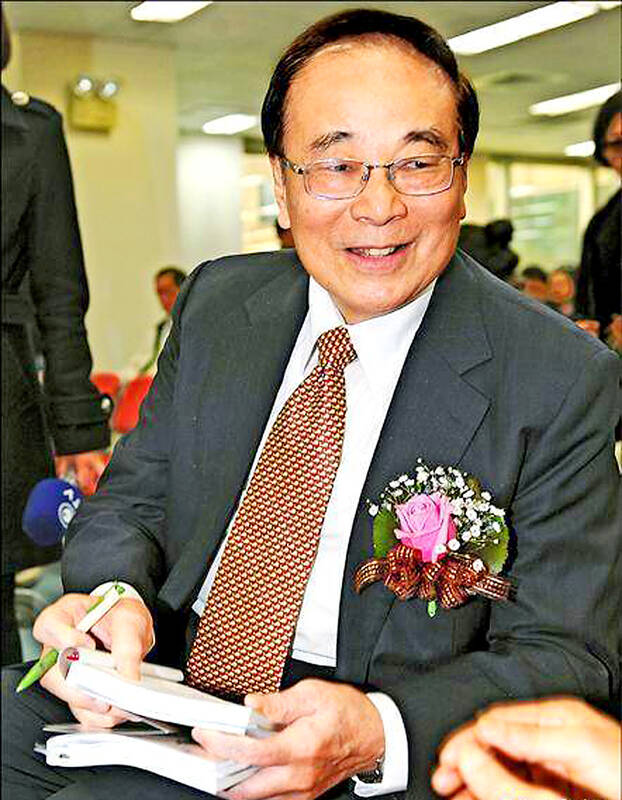
Photo: Taipei Times
Chang had been a defense lawyer for people prosecuted during the 1979 Kaohsiung Incident, showing a stout heart in the defense of freedom and human rights, Lai said.
He was a faithful servant of the public, having served as a lawmaker for multiple terms, Presidential Office secretary-general and chairman of the Straits Exchange Foundation, Lai said, adding that Chang played a role in cultivating Taiwan’s ties with the international community.
Chang was deeply involved in charitable causes and issues affecting the public even after retiring from politics, Lai said.
Taiwanese should remember Chang’s achievements in facilitating the development of democracy, the rule of law, human rights and public governance, he said.
Government offices have been ordered to provide for Chang’s funeral arrangements if necessary.
Former presidents Chen Sui-bian (陳水扁) and Tsai Ing-wen (蔡英文), as well as Premier Cho Jung-tai (卓榮泰) also offered their condolences yesterday.
Born in Chiayi County in 1938, Chang graduated from National Taiwan University's law school before beginning his legal career in Kaohsiung.
A core member who co-founded the DPP in 1986, Chang served six terms as a legislator and also held posts such as DPP secretary-general, Presidential Office secretary-general, and twice as premier -- from Oct. 2000 to Feb. 2002 and from May 2007 to May 2008 -- both under Chen.
Following his one-year stint as premier for a second time from 2007 to 2008, Chang stepped back from politics and devoted himself to charitable work, mainly volunteering in prisons to support inmate rehabilitation.
Chang was appointed a senior adviser to the president when the DPP returned to power in 2016 under Tsai, a role he continued in under Lai.
While neither the Presidential Office nor the DPP disclosed the cause of death, former legislator Huang Chao- hui (黃昭輝) of the DPP said Chang passed away peacefully at home on Saturday afternoon, attributing it to natural causes associated with aging.
Additional reporting by CNA

FUKUOKA SITUATION: Japanese media reported that the pathogen is expected to be identified by the summer, while the CDC downplayed the idea that it was hMPV A “mysterious cold-like illness” reported in Japan’s Fukuoka Prefecture does not seem to be a new disease, but Japanese authorities have been asked about the situation, the Centers for Disease Control (CDC) said yesterday. The Fukuoka Prefectural Medical Association on Wednesday told a news conference that a “mystery cold” that has become a hot topic on social media is “highly likely to be caused by some kind of viral infection,” Japan’s KBC News reported. “Many people are experiencing symptoms starting with a sore throat, followed by a runny nose, phlegm and a severe cough,” KBC News reported, citing association officials. Health authorities are

Nvidia Corp CEO Jensen Huang (黃仁勳) arrived in Taiwan yesterday ahead of upcoming AI and technology events, saying he plans to meet with clients and Taiwan Semiconductor Manufacturing Co Chairman C.C. Wei (魏哲家) during his visit. After landing at Taipei Songshan Airport, Huang posed for photos with fans and handed out Yakult drinks to reporters and supporters waiting at the scene, saying he has “a lot to do” during the trip. Asked about reports that Nvidia’s planned headquarters site in Taipei’s Beitou Shilin Technology Park could break ground on May 27, Huang said that if the company holds an event, he would

The Ministry of Finance this afternoon announced the winning numbers for the March-April uniform invoice lottery. The winning number for the NT$10 million (US$318,060) special prize is 19531471, and the winning number for the NT$2 million grand prize is 85941329. Three numbers were drawn for the NT$200,000 first prize: 07225810, 20231230 and 83518781. Those with receipts matching the last seven digits of any of the first-prize numbers will win the NT$40,000 second prize, while those matching the last six digits will win the NT$10,000 third prize. Those whose receipts match the last five digits of the first-prize numbers can claim the NT$4,000 fourth prize,
Former president Ma Ying-jeou (馬英九) yesterday expressed “shock and regret” over a statement issued by his wife without his consent, and rejected her assertion that his eldest sister, Ma Yi-nan (馬以南), would manage his medical care or act as his spokesperson amid an ongoing embezzlement probe into his foundation. Ma Ying-jeou in a statement said he was shocked by a statement by his wife, Chou Mei-ching (周美青), regarding his affairs. Ma Yi-nan “must not” be in charge of his healthcare and other personal affairs, nor can she be allowed to represent the Ma family, the former president said. He said he was also


 RSS
RSS