


Civic groups yesterday urged the inclusion of more specific and comprehensive risk assessment criteria in draft amendments to nuclear facility regulations proposed by the Nuclear Safety Commission.
The commission last month announced draft amendments to the Regulations on the Application for an Operating License of Nuclear Reactor Facilities (核子反應器設施運轉執照申請審核辦法).
The bill would cancel the operating license renewal deadline of five to 15 years prior to the originally scheduled retirement date, but would require operators to submit evaluation reports on seismic safety and radiation hazards, in addition to age-related degradation, for extended use of the facilities.
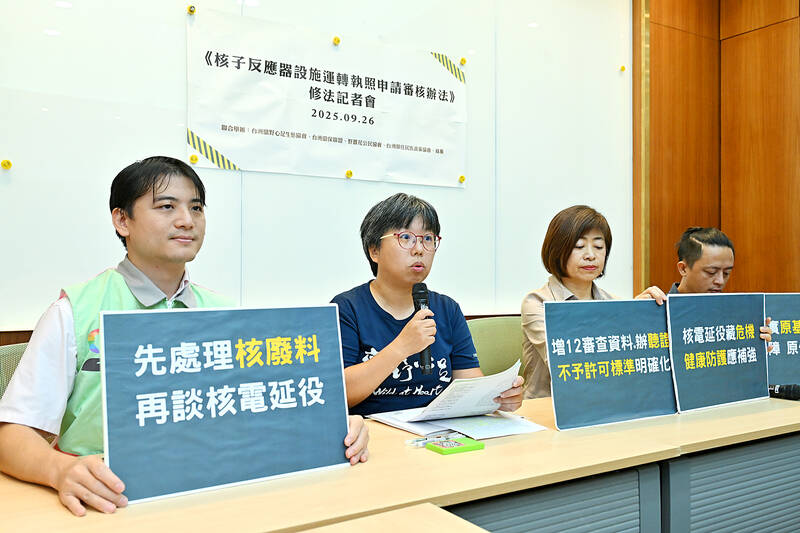
Photo: Tien Yu-hua, Taipei Times
However, civic groups yesterday told a news conference that such requirements were too loose and failed to consider threats from extreme weather and protection of indigenous people’s rights.
Wild at Heart Legal Defense Association attorney Tsai Ya-ying (蔡雅瀅) said concerns that would advise against license renewals should also be specified in proposed revisions.
For example, nuclear facilities in areas with high geological risk, such as volcanic regions, active faults, land subsidence and potential debris flow, or with coastal hazards, such as tsunami, storm surges, coastal erosion or rising sea levels, should have their renewal denied, Tsai said.
The same should apply to nuclear facilities that are not cost-effective or located within 50km of reservoir watersheds or in areas where residents within a 30km radius could not be evacuated after a nuclear accident, she said.
Tsai also suggested necessitating two-phase environmental impact assessments (EIA) in license renewal applications in line with the retirement procedure.
“The three previously serving nuclear plants have all undergone two-phase EIA reviews when they were retired, and extending a nuclear plant’s service life would pose hazards no less than shutting them down,” she said.
Tsai also cited National Taiwan Ocean University Earth sciences researcher Wang Shou-cheng (王守誠) as saying that the US Nuclear Regulatory Commission requires an EIA on extreme weather conditions such as floods, extreme heat and sea-level rise in license renewal applications.
Tzu Chi University public health associate professor Hsieh Wan-hua (謝婉華) said the risk and long-term impact of potential radioactive contamination on local residents should also be considered.
Operators seeking license renewal should be required to simulate scenarios of composite disasters caused by extreme weather and conduct graded disaster response drills, she said.
They should also plan long-term, periodic health checks for residents, given that radioactive contamination’s impact on human health can last for decades, Hsieh said, adding that such reports could be submitted as supplementary documents to simplify regulatory procedures.
Association for Taiwan Indigenous Peoples’ Policies president Yapasuyongu Akuyana said that informed consent from local indigenous people should be necessitated in any proposed extension of nuclear facilities that are in indigenous traditional territories.
The commission should take its responsibility as the license granting authority by enforcing Article 21 of the Indigenous Peoples Basic Act (原住民族基本法), he said.

FUKUOKA SITUATION: Japanese media reported that the pathogen is expected to be identified by the summer, while the CDC downplayed the idea that it was hMPV A “mysterious cold-like illness” reported in Japan’s Fukuoka Prefecture does not seem to be a new disease, but Japanese authorities have been asked about the situation, the Centers for Disease Control (CDC) said yesterday. The Fukuoka Prefectural Medical Association on Wednesday told a news conference that a “mystery cold” that has become a hot topic on social media is “highly likely to be caused by some kind of viral infection,” Japan’s KBC News reported. “Many people are experiencing symptoms starting with a sore throat, followed by a runny nose, phlegm and a severe cough,” KBC News reported, citing association officials. Health authorities are

Nvidia Corp CEO Jensen Huang (黃仁勳) arrived in Taiwan yesterday ahead of upcoming AI and technology events, saying he plans to meet with clients and Taiwan Semiconductor Manufacturing Co Chairman C.C. Wei (魏哲家) during his visit. After landing at Taipei Songshan Airport, Huang posed for photos with fans and handed out Yakult drinks to reporters and supporters waiting at the scene, saying he has “a lot to do” during the trip. Asked about reports that Nvidia’s planned headquarters site in Taipei’s Beitou Shilin Technology Park could break ground on May 27, Huang said that if the company holds an event, he would

The Ministry of Finance this afternoon announced the winning numbers for the March-April uniform invoice lottery. The winning number for the NT$10 million (US$318,060) special prize is 19531471, and the winning number for the NT$2 million grand prize is 85941329. Three numbers were drawn for the NT$200,000 first prize: 07225810, 20231230 and 83518781. Those with receipts matching the last seven digits of any of the first-prize numbers will win the NT$40,000 second prize, while those matching the last six digits will win the NT$10,000 third prize. Those whose receipts match the last five digits of the first-prize numbers can claim the NT$4,000 fourth prize,

SIX SUBSIDIES: The monthly allowance for older farmers is to increase to NT$10,000, and NT$5,000 is to be given to homemakers under the national pension system, Lai said The government is to implement major welfare policies for disadvantaged groups, including raising the monthly allowance for older farmers to NT$10,000 and providing homemakers with NT$5,000 per month, President William Lai (賴清德) said yesterday. Lai made the remarks during a visit to Wangling Temple in Chiayi County, saying that the planned increases were being introduced amid economic growth and an increase in tax revenue. Touting a policy, in which the government plans to provide a monthly allowance of NT$5,000 for every child under the age of 18 in a bid to address Taiwan’s low birthrate, Lai said that if received for the


 RSS
RSS