


The majority of air defense shelters do not meet standards, Taiwan Statebuilding Party (TSP) members said on Wednesday last week, criticizing the National Police Agency (NPA) for failing to provide adequate information to the public.
Party officials and volunteers have in the past month conducted on-site inspections of more than 200 air defense shelters in northern Taiwan, and have found numerous flaws and subpar conditions, TSP secretary-general Wu Hsin-tai (吳欣岱) told a news conference.
Only 20 percent conform to the required standards, while they found recurring problems during their inspections, including “erroneous location and confusing data on the map,” “dirty or dilapidated shelter entrance signage,” and “lacking proper management and control at the shelter entrance,” Wu said.

Photo: Lo Pei-de, Taipei Times
The NPA lists about 105,000 air defense shelters throughout the nation, but “in our inspection, we found the actual locations were way off from the location indicated on the digital map. The largest discrepancy was off by more than 300m,” Wu said.
“Also in our on-site visit, most shelter signage is merely a piece of paper. So people at these buildings have to spend time and effort to update the shelter signage,” she said.
“Most shelters are in the basement. In the event of a major disaster that necessitates evacuation, would the building’s security personnel ensure the entrance is open, any time during the 24-hour cycle, for local residents to go inside the shelter?” Wu asked.
Kuma Academy cofounder Ho Cheng-hui (何澄輝) said Taiwan must take lessons from other countries on how to improve resilience during major emergency events.
“An air defense shelter is not just a space underground. When large numbers of people take shelter in the basement, it is required to have proper air circulation and drinking water systems, and basic infrastructure set-ups are important, but we have yet to see these in government plans,” Ho said.
TSP Tainan chapter director Wu Yi-chieh (吳依潔) said that most evacuation plans consist of recording the location data on file and making checks at some shelters.
“Overall these are lacking in proper management, and have insufficient guidance and public education for local people to have better awareness,” she said.
“Right now it relies on residents to report shelters not meeting the criteria, or if provisions of the Building Act (建築法) have been contravened, then local police would come to deal with the complaint,” she added.
“We urge the local city and county governments to first introduce relevant regulations and administrative orders, and mandate building management committees to implement them. These would include supervision of entrance opening, crowd control, refurbishment of needed equipment, and regular checks,” Wu Yi-chieh said.
Chuang Kuo-yu (莊國煜), founder of software firm GeoThings Inc, based in Hsinchu County, said that he has launched Line groups based on the concept of “disaster prevention and safeguarding the local community,” so people can update air defense shelter information, including GPS locations, as well as being able to upload photographs.
“We invite everyone to inspect shelters near their homes to have more complete information on air defense shelters in local neighborhoods, so that we can build up a more accurate and more useful digital map to locate all the shelters. We are doing this from the grassroots, going up to higher levels of society to awaken people to the importance and needs of whole-of-society defense planning,” Wu Hsin-tai said.
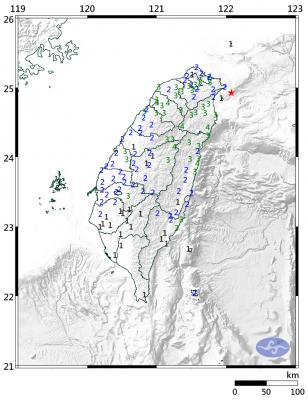
A magnitude 6.1 earthquake struck off the coast of Yilan County at 8:39pm tonight, the Central Weather Administration (CWA) said, with no immediate reports of damage or injuries. The epicenter was 38.7km east-northeast of Yilan County Hall at a focal depth of 98.3km, the CWA’s Seismological Center said. The quake’s maximum intensity, which gauges the actual physical effect of a seismic event, was a level 4 on Taiwan’s 7-tier intensity scale, the center said. That intensity level was recorded in Yilan County’s Nanao Township (南澳), Hsinchu County’s Guansi Township (關西), Nantou County’s Hehuanshan (合歡山) and Hualien County’s Yanliao (鹽寮). An intensity of 3 was
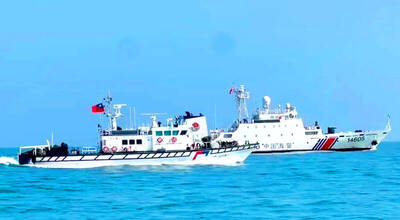
Instead of focusing solely on the threat of a full-scale military invasion, the US and its allies must prepare for a potential Chinese “quarantine” of Taiwan enforced through customs inspections, Stanford University Hoover fellow Eyck Freymann said in a Foreign Affairs article published on Wednesday. China could use various “gray zone” tactics in “reconfiguring the regional and ultimately the global economic order without a war,” said Freymann, who is also a nonresident research fellow at the US Naval War College. China might seize control of Taiwan’s links to the outside world by requiring all flights and ships entering or leaving Taiwan
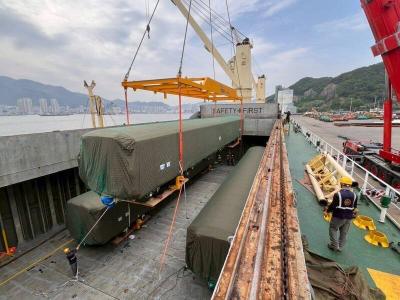
The first of 10 new high-capacity trains purchased from South Korea’s Hyundai Rotem arrived at the Port of Taipei yesterday to meet the demands of an expanding metro network, Taipei Rapid Transit Corp (TRTC) said yesterday. The train completed a three-day, 1,200km voyage from the Port of Masan in South Korea, the company said. Costing NT$590 million (US$18.79 million) each, the new six-carriage trains feature a redesigned interior based on "human-centric" transportation concepts, TRTC said. The design utilizes continuous longitudinal seating to widen the aisles and optimize passenger flow, while also upgrading passenger information displays and driving control systems for a more comfortable
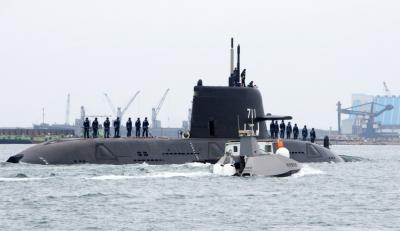
Taiwan's first indigenous defense submarine, the SS-711 Hai Kun (海鯤, or Narwhal), departed for its 13th sea trial at 7am today, marking its seventh submerged test, with delivery to the navy scheduled for July. The outing also marked its first sea deployment since President William Lai (賴清德) boarded the submarine for an inspection on March 19, drawing a crowd of military enthusiasts who gathered to show support. The submarine this morning departed port accompanied by CSBC Corp’s Endeavor Manta (奮進魔鬼魚號) uncrewed surface vessel and a navy M109 assault boat. Amid public interest in key milestones such as torpedo-launching operations and overnight submerged trials,


 RSS
RSS