


A large-scale tabletop simulation of a war between Taiwan and China conducted in June showed that Taiwan’s eastern flank is vulnerable to Chinese People’s Liberation Army (PLA) attacks, a review of the exercise said yesterday.
The Taipei School of Economics and Political Science Foundation, and cosponsors of the war games made the comments at the launch of a book series detailing the findings of the war games in Taipei.
The simulation suggests that effective countermeasures must be enacted to shield eastern Taiwan from unexpected strikes, as the region can no longer serve as a secure base of operations for the nation’s armed forces, they said.
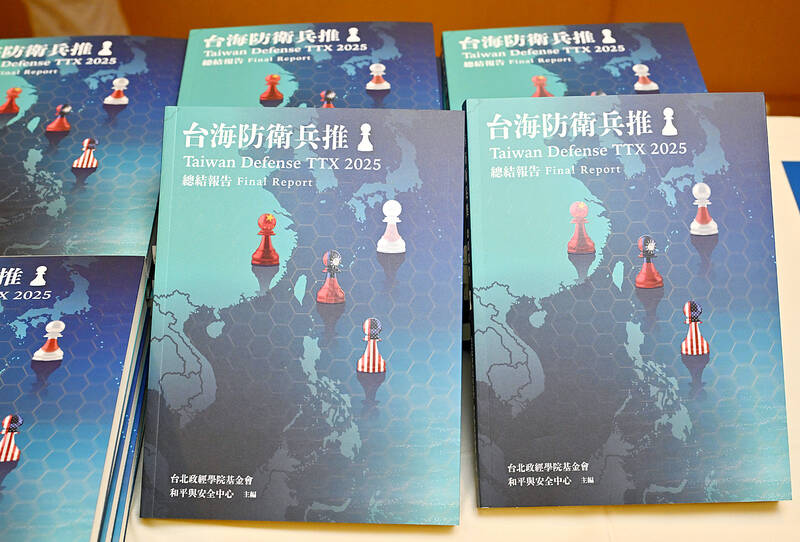
Photo: Tien Yu-hua, Taipei Times
Evolving PLA capabilities have upended the Taiwanese military’s go-to strategy of concentrating its main forces to defend Taiwan’s western coastline, Council on Strategic and Wargaming Studies chairman Huang Chieh-cheng (黃介正) said.
In the war games, PLA attacks on Penghu County and eastern Taiwan proved extremely dangerous, as Taiwanese forces found it impossible to relocate units to defend the thinly held fronts, he said.
Players assuming the role of foreign allies believed that Taiwanese forces should have held northern Taiwan more strongly, Huang said.
The dilemma of bolstering Taiwan’s northern and eastern defenses is a problem that the military leadership should consider, he said.
Taiwanese armed forces’ long-held assumption that strategic assets could be sheltered in Taiwan’s eastern region is no longer correct, former chief of the general staff Admiral Lee Hsi-ming (李喜明) said.
The PLA now possesses submarines and bombers with the capability of firing cruise missiles from the air and seas east of Taiwan, endangering the fighter jets in the underground hangars of Hualien County’s Chiashan Air Force Base, he said.
Stationing more aircraft at the base would be risky, as they could be destroyed by one missile scoring a direct hit through the mouth of the cave, he added.
Meanwhile, the navy’s strategy to relocate its fleet to the Pacific Ocean would lead to it being compelled to fight a decisive battle with a PLA carrier strike group, or conceding Taiwan’s western waters to the enemy, he said.
The latter scenario would allow the PLA to cross the Taiwan Strait and impose a blockade uncontested, cutting off the Taiwanese navy from its home base, he said.
The navy’s better option would be to deploy in the near waters off eastern Taiwan as an integral component of a joint coastal defense force, he said.
The protection offered by land-based air defense and anti-ship missiles would enable the fleet to contribute to military operations in a full-scale conflict with China, Huang said.
The war games also demonstrated that the Taiwanese armed forces need to establish clear rules of engagement to counter China’s “gray zone” warfare, the organizers said.
The simulation confirmed that the PLA could utilize a pretend exercise to prepare for a full-scale invasion, and that Taiwan’s outlying islands are highly vulnerable to being isolated, they said.
It showed that the nation should enhance its coordination with allies to counter a PLA blockade, as well as cooperation between the navy and coast guard, the organizers said.

FUKUOKA SITUATION: Japanese media reported that the pathogen is expected to be identified by the summer, while the CDC downplayed the idea that it was hMPV A “mysterious cold-like illness” reported in Japan’s Fukuoka Prefecture does not seem to be a new disease, but Japanese authorities have been asked about the situation, the Centers for Disease Control (CDC) said yesterday. The Fukuoka Prefectural Medical Association on Wednesday told a news conference that a “mystery cold” that has become a hot topic on social media is “highly likely to be caused by some kind of viral infection,” Japan’s KBC News reported. “Many people are experiencing symptoms starting with a sore throat, followed by a runny nose, phlegm and a severe cough,” KBC News reported, citing association officials. Health authorities are

Nvidia Corp CEO Jensen Huang (黃仁勳) arrived in Taiwan yesterday ahead of upcoming AI and technology events, saying he plans to meet with clients and Taiwan Semiconductor Manufacturing Co Chairman C.C. Wei (魏哲家) during his visit. After landing at Taipei Songshan Airport, Huang posed for photos with fans and handed out Yakult drinks to reporters and supporters waiting at the scene, saying he has “a lot to do” during the trip. Asked about reports that Nvidia’s planned headquarters site in Taipei’s Beitou Shilin Technology Park could break ground on May 27, Huang said that if the company holds an event, he would

The Ministry of Finance this afternoon announced the winning numbers for the March-April uniform invoice lottery. The winning number for the NT$10 million (US$318,060) special prize is 19531471, and the winning number for the NT$2 million grand prize is 85941329. Three numbers were drawn for the NT$200,000 first prize: 07225810, 20231230 and 83518781. Those with receipts matching the last seven digits of any of the first-prize numbers will win the NT$40,000 second prize, while those matching the last six digits will win the NT$10,000 third prize. Those whose receipts match the last five digits of the first-prize numbers can claim the NT$4,000 fourth prize,
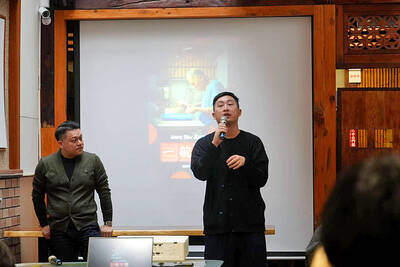
Taiwan Travelogue (臺灣漫遊錄), which earlier this week became the first Taiwanese novel to win the International Booker Prize, is to be adapted into a television series through a Taiwan-Japan coproduction, producer Chang Chen-yu (張辰漁) said yesterday. Chang, a producer at World Softest Production Film Co, wrote on Facebook that the company had been searching for projects with international appeal that retain a strong Taiwanese identity after colleagues and Japanese partners strongly recommended the novel. After reading the book, Chang said he immediately decided to pursue the screen rights. “A great story has the power to transcend time and borders, and connect countless people,”


 RSS
RSS