


The Ocean Affairs Council yesterday unveiled its latest National Ocean Policy White Paper, with the goal of building Taiwan into a resilient maritime state that upholds safety, sustainability and coprosperity.
Vice President Hsiao Bi-khim (蕭美琴), in her address, said the applications of space and satellite technology in vessel monitoring, maritime security and ocean resource management are aligned with the vision to develop the space and oceanic industries, which was proposed by President William Lai (賴清德) in his inaugural address last year.
“The ocean and the space are not two isolated worlds, but should be regarded as critical partners that jointly safeguard the Carth,” she said, adding that “resilience” is considered the core idea to build Taiwan into a maritime state with safety, sustainability and coprosperity.
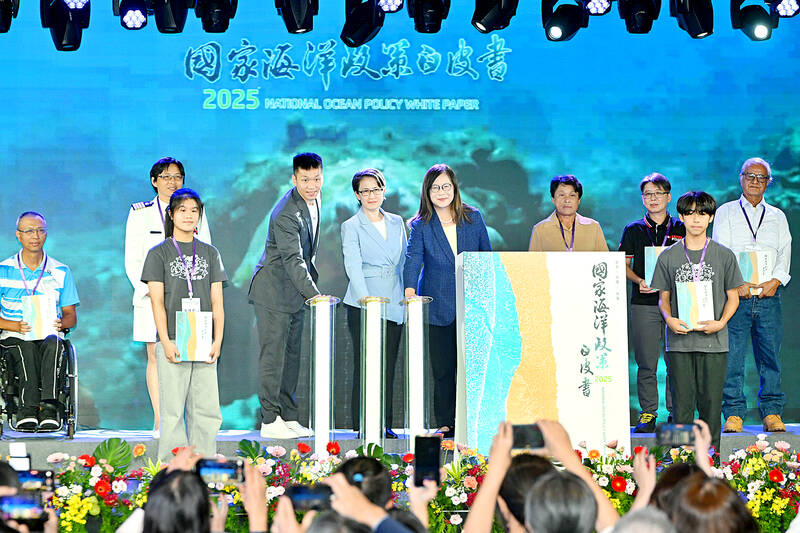
Photo: Tien Yu-hua, Taipei Times
Oceanic safety reflects defense resilience, Hsiao said.
More advanced technology, such as drones and artificial intelligence, as well as modern vessels, would be adopted to support frontline personnel in maritime law enforcement and rights protection, she said.
Taiwan will also continue to cooperate with international partners to defend maritime order, protect people and conserve ocean resources, she said.
Oceanic sustainability reflects ecological resilience, she said, adding that the Marine Conservation Act (海洋保育法) enacted last year was a commitment made by the government to sustainability.
More than 6,000 fishing boats and more than 5,000 divers have volunteered to help collect marine debris from the ocean over the past few years, Hsiao said.
Oceanic coprosperity demonstrates marine governance by all people and industrial applications of ocean resources, she said.
The government continues to promote maritime spatial planning and information openness to make ocean resources more accessible to all people, she said.
The implementation of ocean policies requires interagency efforts, and collaborations among the government, research institutions and the private sector, she said.
Hsiao said she expects the ruling and opposition parties to cooperate in the legislature to support a special budget bill proposed by the Cabinet in accordance with the Special Act for Strengthening Economic, Social and National Security Resilience in Response to International Circumstances (因應國際情勢強化經濟社會及民生國安韌性特別條例).
Ocean Affairs Council Minister Kuan Bi-ling (管碧玲) said the oceanic challenges facing Taiwan include the disparity between the vision and resources available, obstacles to interagency collaborations, the dilemma between economic development and environmental protection, and geopolitical pressure — particularly “gray zone” harassment by China.
“We must realize that this [Chinese ‘gray zone’ warfare] is not a short-term problem, but a structural challenge,” she said.
To resolve these challenges, continued support from the legislature, sufficient government funding and academic research, and broad public involvement are all required, she added.
Kuan said the first version of the white paper was published five years ago based on the Ocean Basic Act (海洋基本法).
The government has invested NT$100 billion (US$3.29 billion) in related schemes and construction projects, and completed 177 undertakings over the past five years, including building 95 patrol vessels and eradicating illegal sand dredging, she said.
The output value of the ocean industry increased to NT$1.2 trillion over the period, accounting for 5.4 percent of the nation’s GDP and is estimated to have created more than 1 million job opportunities, she added.

NATIONAL SECURITY: Authorities are working to confirm the identities of the military personnel involved and investigating possible illegal conduct and regulatory violations Authorities are probing possible national security implications after Kinmen police and immigration officers on Sunday found a Chinese woman allegedly posing as a tourist while engaging in prostitution involving more than 10 military personnel. The woman, surnamed Chen (陳), has since been deported, authorities said, adding that investigators are still working to confirm the identities of those implicated, as the records only listed code names and aliases. The case stemmed from a report received by the Kinmen District Prosecutors’ Office on Friday last week from the Jinhu Precinct of the Kinmen County Police Bureau. On Sunday, police, along with the National Immigration

GLOBALGIVING: ‘ Caving to external pressure is not acceptable for an organization that has cultivated justice reform and human rights for 30 years,’ one NGO said A slew of non-government organizations (NGOs) have withdrawn from the GlobalGiving fundraising platform after it announced it would use “Chinese Taipei” instead of “Taiwan” from next month. The Taiwan Good Rice Association wrote on Facebook on Friday that it was informed on April 28 via a teleconference call of the change, which was made because the platform wanted to operate in China. Taiwan Good Rice is to terminate all cooperative relationships with GlobalGiving in response to the platform’s “unilateral and non-negotiable” decision to remove references to Taiwan, the NGO said. “Taiwan is in the official name of Taiwan Good Rice Association and the

HEAVY WEATHER: Typhoon Jangmi is due to crash straight into the Ryukyus as airlines look to shift flights to larger aircraft or cancel flights to Okinawa entirely Taiwan’s international air carriers announced flight adjustments over the weekend as Typhoon Jangmi is forecast to hit the Ryukyu Islands today and tomorrow. The Central Weather Administration (CWA) upgraded Jangmi from a tropical storm to a typhoon at 8am yesterday, with the eye located 580km south of Naha city. It was moving north at 19kph. Today, China Airlines’ CI-120, CI-121, CI-122 and CI-123 flights between Taoyuan and Naha, Okinawa, have been canceled as well as CI-132 and CI-133 between Kaohsiung and Naha. EVA Air’s BR-112, BR-113, BR-186 and BR-185 flights between Taoyuan and Naha are also canceled. Low-cost carrier Tigerair Taiwan canceled IT-230,

Chinese Nationalist Party (KMT) Chairwoman Cheng Li-wun (鄭麗文) yesterday briefed her party’s Central Standing Committee regarding her scheduled visit to the US between Monday next week and June 16, saying that her purpose would be to persuade the US that the Republic of China (ROC) Constitution was a “one China” constitution that would foster stable and peaceful cross-strait relations. The ROC Constitution is the most important defense for all Taiwanese citizens, as it upholds our democracy and has contributed to our robust economy, which aligns with international and US interests, she said. “We would not be troublemakers and drag the US under,”


 RSS
RSS