


Visitors to Taiwan’s Tech World pavilion at the World Expo in Osaka, Japan, could potentially exceed 1 million when the event wraps up next month, the pavilion’s management said on Wednesday.
A total of 158 countries around the world are participating in the quinquennial event in Kansai, which opened on April 13 and runs until Oct. 13.
As Taiwan is not a member of the Paris-based International Exhibition Bureau, the pavilion cannot be named the “Taiwan Pavilion,” nor can it be organized by a government agency.
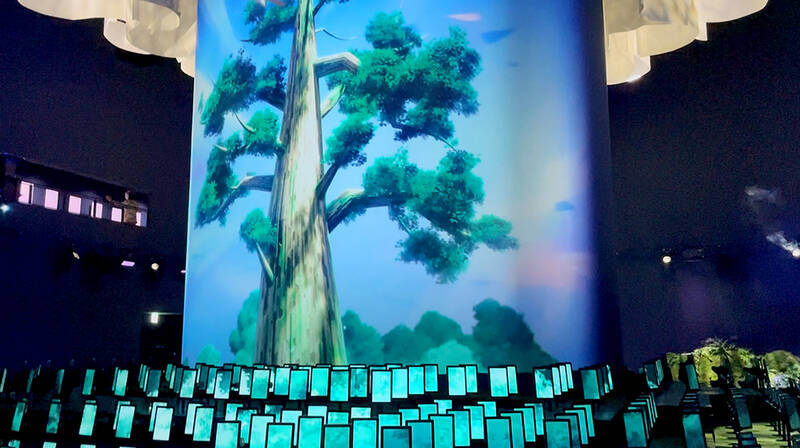
Photo: Shelley Shan, Taipei Times
Instead, the pavilion was called Tech World, which was built and organized by Tamayama Digital Tech Co, a private Tokyo-based firm established by the semi-official Taiwan External Trade Development Council (TAITRA).
The pavilion’s metallic exterior, which was jointly designed by Taiwanese and Japanese architects, was inspired by Taiwan’s sprawling mountain ranges, the organizer said.
Its three main exhibition sections are designed around the themes of life, nature and the future, it said.
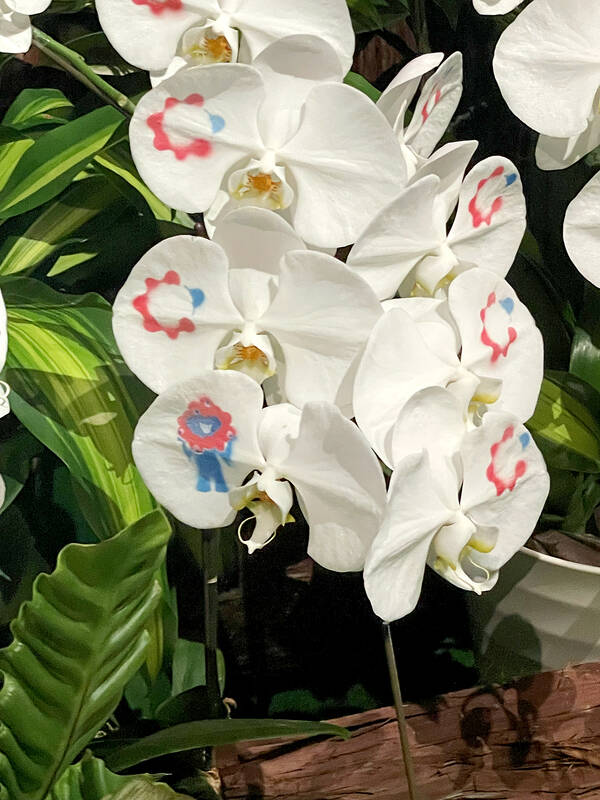
Photo: Shelley Shan, Taipei Times
In the “Life Theater,” visitors are greeted by a large cylindrical projection of a Taiwania tree to showcase Taiwan’s rich and diverse ecosystems.
The projection is surrounded by a mechanical flower display that was created by integrating a human-responsive swaying mechanism, robotic arms and 560 tablet computers.
The human-responsive swaying mechanism is a patented technology developed by Taiwan’s Industrial Technology Research Institute, while the tablets were manufactured by Asustek Computer and the robotic arms by Hiwin Technologies.
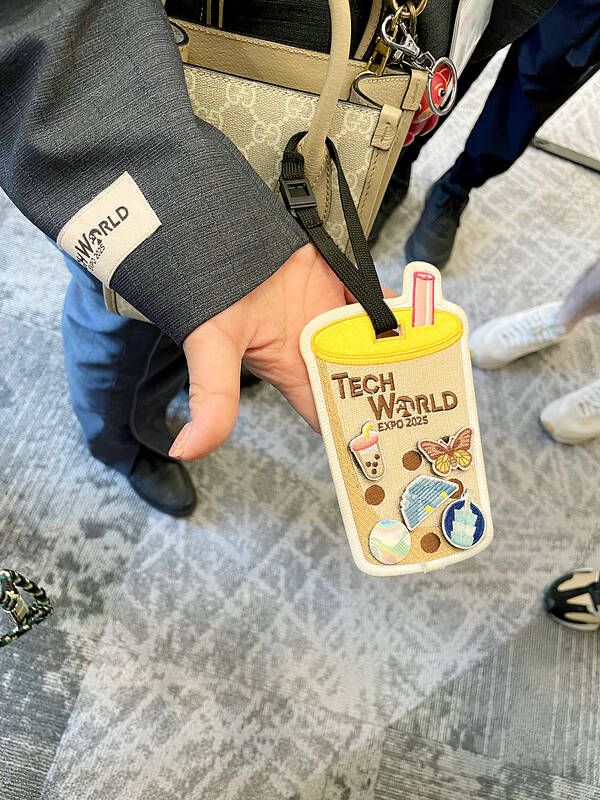
Photo: Shelley Shan, Taipei Times
To showcase Taiwan’s Phalaenopsis orchid industry, a 60-inch micro-LED panel made by AUO Corp was installed to showcase digital butterflies dancing around real orchids, the organizer said.
Nano-spray dyeing technology was applied to print different colors or patterns on the petals of the orchids without damaging the floor, it added.
An artificial intelligence model was trained to learn the artistic styles of several famous 20th-century Taiwanese painters — including Chen Cheng-po (陳澄波) — to recreate digital displays of Taiwanese urban and rural landscapes, it said.
Visitors are given a smart watch upon entry to the pavilion to record their heartbeats in each section.
Toward the end of their visit, they can place the watch close to a device, which would then recommend, based on their heartbeat, the type of trips that might suit them best when they visit Taiwan.
This was the second time that Taiwan was invited to the World Expo since 1972, TAITRA deputy secretary-general Felix Chiu (邱輝立) told Taiwanese journalists on Wednesday, adding that the Tech World pavilion was designed according to the main theme of this year’s World Expo: Designing Future Society for Our Lives.
The pavilion can accommodate up to 5,000 visitors per day, he added.
“We initially set a goal of attracting 1 million visitors during the World Expo. This includes visitors entering the pavilion, people who stop by gift stores only, as well as those who come for the special events we organized. We should have no trouble exceeding that goal,” he told reporters.
Tech World has become one of the five-to-six-most popular pavilions in the past five months, and one of the top five pavilions generating discussion among Japanese on X, Chiu said.
“People usually aim for certain pavilions when they visit. What I mean by popular is that visitors would form a line way past the designated queue area before 10am daily,” he said.
Chiu attributed the popularity of the pavilion in part to visitors receiving souvenirs at the end of their visit, with morning and afternoon guests receiving different gifts.
A Japanese visitor who bought a multiple-day pass to the expo visited the pavilion more than 100 times to collect all eight different souvenirs that the pavilion has prepared for visitors, including a tote bag, a steamed dumpling-shaped ornament, a towel with the image of Formosan black bear and a bubble-tea-shaped luggage tag, he said.
More visitors may be more motivated to visit the exhibition, as it is ending in less than 20 days, he said.
About 60 percent of the visitors to the pavilion are Japanese, while 30 to 40 percent were from other parts of the world, including Taiwan, he said.
Asked what they would do with the pavilion after the event ends, Chiu said that there has yet to be a formal discussion over this matter, adding that it would be decided after considering the public response to it in Taiwan.
Japan has not decided what it would do with the venue and facilities built specifically for the World Expo, such as the Grand Ring, the world’s largest wooden architectural structure, he added.
Sachiko Yoshimura, director-general of Public Relations and Promotion Bureau from the Japan Association for the 2025 World Exposition, said that the three pavilions with the longest waiting time are those of Italy, the US and France.
The instruction that the association received from France is to demolish all the installations at the venue after the exposition ends and return it to the city of Osaka, she said.

FUKUOKA SITUATION: Japanese media reported that the pathogen is expected to be identified by the summer, while the CDC downplayed the idea that it was hMPV A “mysterious cold-like illness” reported in Japan’s Fukuoka Prefecture does not seem to be a new disease, but Japanese authorities have been asked about the situation, the Centers for Disease Control (CDC) said yesterday. The Fukuoka Prefectural Medical Association on Wednesday told a news conference that a “mystery cold” that has become a hot topic on social media is “highly likely to be caused by some kind of viral infection,” Japan’s KBC News reported. “Many people are experiencing symptoms starting with a sore throat, followed by a runny nose, phlegm and a severe cough,” KBC News reported, citing association officials. Health authorities are

Nvidia Corp CEO Jensen Huang (黃仁勳) arrived in Taiwan yesterday ahead of upcoming AI and technology events, saying he plans to meet with clients and Taiwan Semiconductor Manufacturing Co Chairman C.C. Wei (魏哲家) during his visit. After landing at Taipei Songshan Airport, Huang posed for photos with fans and handed out Yakult drinks to reporters and supporters waiting at the scene, saying he has “a lot to do” during the trip. Asked about reports that Nvidia’s planned headquarters site in Taipei’s Beitou Shilin Technology Park could break ground on May 27, Huang said that if the company holds an event, he would

The Ministry of Finance this afternoon announced the winning numbers for the March-April uniform invoice lottery. The winning number for the NT$10 million (US$318,060) special prize is 19531471, and the winning number for the NT$2 million grand prize is 85941329. Three numbers were drawn for the NT$200,000 first prize: 07225810, 20231230 and 83518781. Those with receipts matching the last seven digits of any of the first-prize numbers will win the NT$40,000 second prize, while those matching the last six digits will win the NT$10,000 third prize. Those whose receipts match the last five digits of the first-prize numbers can claim the NT$4,000 fourth prize,
SIX SUBSIDIES: The monthly allowance for older farmers is to increase to NT$10,000, and NT$5,000 is to be given to homemakers under the national pension system, Lai said The government is to implement major welfare policies for disadvantaged groups, including raising the monthly allowance for older farmers to NT$10,000 and providing homemakers with NT$5,000 per month, President William Lai (賴清德) said yesterday. Lai made the remarks during a visit to Wangling Temple in Chiayi County, saying that the planned increases were being introduced amid economic growth and an increase in tax revenue. Touting a policy, in which the government plans to provide a monthly allowance of NT$5,000 for every child under the age of 18 in a bid to address Taiwan’s low birthrate, Lai said that if received for the


 RSS
RSS