


For years, Taiwan has viewed its dominance in supplying countries with cutting-edge chips as a shield from Chinese aggression. Now, officials are testing out semiconductors as a diplomatic sword.
On Tuesday, Taipei for the first time unilaterally imposed semiconductor export controls on a country, limiting shipments to South Africa for actions that “undermined our national and public security.”
Yesterday, the Ministry of Economic Affairs said it had decided to pause the controls as South Africa agreed to re-enter talks about relocating Taiwan’s representative office from Pretoria to Johannesburg.
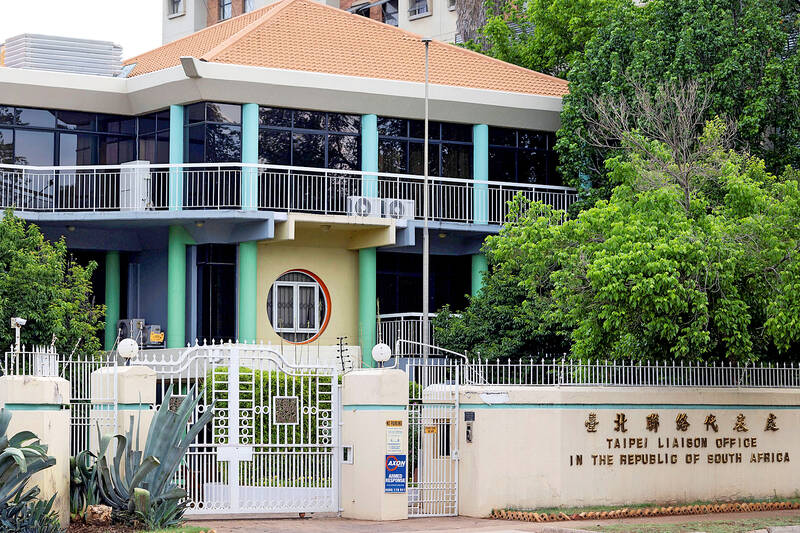
Photo: REUTERS
Taipei’s chip curbs reflect its strategy to increasingly use economic and trade policy for diplomatic goals, a Taiwanese official familiar with the matter said.
Similar measures could be imposed on other unfriendly nations, they added.
“By utilizing Taiwan’s position in the global chip supply chain, this looks like Taipei’s attempt at building an autonomous deterrent on the world stage,” said Sung Wen-ti (宋文笛), non-resident fellow at the Atlantic Council’s Global China Hub. “Going forward, other governments will be looking at this example and considering not only Taiwan’s carrots, but also its potential sticks.”’
While Taiwan likely would not wield such restrictions against major European economies or the US, President William Lai’s (賴清德) decision to target smaller partners could amplify broader concerns over its dominance of chips.
Export controls on semiconductors and chipmaking equipment have become a central battleground between the US and China in recent years, with Washington pressuring allies including the Netherlands, South Korea and Japan to adopt policies despite their potential to hurt domestic companies.
That has ramped up the need for countries to maintain a degree of supply chain self-reliance, even from friendly partners.
China is perhaps most exposed to Taiwan’s controls, as Lai becomes more assertive in countering Beijing’s aggression.
Earlier this year, Taiwan blacklisted Chinese tech giants Huawei Technologies Co and Semiconductor Manufacturing International Corp from accessing crucial chip plant construction technology, signaling a willingness to ramp up its use of trade tools.
Chinese Ministry of Foreign Affairs spokesman Guo Jiakun (郭嘉昆) on Wednesday told a regular news briefing in Beijing that Taiwan had “deliberately destabilized global” supply chains with its action against South Africa.
The South Africa policy is still in its “notification period,” said Cathy Fang (方怡然), an analyst at the Research Institute for Democracy, Society and Emerging Technology in Taipei, suggesting the government was leaving room for negotiation.
“The global push for domestic semiconductor manufacturing has already been underway for some time and is driven by broader strategic concerns,” she said, downplaying the potential impact of skirmishes like the one with South Africa.
South Africa relies significantly on foreign automaking plants for its economic growth.
While Taiwan’s actions could affect those operations, the official said such companies generally source semiconductors through global automakers rather than directly from manufacturers in Taiwan — a signal the curbs were not intended to apply maximum pain.
Underscoring the symbolic nature of the action, official data from Taiwan show that last year it exported to South Africa about US$4 million of the goods included on the export suspension list.
William Yang, a senior analyst for North East Asia at the International Crisis Group, described Taiwan’s response to South Africa’s demands as simply “self defense,” which could inspire solidarity in some parts.
“The move might even push like-minded democracies to deepen supply chain cooperation with Taiwan,” he added.

FUKUOKA SITUATION: Japanese media reported that the pathogen is expected to be identified by the summer, while the CDC downplayed the idea that it was hMPV A “mysterious cold-like illness” reported in Japan’s Fukuoka Prefecture does not seem to be a new disease, but Japanese authorities have been asked about the situation, the Centers for Disease Control (CDC) said yesterday. The Fukuoka Prefectural Medical Association on Wednesday told a news conference that a “mystery cold” that has become a hot topic on social media is “highly likely to be caused by some kind of viral infection,” Japan’s KBC News reported. “Many people are experiencing symptoms starting with a sore throat, followed by a runny nose, phlegm and a severe cough,” KBC News reported, citing association officials. Health authorities are

Nvidia Corp CEO Jensen Huang (黃仁勳) arrived in Taiwan yesterday ahead of upcoming AI and technology events, saying he plans to meet with clients and Taiwan Semiconductor Manufacturing Co Chairman C.C. Wei (魏哲家) during his visit. After landing at Taipei Songshan Airport, Huang posed for photos with fans and handed out Yakult drinks to reporters and supporters waiting at the scene, saying he has “a lot to do” during the trip. Asked about reports that Nvidia’s planned headquarters site in Taipei’s Beitou Shilin Technology Park could break ground on May 27, Huang said that if the company holds an event, he would

The Ministry of Finance this afternoon announced the winning numbers for the March-April uniform invoice lottery. The winning number for the NT$10 million (US$318,060) special prize is 19531471, and the winning number for the NT$2 million grand prize is 85941329. Three numbers were drawn for the NT$200,000 first prize: 07225810, 20231230 and 83518781. Those with receipts matching the last seven digits of any of the first-prize numbers will win the NT$40,000 second prize, while those matching the last six digits will win the NT$10,000 third prize. Those whose receipts match the last five digits of the first-prize numbers can claim the NT$4,000 fourth prize,
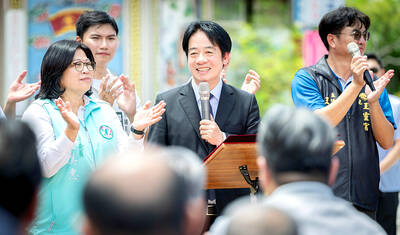
SIX SUBSIDIES: The monthly allowance for older farmers is to increase to NT$10,000, and NT$5,000 is to be given to homemakers under the national pension system, Lai said The government is to implement major welfare policies for disadvantaged groups, including raising the monthly allowance for older farmers to NT$10,000 and providing homemakers with NT$5,000 per month, President William Lai (賴清德) said yesterday. Lai made the remarks during a visit to Wangling Temple in Chiayi County, saying that the planned increases were being introduced amid economic growth and an increase in tax revenue. Touting a policy, in which the government plans to provide a monthly allowance of NT$5,000 for every child under the age of 18 in a bid to address Taiwan’s low birthrate, Lai said that if received for the


 RSS
RSS