


A barrier lake on the Mataian River (馬太鞍溪) overflowed on Tuesday not due to hydroengineering faults, but primarily because of the unexpected volume of water and mud, Ministry of Economic Affairs Water Resources Agency Director-General Lin Yuan-peng (林元鵬) said in Hualien County’s Guangfu Township (光復) yesterday, where the Executive Yuan’s Forward Coordination Task Force was inspecting the damage.
The task force found a 300m opening in a southern section of the barrier blocking the lake, which was presumably the primary outlet of the lake, Lin said.
Debris from the Mataian Bridge, which was destroyed in the flood, obstructed the flow of the water, leading to multiple breaches of the dike between the river and the town, he said.
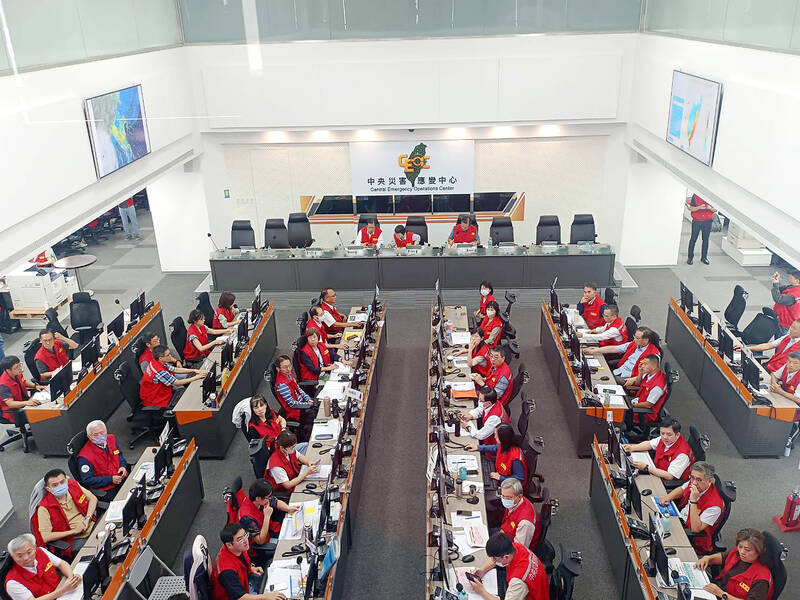
Photo courtesy of the Central Emergency Operation Center
After the government was made aware of the barrier lake, which formed in July, it launched operations to mitigate the effects should it break, including stacking sandbags and removing nearly 400,000 tonnes of earth from the riverbed, he said.
However, the volume of water released, as well as the sediment it carried, was too much for the barriers protecting the town, Lin said.
Reporters asked Lin if three open levees had caused the flooding of the town.
He said that the levees were opened to drain water from urban areas and the severity of the flooding was primarily due to the dike being topped.
Separately, former minister of the interior Lee Hong-yuan (李鴻源), who specialized in water resources, said that he was approached by Minister of the Interior Liu Shyh-fang (劉世芳) two weeks ago to convene a team to help monitor the risks posed by the barrier lake.
Lee said that his team was tasked with facilitating the evacuation of 8,000 people, a plan based on simulation data, and urged other residents to also vacate the area,
The region remains at high risk of flooding for at least another week, he added.
Had the Ministry of the Interior not acted according to the data, the damage and death toll would have been far greater, Lee said.
Asked whether destroying the barrier that formed the lake would be a solution, he said that such an operation would be impossible, tantamount to blowing up an entire mountain.
There is no standard for handling barrier lakes, which pose significant threats in most countries, he said, adding that in many situations, mitigation efforts are unable to resolve problems born of natural forces.
Meanwhile, Liu on Sunday spoke with Executive Yuan Secretary-General Xavier Chang (張惇涵), which was when the decision was made that residents along the Mataian River should be evacuated, a source said.
The Forestry and Nature Conservation Agency and the National Fire Agency had contacted the Hualien County Government nine and 10 times respectively to urge it to expedite the evacuation, the source said.
When President William Lai (賴清德) visited the Hualien Emergency Operation Center on Monday, he instructed local governments to work with the central government to “ensure that evacuation of the Mataian River area when necessary,” the source said.
Moreover, Premier Cho Jung-tai (卓榮泰) had facilitated evacuation plans for the area and asked the Hualien County Government to enact them, they added.
The emergency operation center had remained on a Category 2 alert and only raised it to Category 1 after the water topped the dike, they said.
The 14 people known to have died at the time were in areas that the Central Emergency Operation Center had designated for forced evacuation, the source added.

The Ministry of Finance this afternoon announced the winning numbers for the March-April uniform invoice lottery. The winning number for the NT$10 million (US$318,060) special prize is 19531471, and the winning number for the NT$2 million grand prize is 85941329. Three numbers were drawn for the NT$200,000 first prize: 07225810, 20231230 and 83518781. Those with receipts matching the last seven digits of any of the first-prize numbers will win the NT$40,000 second prize, while those matching the last six digits will win the NT$10,000 third prize. Those whose receipts match the last five digits of the first-prize numbers can claim the NT$4,000 fourth prize,

SIX SUBSIDIES: The monthly allowance for older farmers is to increase to NT$10,000, and NT$5,000 is to be given to homemakers under the national pension system, Lai said The government is to implement major welfare policies for disadvantaged groups, including raising the monthly allowance for older farmers to NT$10,000 and providing homemakers with NT$5,000 per month, President William Lai (賴清德) said yesterday. Lai made the remarks during a visit to Wangling Temple in Chiayi County, saying that the planned increases were being introduced amid economic growth and an increase in tax revenue. Touting a policy, in which the government plans to provide a monthly allowance of NT$5,000 for every child under the age of 18 in a bid to address Taiwan’s low birthrate, Lai said that if received for the
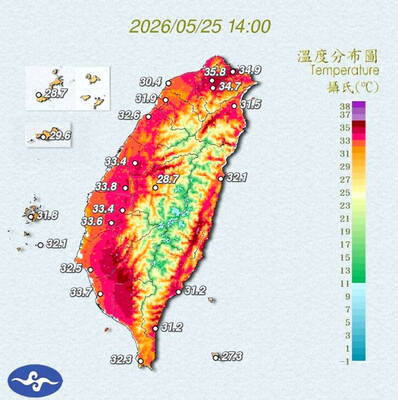
STAY COOL: The HPA recommended that people stay hydrated, use air-conditioning or fans while indoors, wear loose-fitting clothes and walk in the shade while outdoors Employers must implement measures such as installing cooling equipment, and providing drinking water and rest breaks for outdoor workers starting from Monday next week, the Taipei Department of Labor said on Sunday. Employers who fail to comply could face fines of NT$30,000 to NT$300,000 under the Occupational Safety and Health Act (職業安全衛生法), the department said. Businesses in Taipei employing fewer than 100 workers, as well as registered self-employed workers with labor insurance coverage, could receive on-site assessments and guidance from occupational safety consultants to help them apply for central government subsidies to implement or improve heat-protection measures, it said. Under the Ministry of
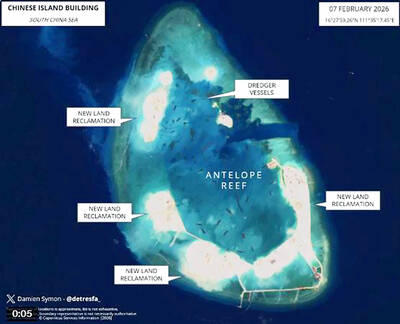
ISOLATION: The outposts would serve as support and backup bases, forcing US forces to either face China head-on or reroute, increasing travel time and operational costs China’s outposts in the South China Sea could be used to delay and constrain foreign forces during a conflict in the Taiwan Strait, giving Beijing a critical window to carry out amphibious landing and blockade operations, a report said. The Chinese Communist Party’s (CCP) forward operating bases on islands and reclaimed features in the South China Sea could delay foreign forces long enough for the Chinese People’s Liberation Army (PLA) to secure a key 48-to-72-hour window in the Taiwan Strait, a report commissioned by the Mainland Affairs Council found. The report, conducted by the Institute for National Defense and Security Research, examined


 RSS
RSS