


The Supreme Court on Thursday rejected appeals and finalized prison terms for three Taiwanese affiliated with the China Unification Promotion Party (CUPP) for recruiting active and retired military personnel to spy for China.
The Kaohsiung branch of the High Court in March sentenced CUPP Deputy Secretary-General Wen Lung (溫瓏) to 10 months in prison, and retired officers Chiang Chiung-lin (江瓊麟) and Chu Hsin-yu (朱新瑜) to one year and six months respectively.
They were found guilty of contravening the National Security Act (國家安全法), which prohibits Taiwanese from developing organizations on behalf of China, prosecution documents showed.
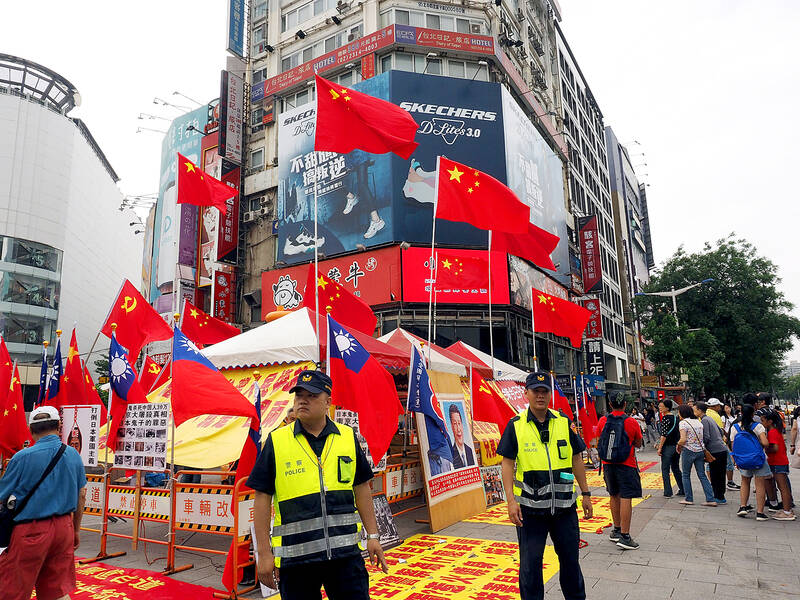
Photo: David Chang, EPA-EFE
Chu was also fined NT$50,000.
His jail sentence can be converted to a fine of NT$1,000 per day of prison time or community service, the ruling said.
In 2016, Wen launched a technology and crop import business in China, where he was recruited by Chinese operatives to build espionage networks targeting active and retired Taiwanese military personnel, prosecutors told the High Court.
He was initially recruited by officers from the Taiwan Affairs Office branch in Zhuhai in China’s Guangdong Province, and the Chinese People’s Liberation Army Political Work Department’s Liaison Bureau, the court said.
Wen invited Chu, a former navy officer, to China in 2016, and in 2018 took Chiang, a retired air force officer, to the Zhuhai Airshow, where both agreed to join the network. Another officer, surnamed Pu (朴), declined the offer, the court said.
In 2019, Chiang was caught attempting to recruit an air force officer surnamed Chang (張) from the Songshan Base Command in Taipei. Chang rejected promises of career opportunities and financial rewards and reported the approach to authorities, prosecutors said.
Wen and Chu pleaded guilty to the charges, qualifying for reduced sentences, but Chiang denied guilt and said that he had only invited Chang to join the CUPP, the court said.
The court rejected Chiang’s defense, citing wiretap transcripts and witness testimony, but granted him a reduced sentence as his offense was considered “attempted,” it said.

Considering that most countries issue more than five denominations of banknotes, the central bank has decided to redesign all five denominations, the bank said as it prepares for the first major overhaul of the banknotes in more than 24 years. Central bank Governor Yang Chin-lung (楊金龍) is expected to report to the Legislative Yuan today on the bank’s operations and the redesign’s progress. The bank in a report sent to the legislature ahead of today’s meeting said it had commissioned a survey on the public’s preferences. Survey results showed that NT$100 and NT$1,000 banknotes are the most commonly used, while NT$200 and NT$2,000

The Centers for Disease Control (CDC) yesterday reported the first case of a new COVID-19 subvariant — BA.3.2 — in a 10-year-old Singaporean girl who had a fever upon arrival in Taiwan and tested positive for the disease. The girl left Taiwan on March 20 and the case did not have a direct impact on the local community, it said. The WHO added the BA.3.2 strain to its list of Variants Under Monitoring in December last year, but this was the first imported case of the COVID-19 variant in Taiwan, CDC Deputy Director-General Lin Ming-cheng (林明誠) said. The girl arrived in Taiwan on

South Korea is planning to revise its controversial electronic arrival card, a step Taiwanese officials said prompted them to hold off on planned retaliatory measures, a South Korean media report said yesterday. A Yonhap News Agency report said that the South Korean Ministry of Foreign Affairs is planning to remove the “previous departure place” and “next destination” fields from its e-arrival card system. The plan, reached after interagency consultations, is under review and aims to simplify entry procedures and align the electronic form with the paper version, a South Korean ministry official said. The fields — which appeared only on the electronic form

The Ministry of Foreign Affairs (MOFA) is suspending retaliation measures against South Korea that were set to take effect tomorrow, after Seoul said it is updating its e-arrival system, MOFA said today. The measures were to be a new round of retaliation after Taiwan on March 1 changed South Korea's designation on government-issued alien resident certificates held by South Korean nationals to "South Korea” from the "Republic of Korea," the country’s official name. The move came after months of protests to Seoul over its listing of Taiwan as "China (Taiwan)" in dropdown menus on its new online immigration entry system. MOFA last week


 RSS
RSS