

A new legislative session began yesterday, with the Cabinet pledging to prioritize 30 bills, including a basic law on artificial intelligence (AI) and amendments to protect underwater infrastructure, while opposition parties outlined their own agendas.
Premier Cho Jung-tai (卓榮泰) met in the afternoon with key Democratic Progressive Party (DPP) officials and lawmakers to plan for the session. Attendees included DPP caucus whip Ker Chien-ming (柯建銘), newly elected caucus secretary-general Chen Pei-yu (陳培瑜) and chief executive Chung Chia-pin (鍾佳濱).
Cabinet spokeswoman Michelle Lee (李慧芝) told reporters after the meeting that the priority package covers measures such as an AI basic law, new rules to bolster coastal defense and law enforcement against subsea cable sabotage, amendments to the Business Mergers and Acquisitions Act (企業併購法) and a draft revision of the Commodity Tax Act (貨物稅條例).
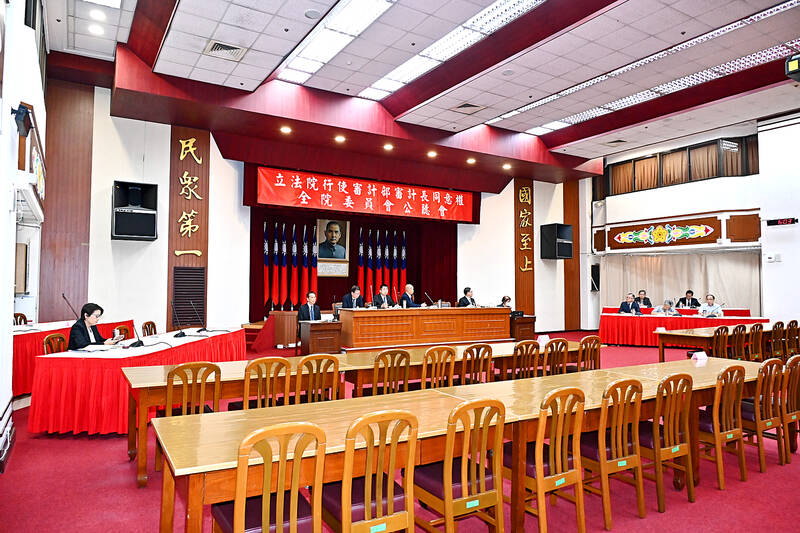
Photo: Tu Chien-jung, Taipei Times
Of the 30 bills, 20 are aimed at spurring economic growth, improving livelihoods, and supporting young people and disadvantaged groups, Lee said.
Amendments to budget allocation laws, promoted by opposition parties last year, have steered more resources toward major northern cities, such as Taipei, New Taipei City and Taichung, but widened disparities for southern regions, Lee said, adding that the Ministry of Finance would need to address the imbalance.
Cho urged attending DPP legislators to promote the Cabinet’s 30 priority bills in their constituencies so the public can better understand the government’s legislative agenda, she said.
He also emphasized the need for better collaboration between the executive and legislative branches, and expressed hope that budget allocation disputes could be resolved, she added.
Meanwhile, Chinese Nationalist Party (KMT) caucus secretary-general Lo Chih-chiang (羅智強) said the KMT has a duty as the main opposition party to supervise the government.
“We will support necessary government spending, but will closely scrutinize the budget to expose items that are wasteful, inflated to embellish policy results or funneled to DPP allies,” Lo said. “On such items, we will propose cuts to protect taxpayers’ money.”
“The KMT’s foremost priority is to propose amendments to reverse the government’s cuts to pensions for retired civil servants and educators,” KMT caucus whip Fu Kun-chi (傅?萁) told reporters.
Separately, the Taiwan People’s Party (TPP) in a statement said its priorities include amending the Code of Criminal Procedure (刑事訴訟法) to remove provisions allowing detention based on the risk of collusion with accomplices or witnesses.
The TPP also said it would push to amend the Assisted Reproduction Act (人工生殖法) to legalize surrogacy and safeguard the rights of infertile couples.
Other proposals include legislation to safeguard the rights of food delivery workers employed by online platforms, a bill to standardize nutrition and safety standards for school lunch programs and amendments to allow public referendums to be held on the same day and at the same polling stations as national and municipal elections, it said.
Additional reporting by Liu Wan-lin
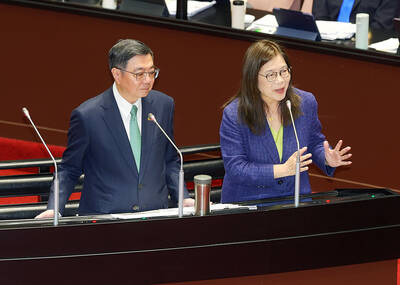
The donation of offshore patrol vessel Kinmen to the Philippines includes provisions that protect Taiwanese fishers and facilitate security cooperation across the First Island Chain, officials said yesterday. The comment was made during the Cabinet’s comprehensive administrative report at the legislature after Chinese Nationalist Party (KMT) Legislator Hsu Yu-chen (許宇甄) expressed concerns about the decision to give a ship to a country whose coast guard had in 2013 fired on a Taiwanese trawler and killed its captain without provocation. The Cabinet should lay out the safeguards that have been established to prevent the Philippine government from using the Kinmen to harass, expel
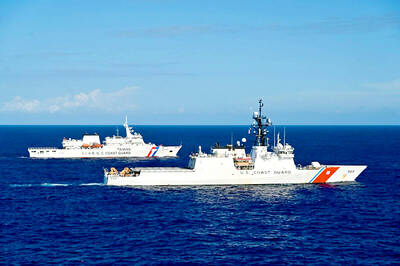
GROWING TIES: The CGA is planning a goodwill mission to the Philippines, in what would be the first time since 1975 a Taiwanese paramilitary vessel has visited the country The Coast Guard Administration (CGA) plans to significantly expand its participation in international security cooperative frameworks and its operational capabilities, a budget proposal for next year showed. The budget indicates a transformation of the CGA from a maritime law enforcement arm into a national defense and intelligence gathering entity capable of tackling larger regional security matters. The proposal showed that personnel from the coast guard’s Intelligence Division and Special Action Support Center are to participate in high-level national security talks with the US. As the CGA has dealt with China’s rising “gray zone” threats around Taiwan, it has become a valuable asset to
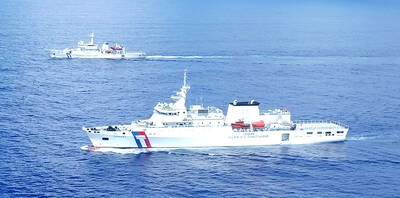
‘FRIENDSHIP FLEET’: A CGA official is scheduled to meet with the president of the Pacific nation, while one of the ships is to host a banquet and National Day event Two Coast Guard Administration (CGA) patrol vessels have docked at Malakal Harbor in Palau as part of an expedition exercise and diplomatic visit, during which a senior official is expected to meet with Palauan President Surangel Whipps Jr, the agency said yesterday. The two vessels, the 4,000-tonne-class Chiayi and the 1,000-tonne-class Penghu, set sail for Palau from Taiwan last week and arrived on Tuesday at Malakal Harbor, the CGA’s Fleet Branch said in a statement. The journey marks the second time the CGA has dispatched a “friendship fleet” to another country, after it sent its first-ever goodwill fleet, comprising the Hualien and
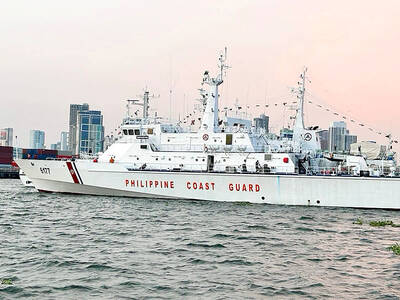
A patrol vessel donated by the Coast Guard Administration (CGA) to the Philippines was commissioned into the Philippine Coast Guard (PCG) on Friday, a Philippine non-governmental organization said. The CGA on Sept. 16 confirmed media reports that Taiwan had donated a retired 500-tonne patrol vessel to the Philippines. The Manila-based We Protect Our Seas (WPS) foundation, which served as an intermediary in the transfer, said that the vessel was formerly the CGA’s 500-tonne petrol vessel Kinmen (CG123). The WPS, in a statement issued on Friday, said the vessel, renamed as the BRP Sarangani, had been commissioned into the PCG the


 RSS
RSS