


The Supreme Court yesterday rejected appeals and finalized the prison sentences for three Taiwanese affiliated with the China Unification Promotion Party (CUPP), for recruiting active and retired military personnel to spy on behalf of China.
The Kaohsiung branch of the High Court first tried the three in March, sentencing CUPP deputy secretary-general Wen Lung (溫瓏) to 10 months in prison, and retired military officers Chiang Chiung-lin (江瓊麟) and Chu Hsin-yu (朱新瑜) to one year in jail and six months respectively.
They were found guilty of contravening the National Security Act (國家安全法), which prohibits Taiwanese from developing organizations for China, prosecution documents showed.

Photo: David Chang, EPA-EFE
Chu was also fined NT$50,000. His jail sentence can be converted to a daily fine of NT$1,000 or community service, the ruling showed.
In 2016, Wen began a technology and crop import business in China, where he was recruited by Chinese operatives to develop espionage networks of active and retired Taiwanese military personnel, prosecutors told the High Court.
He was initially recruited by officers from China's Taiwan Affairs Office branch in Zhuhai, Guangdong Province, and the Chinese Political Work Department Liaison Bureau, the court said.
Wen invited Chu, who served in the navy, to China in 2016, followed by Chiang, who served in the air force, to the 2018 Zhuhai Airshow, it said.
The two agreed to join the espionage network, though another officer surnamed Pu (朴) rejected the offer, the court said.
Chiang was caught in 2019 trying to recruit an officer, surnamed Chang (張), from the air force’s Songshan Base Command in Taipei, who rejected the offer of professional opportunities and financial rewards and reported the incident, prosecutors said.
Wen and Chu admitted to the charges, qualifying for reduced sentences, but Chiang denied wrongdoing and said that he had only invited Chang to join the CUPP, the court said.
Chiang’s defense was rejected based on evidence including wiretap transcripts and witness testimony, but he qualified for a reduced sentence as his offense was considered “attempted,” it said.

Actor Darren Wang (王大陸) was sentenced to six months in prison, commutable to a fine, by the New Taipei District Court today for contravening the Personal Data Protection Act (個人資料保護法) in a case linked to an alleged draft-dodging scheme. Wang allegedly paid NT$3.6 million (US$114,380) to an illegal group to help him evade mandatory military service through falsified medical documents, prosecutors said. He transferred the funds to Chen Chih-ming (陳志明), the alleged mastermind of a draft-evasion ring, although he lost contact with him as he was already in detention on fraud charges, they said. Chen is accused of helping a

SECURITY: Starlink owner Elon Musk has taken pro-Beijing positions, and allowing pro-China companies to control Taiwan’s critical infrastructure is risky, a legislator said Starlink was reluctant to offer services in Taiwan because of the nation’s extremely high penetration rates in 4G and 5G services, the Ministry of Digital Affairs said yesterday. The ministry made the comments at a meeting of the legislature’s Transportation Committee, which reviewed amendments to Article 36 of the Telecommunications Management Act (電信管理法). Article 36 bans foreigners from holding more than 49 percent of shares in public telecommunications networks, while shares foreigners directly and indirectly hold are also capped at 60 percent of the total, unless specified otherwise by law. The amendments, sponsored by Chinese Nationalist Party (KMT) Legislator Ko
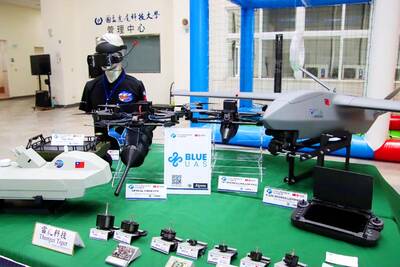
NON-RED SUPPLY: Boosting the nation’s drone industry is becoming increasingly urgent as China’s UAV dominance could become an issue in a crisis, an analyst said Taiwan’s drone exports to Europe grew 41.7-fold from 2024 to last year, with demand from Ukraine’s fight against Russian aggression the most likely driver of growth, a study showed. The Institute for Democracy, Society and Emerging Technology (DSET) in a statement on Wednesday said it found that many of Taiwan’s uncrewed aerial vehicle (UAV) sales were from Poland and the Czech Republic. These countries likely transferred the drones to Ukraine to aid it in its fight against the Russian invasion that started in 2022, it said. Despite the gains, Taiwan is not the dominant drone exporter to these markets, ranking second and fourth

The eastern extension of the Taipei MRT Red Line could begin operations as early as late June, the Taipei Department of Rapid Transit Systems said yesterday. Taipei Rapid Transit Corp said it is considering offering one month of free rides on the new section to mark its opening. Construction progress on the 1.4km extension, which is to run from the current terminal Xiangshan Station to a new eastern terminal, Guangci/Fengtian Temple Station, was 90.6 percent complete by the end of last month, the department said in a report to the Taipei City Council's Transportation Committee. While construction began in October 2016 with an


 RSS
RSS