


The Formosan Association for Public Affairs (FAPA) held its National Advocacy Conference over the weekend, instructing Taiwanese-Americans on how to convey the critical importance of Taiwan’s survival to their legislators and best promote pro-Taiwan legislation.
A record 112 people participated in the conference, with one Taiwanese-American even flying from Alaska to Washington for the event.
The conference, held annually by FAPA, a nongovernmental advocacy organization, began on Saturday last week and ran until yesterday in the US capital.
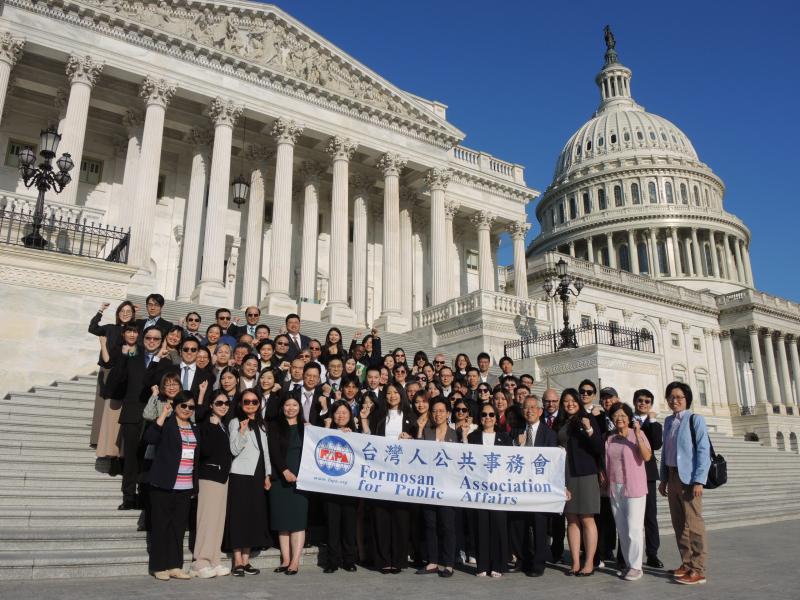
Photo courtesy of the Formosan Association for Public Affairs
Participants studied how to properly engage with the US Congress and maximize their time with lawmakers.
Today, they were to visit the Capitol Hill offices of Republican Representative Young Kim, Democratic Senator Chris Van Hollen and others.
As the US Congress introduces numerous bills every year, FAPA said one of its biggest challenges is competing with large lobbying organizations and making the case for Taiwan in a limited amount of time.
FAPA president Kao Su-mei (林素梅) said that the main goal of this trip is to explain to Congress why Taiwan is critical to US national security.
FAPA executive director Anny Hsiao (蕭喬勻) and policy fellow Henry Tsai (蔡宗翰) yesterday explained the format for writing letters to US lawmakers, offering tips on attention-grabbing subject lines and researching legislators’ backgrounds to target issues they care about.
They also urged participants to start conversations with personal stories, rather than directly asking their representatives to support policies such as the US-Taiwan Expedited Double-Tax Relief Act.
FAPA was founded in 1982 in Los Angeles by political and social activists, academics and entrepreneurs to promote the rights of Taiwanese at home and abroad.
It currently has more than 40 chapters across the US and about 2,700 members.
Chapters regularly meet with local representatives, while staff at FAPA headquarters in Washington visit Capitol Hill to promote pro-Taiwan policies in Congress.
FAPA’s efforts were indispensable in promoting the 2018 Taiwan Travel Act, which encourages exchanges between US and Taiwan officials.
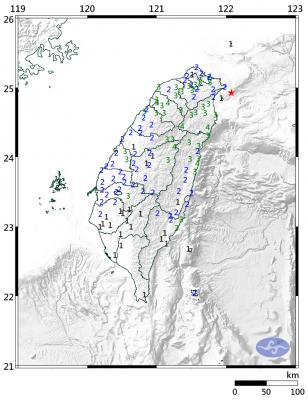
A magnitude 6.1 earthquake struck off the coast of Yilan County at 8:39pm tonight, the Central Weather Administration (CWA) said, with no immediate reports of damage or injuries. The epicenter was 38.7km east-northeast of Yilan County Hall at a focal depth of 98.3km, the CWA’s Seismological Center said. The quake’s maximum intensity, which gauges the actual physical effect of a seismic event, was a level 4 on Taiwan’s 7-tier intensity scale, the center said. That intensity level was recorded in Yilan County’s Nanao Township (南澳), Hsinchu County’s Guansi Township (關西), Nantou County’s Hehuanshan (合歡山) and Hualien County’s Yanliao (鹽寮). An intensity of 3 was
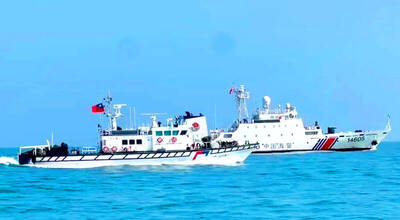
Instead of focusing solely on the threat of a full-scale military invasion, the US and its allies must prepare for a potential Chinese “quarantine” of Taiwan enforced through customs inspections, Stanford University Hoover fellow Eyck Freymann said in a Foreign Affairs article published on Wednesday. China could use various “gray zone” tactics in “reconfiguring the regional and ultimately the global economic order without a war,” said Freymann, who is also a nonresident research fellow at the US Naval War College. China might seize control of Taiwan’s links to the outside world by requiring all flights and ships entering or leaving Taiwan
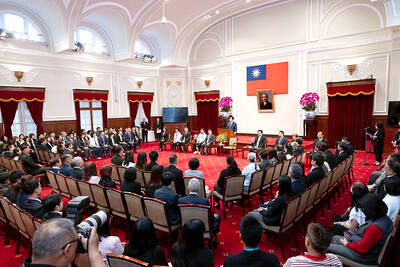
The next minimum wage hike is expected to exceed NT$30,000, President William Lai (賴清德) said yesterday during an award ceremony honoring “model workers,” including migrant workers, at the Presidential Office ahead of Workers’ Day today. Lai said he wished to thank the awardees on behalf of the nation and extend his most sincere respect for their hard work, on which Taiwan’s prosperity has been built. Lai specifically thanked 10 migrant workers selected for the award, saying that although they left their home countries to further their own goals, their efforts have benefited Taiwan as well. The nation’s industrial sector and small businesses lay
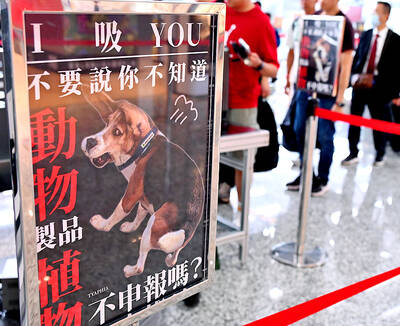
Quarantine awareness posters at Taiwan Taoyuan International Airport have gone viral for their use of wordplay. Issued by the airport branch of the Animal and Plant Health Inspection Agency, the posters feature sniffer dogs making a range of facial expressions, paired with advisory messages built around homophones. “We update the messages for holidays and campaign needs, periodically refreshing materials to attract people’s attention,” quarantine officials said. “The aim is to use the dogs’ appeal to draw focus to quarantine regulations.” A Japanese traveler visiting Taiwan has posted a photo on X of a poster showing a quarantine dog with a


 RSS
RSS